On the BMW F30 platform, the gear shift boot leather seals the transmission tunnel against dust, moisture, and debris while dampening shift vibrations. It seems like a minor component — until it cracks, sags, or detaches at the base collar. A compromised boot allows grit into the shift mechanism, accelerates wear on selector cable bushings, and degrades the tactile precision that defines a premium driving experience. Most OEM gear shift boot leather fails within 3 years of daily use. The question is why — and what material lasts 10+ years without replacement.
The answer comes down to three failure modes that automotive interior engineers consistently underestimate: thermal cycling fatigue, UV-driven collagen degradation, and chemical exposure from cleaning products. Each mode attacks a different weakness in leather and PU-based shift boot materials. Silicone leather — already adopted by leading silicone leather car seat programs — addresses all three at the polymer level. Let us break down the failure data and compare materials.
Request Automotive Sample Roll
Failure Mode 1: Thermal Cycling — When -20°C Cracks OEM Leather
Gear shift boots live in the cabin tunnel area — a microclimate that experiences extreme temperature swings. In winter, overnight temperatures in unheated garages across northern Europe and North America routinely drop below -20°C. In summer, interior cabin temperatures can exceed 70°C when parked in direct sunlight. The shift boot material cycles through this range thousands of times over a vehicle’s lifespan.
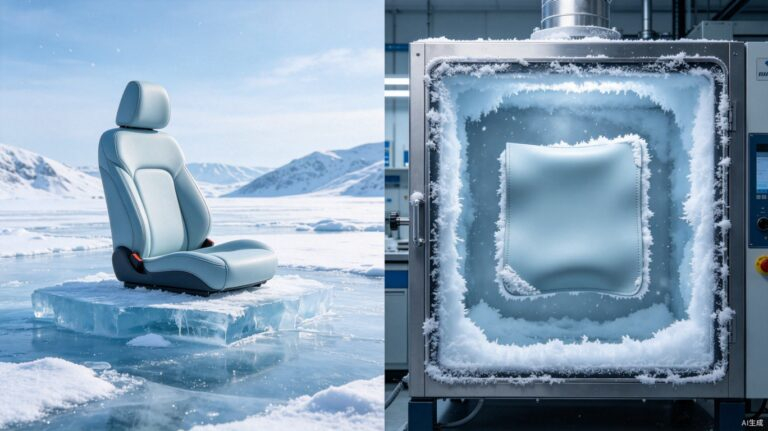
OEM full-grain leather handles moderate temperatures well, but its collagen matrix loses flexibility at low temperatures. Leather’s practical low-temperature limit sits around -15°C to -20°C, below which the material becomes brittle and micro-cracks form along stress concentration points at the boot’s fold lines. These cracks propagate with each shift cycle until the boot tears. Testing data from cold-resistance studies shows that leather retains only about 50% of its flex capacity at -20°C.
Silicone leather tells a different story. The material’s glass transition temperature (Tg) is approximately -120°C, giving it a practical low-temperature limit of -40°C to -60°C. Flex retention at -20°C remains at 90% — nearly identical to room-temperature performance. The cross-linked silicone elastomer maintains elasticity across the entire thermal range because the Si-O bond rotation energy is low, meaning the polymer chains can flex freely even at temperatures that embrittle leather and PU.

Failure Mode 2: UV Degradation — Collagen Breaks Down in Sunlight
UV exposure is the second killer of gear shift boot leather. While the boot sits below the shift lever and receives less direct sunlight than dashboard surfaces, UV radiation still penetrates through side windows — especially in vehicles with large glass areas like modern SUVs and EVs. The UV degradation mechanism in leather is well documented: ultraviolet radiation causes the collagen fibers to lose their natural oils, dry out, and become brittle. The surface develops visible cracks, the color fades unevenly, and the material loses structural integrity at the fold lines where the boot flexes during every gear change.
PU-based shift boots face a different UV problem. Polyurethane relies on UV stabilizer additives mixed into the polymer during manufacturing. These stabilizers deplete over time — typically within 24-36 months of continuous sun exposure — leaving the underlying PU vulnerable to yellowing, surface chalking, and delamination from the base fabric. A pinch test reveals the damage: fold the material 180° and hold for 10 seconds; if creasing persists, the material has lost its recovery memory and will sag prematurely.
Silicone leather’s UV resistance is inherent, not additive. The Si-O backbone is fundamentally resistant to UV degradation because the bond energy exceeds the photon energy of UV wavelengths that reach Earth’s surface. In xenon arc weathering tests — the industry standard for accelerated UV simulation — silicone leather maintains a Delta E color shift below 1.5 after 1,000 hours of exposure. PU leather under identical conditions typically shows Delta E values of 3.0-5.0, and leather shows visible fading and surface cracking within the same timeframe.

Failure Mode 3: Chemical Exposure — Cleaning Products Destroy Boot Material
The third failure mode is the least discussed but equally destructive. Automotive interior cleaning products — particularly solvent-based cleaners, alcohol wipes, and pH-disrupting solutions — chemically attack both leather and PU shift boots. On leather, these products strip the natural oils that maintain flexibility, accelerating the drying and cracking process. On PU, solvents can dissolve the surface coating, causing the material to become sticky, then peel and delaminate from the base fabric.
BMW’s own Technical Information System bulletin addresses this concern: solvent-based, silicone-laden, or wax-infused products can void warranty coverage for leather-related defects. But the problem extends beyond warranty periods — vehicle owners and detailers use a wide range of products throughout the vehicle’s life, and shift boot material must withstand this chemical barrage without degrading.
Silicone leather’s chemical inertness is one of its most significant advantages for gear shift boot applications. The material resists staining and degradation from coffee, sunscreen, hand sanitizer, and automotive cleaning chemicals. In AATCC stain resistance testing, silicone leather consistently rates 4-5 on the gray scale across all test substances — the highest performance tier. Water absorption is near-zero at 0.01%, meaning liquids sit on the surface rather than penetrating the material matrix. This is why automotive interior trends increasingly favor silicone-based materials for high-contact components like shift boots, steering wheel wraps, and armrests.

Material Comparison: Leather vs PU vs Silicone for Shift Boots
The procurement decision for gear shift boot material comes down to balancing initial cost against lifecycle performance. Here is the data that matters:
| Property | OEM Leather | PU Leather | Silicone Leather |
|---|---|---|---|
| Low-Temp Flex Limit | -15°C to -20°C | -15°C to -20°C | -40°C to -60°C |
| Flex Retention at -20°C | ~50% | ~40% | 90% |
| UV Resistance (hrs) | 200-500 hrs | 500-1,000 hrs | 1,500+ hrs |
| Stain Resistance (AATCC) | 3-4 | 3-4 | 4-5 |
| Water Absorption | High | Moderate | 0.01% |
| Expected Lifespan | 3-5 years | 2-4 years | 10+ years |
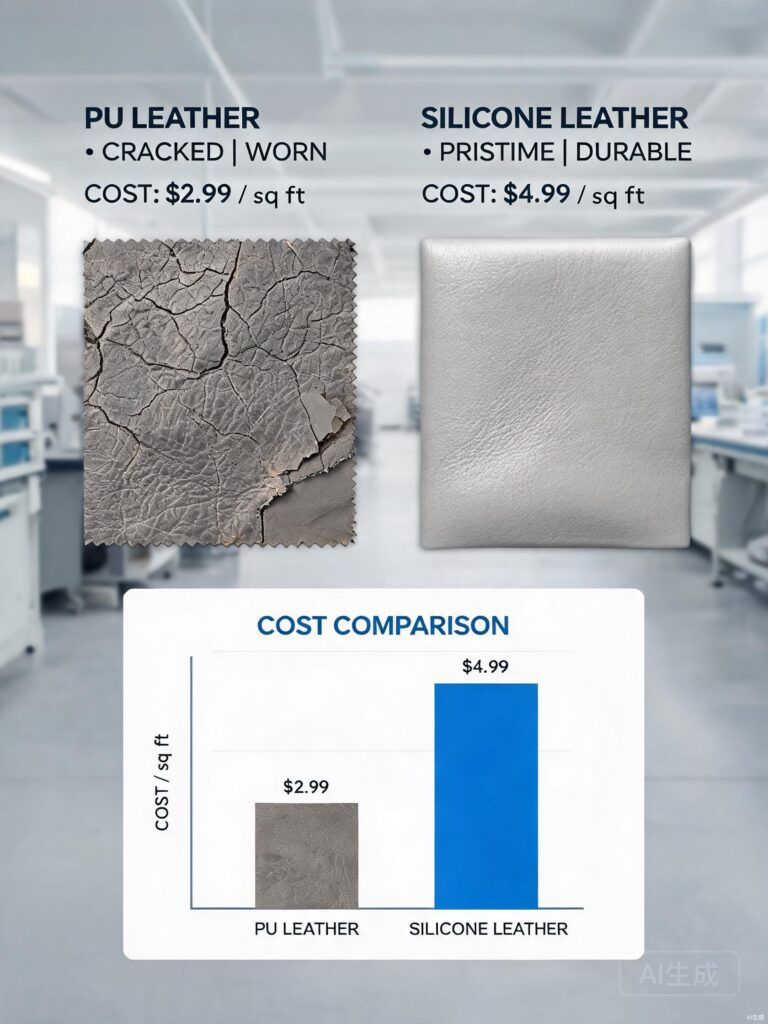
The cost gap narrows when you factor in lifecycle costs. Silicone blends cost more per unit than OEM leather or PU, but the elimination of replacement labor, warranty claims, and customer dissatisfaction with premature boot failure changes the total cost equation. For OEM and Tier-1 procurement teams sourcing car upholstery materials, the 10-year lifespan projection makes silicone leather the lowest total cost material for shift boot applications.
topsun-silicone-leather-breathable-car-seat-intro
Conclusion: The Shift Boot Is a Material Stress Test in Disguise
The gear shift boot looks like a simple cosmetic component, but it functions as an extreme material stress test: thermal cycling from -20°C to +70°C, UV radiation through side glass, chemical exposure from cleaning products, and mechanical flex stress from every gear change. OEM leather survives 3-5 years before cracking. PU peels and delaminates within 24-36 months as UV stabilizers deplete. Silicone leather — with its -40°C flex retention, 1,500+ hour UV resistance, chemical inertness, and near-zero water absorption — is the material purpose-built for this environment.
For Tier-1 suppliers and OEM interior engineering teams evaluating shift boot material specifications, the question is not whether silicone leather outperforms leather and PU — the test data is unambiguous. The question is whether your supply chain is positioned to deliver automotive-grade silicone leather at the volume and certification level that shift boot programs require. TOPSUN’s 500,000 meters monthly capacity, FMVSS 302 and EN 13773 certifications, and per-roll testing protocols ensure that every shift boot material batch meets the same standard that automotive silicone leather programs demand.
Download Automotive Material TDS
About TOPSUN
TOPSUN is an automotive-grade silicone leather manufacturer serving OEM and Tier-1 interior component suppliers worldwide. With 500,000 meters monthly capacity, near-zero VOC production, and full automotive testing certifications, we supply interior materials for gear shift boots, seat bolsters, door panels, and instrument cluster coverings. Our silicone leather passes FMVSS 302, EN 13773, FAR 25.853, VDA 277, REACH, PAHs, and California Prop 65. Every production roll undergoes flex resistance testing at -40°C, xenon arc UV exposure (1,500+ hours), Martindale abrasion cycling (100,000+ cycles), and AATCC stain resistance screening before shipment. Request sample rolls or procurement-level technical discussions to evaluate silicone leather for your next shift boot program.