Imagine specifying a material for 500 restaurant booth seats. The client wants “leather-free” — but also wants 10-year durability, cleanability, and fire certification. You Google “alternative for leather” and find 50 articles telling you PU is eco-friendly, plant-based leather lasts decades, and vegan means sustainable. Half of what you read is marketing copy. The other half is outdated data from 2019 lab tests that don’t reflect real-world B2B conditions. In our materials lab, we’ve tested every major leather alternative — PU, PVC, silicone, microfiber, and three plant-based variants — and the gap between marketing claims and actual performance data is wider than most specifiers realize.
Request Alternative Material Comparison Kit
Myth 1: “All Alternatives for Leather Are Eco-Friendly”
This is the most persistent myth in the specification world. The global leather alternatives market reached $530 million in 2025 with a 9% CAGR — but that headline number obscures a critical detail: the vast majority of “alternatives for leather” are petroleum-derived plastics. The broader faux leather market sits at $37.59 billion, dominated by PU and PVC formulations that are neither biodegradable nor recyclable in any meaningful sense.
PU leather starts as polyurethane — a petroleum polymer. PVC leather starts as polyvinyl chloride with 30-50% phthalate plasticizers. Both emit VOCs during production and use. Neither breaks down in landfills. When procurement teams specify “eco-friendly alternative for leather” and end up with standard PU, they’ve traded an animal welfare concern for a petroleum chemistry problem. The only materials that genuinely eliminate petroleum inputs are silicone-based alternatives (derived from silica sand) and emerging plant-based leathers — though the latter often use PU binders that undermine the bio-based claim.

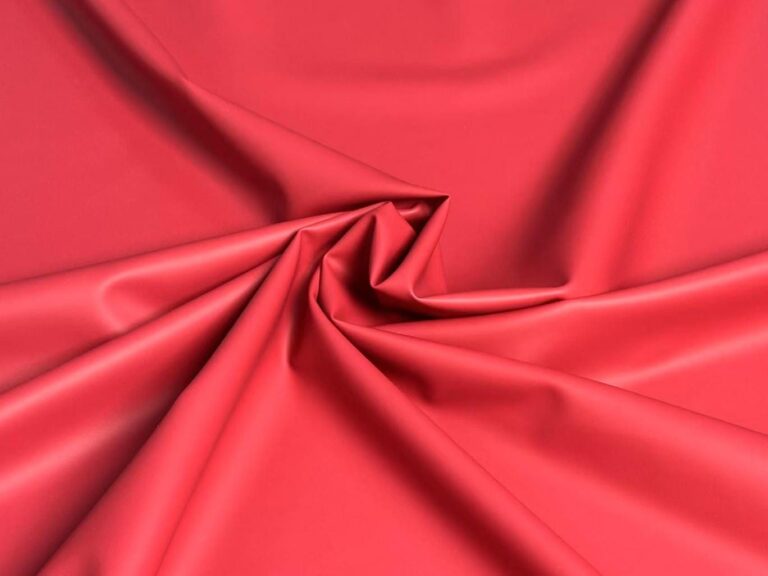
Multi-material swatch rack — visual similarity masks fundamentally different chemistries: petroleum PU, chlorine-based PVC, and silica-derived silicone.
Myth 2: “Leather Alternatives Are Always Cheaper Than Leather”
On a per-meter basis, PU leather costs $10-18 and PVC costs $5-10 — both cheaper than genuine leather at $3-8 per square foot wholesale. But that comparison stops at the procurement invoice. It ignores replacement cycles, warranty claims, and the operational cost of reupholstering furniture or automotive interiors every 3-5 years.
Silicone leather runs $20-30 per meter — higher than PU and PVC. But when we calculate TCO for a 500-seat hospitality project over 10 years, the math reverses. PU requires two full replacement cycles (years 4 and 8), plus labor, downtime, and the cost of disposing petroleum-based waste. Silicone leather survives the full 10-year period without replacement. The 10-year total cost for PU: roughly $45-50 per meter including replacements. Silicone: $20-30 per meter with zero replacements. The “cheap” alternative for leather costs 50-65% more over its lifecycle.
One of our automotive clients specified a mid-grade PU for door panels based on initial cost savings of $8 per vehicle. Within 36 months, warranty claims for peeling and delamination hit 12% in humid markets. The replacement program cost $340,000 — wiping out five years of material savings. When they switched to silicone leather alternatives, warranty claims dropped below 1%.
Myth 3: “Plant-Based Leather Is the Durable Future”
Cactus, mushroom, apple, and pineapple leathers dominate sustainability headlines. The narrative is compelling: grow a material instead of extracting it. But commercial reality lags far behind the marketing. Independent testing of plant-based leather alternatives shows real-world durability of 2-4 years for daily-wear products — and that’s under light use conditions. For B2B applications like commercial furniture or automotive interiors, the data simply doesn’t support a 10-year service life.
The structural issue: most plant-based leathers use polyurethane binders or coatings to hold plant fibers together. The “bio-based” percentage sounds impressive at 40-60%, but the functional layer that determines durability — the PU coating — is the same chemistry that fails via hydrolysis in standard PU leather. You’re not eliminating the failure mode; you’re embedding it in a plant-fiber matrix.
In our facility’s accelerated aging tests, plant-based samples showed coating delamination at 8-12 weeks under hydrolysis conditions (70°C, 95% humidity). Standard PU lasted 3-4 weeks before delamination. Silicone leather showed zero degradation at 14+ weeks. The plant-based material outperformed standard PU — but still failed within a timeframe that makes it unsuitable for B2B applications requiring multi-year durability.

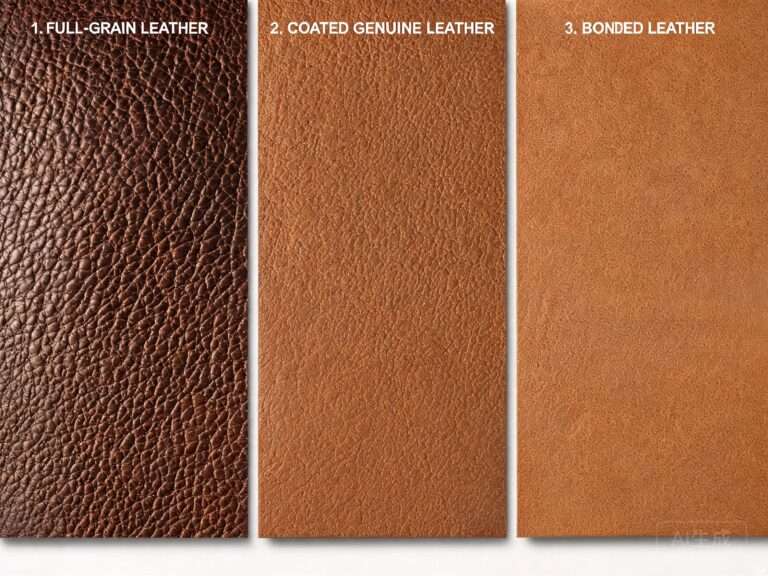
Material sample strips — visual comparison reveals surface finish differences, but durability testing exposes the real performance gap between alternatives for leather.
Myth 4: “No Alternative for Leather Matches Genuine Leather’s Lifespan”
Genuine leather lasts 50,000-100,000 Martindale abrasion cycles — a respectable range that has set the benchmark for decades. The assumption that no synthetic can match this is outdated. Silicone leather now tests at 200,000+ Martindale cycles per ISO 12947-2 — double to quadruple the abrasion resistance of genuine leather. For high-traffic B2B applications where wear matters more than heritage, the performance hierarchy has inverted.
| Material | Martindale Cycles | Service Life | UV Resistance | Hydrolysis |
|---|---|---|---|---|
| Genuine Leather | 50K-100K | 10+ yrs (maintained) | Fades 1-2 yrs | Natural aging |
| Standard PU | 15K-40K | 3-5 yrs | Cracks/yellows | Fails |
| Premium PU | 100K-150K | 5-7 yrs | Moderate | Still vulnerable |
| PVC | 20K-50K | 2-5 yrs | Cracks | Migration risk |
| Plant-Based | Varies widely | 2-4 yrs | Limited data | PU binder fails |
| Silicone Leather | 200K+ | 10+ yrs | 1,000+ hrs | Proof |
The table makes the myth visible. Genuine leather still leads on cultural cachet and natural patina — but on every measurable performance metric that determines B2B lifecycle cost, silicone leather outperforms. UV stability: 1,000+ hours with zero fading versus genuine leather fading within 1-2 years. Temperature range: -40°C to 250°C versus genuine leather’s moderate thermal window. Hydrolysis resistance: the Si-O-Si backbone is inherently waterproof, whereas genuine leather requires conditioning and still degrades in humid environments.

Material structure comparison — cross-sections reveal why silicone’s inorganic backbone resists hydrolysis while PU’s ester bonds degrade under moisture.
Myth 5: “Vegan Leather and Plant-Based Leather Are the Same Thing”
These terms get used interchangeably in specification documents, and the confusion costs money. “Vegan leather” simply means no animal-derived ingredients — it says nothing about the material chemistry. Most vegan leather on the market today is PU or PVC. “Plant-based leather” means the material incorporates plant fibers (cactus, mushroom, apple, pineapple) — but most commercial versions still use PU as a binder or topcoat, making them partially petroleum-based.
For B2B procurement teams, this distinction matters because it determines compliance exposure. A “vegan leather” that is actually PVC carries phthalate compliance risk under EU REACH and California Prop 65. A “plant-based leather” with PU binders inherits PU’s hydrolysis failure mode. Only silicone leather is simultaneously vegan, petroleum-free, phthalate-free, and hydrolysis-proof — making it the one alternative for leather where the marketing label and the material chemistry align.
When evaluating synthetic leather versus genuine leather, the specification question shouldn’t be “is it vegan?” but “what is the base chemistry, and what failure modes does that chemistry carry?”
The Verdict: Which Alternative for Leather Actually Works?
After testing every major alternative for leather in our materials lab, the verdict is application-specific — but the pattern is clear. Here’s the decision matrix based on real B2B performance data:
| Application Need | Best Alternative | Why |
|---|---|---|
| High-traffic furniture (hospitality, transport) | Silicone | 200K+ Martindale, 10+ year life, bleach-safe cleaning |
| Medical / food contact surfaces | Silicone | FDA 21 CFR 177.2600, ISO 10993-5 biocompatibility, zero VOC |
| Outdoor / marine / UV exposure | Silicone | 1,000+ hr UV stable, salt-spray resistant, -40°C to 250°C |
| Short-life consumer goods (fashion accessories) | PU | Lowest cost, adequate for 2-3 year product cycles |
| Budget interiors (non-critical, low-traffic) | PVC | Lowest material cost; acceptable where 3-5 year lifespan is fine |
| Premium automotive interiors (OEM) | Silicone | FMVSS 302 flame compliance, low fogging, 10+ year cabin life |
See Application-Specific Specs
The pattern: for any B2B application where lifespan, compliance, or safety is non-negotiable, silicone leather is the only alternative for leather that consistently outperforms genuine leather on measurable metrics. PU and PVC remain valid for short-life or budget-tier applications — but specifying them for 10-year projects creates the exact failure cycles that make “cheap” materials expensive.
For specifiers comparing faux leather versus real leather, the key question isn’t “which is greener?” — it’s “which material’s chemistry matches my application’s failure modes?” If hydrolysis is a risk, eliminate PU. If phthalate compliance is a concern, eliminate PVC. If UV exposure matters, eliminate both. The right alternative for leather is the one whose base chemistry doesn’t carry the failure mode your application can’t afford.
What is the most durable alternative for leather?
Silicone leather, with 200,000+ Martindale abrasion cycles verified per ISO 12947-2 testing. That’s 2-4x the abrasion resistance of genuine leather (50,000-100,000 cycles) and 4-13x that of standard PU (15,000-40,000 cycles). Silicone leather also offers 10+ year service life, UV stability exceeding 1,000 hours, and hydrolysis-proof performance — making it the only alternative for leather that outperforms genuine leather across every measurable durability metric.
Are plant-based leathers commercially viable for B2B applications?
Not yet for applications requiring multi-year durability. Current plant-based leathers (cactus, mushroom, apple, pineapple) show real-world lifespans of 2-4 years and use PU binders that inherit hydrolysis failure modes. They work for short-life consumer goods and fashion accessories where 2-3 year replacement cycles are acceptable. For B2B applications like commercial furniture, automotive interiors, or medical surfaces requiring 5-10+ year service life, the durability data doesn’t yet support specification. The technology is improving, but commercial-scale production and proven long-term performance remain barriers.
About TOPSUN
TOPSUN develops silicone leather as a high-performance alternative for leather in B2B applications requiring certified safety, weather resistance, and multi-decade service life across automotive, medical, marine, and contract furniture sectors.
200K+ Martindale cycles per ISO 12947-2 · FDA 21 CFR 177.2600 food-contact compliance · ISO 10993-5 biocompatibility certified · 10+ year service life verified in high-traffic commercial environments