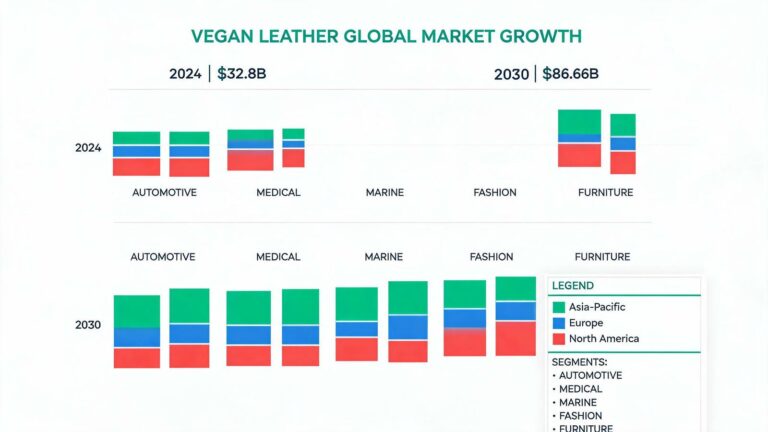
Are vegans and leather truly incompatible? The answer depends on what you mean by “leather.” If you mean animal skin, the question is settled — vegans don’t use it. But if you mean the synthetic materials marketed to vegans as “leather alternatives,” the relationship between vegans and leather becomes far more complex. The global vegan leather market reached $48.97 billion in 2025, and 90% of that material is PU-coated polyester — a petroleum-based product processed with DMF solvent, carrying the same chemical compliance risks as industrial synthetics. When a vegan consumer buys a “vegan leather” bag, they’re not buying an animal-free equivalent of leather. They’re buying a petroleum polymer that may violate the same environmental values that drove them away from animal products. This article examines five myths about vegans and leather, using lab data to separate marketing claims from material reality.
Request Vegan Material Comparison Kit
Vegans and Leather: What ‘Vegan’ Actually Means
The term “vegan” in leather marketing means one thing: the material contains no animal-derived ingredients. It is a binary declaration, not a quality standard. A PVC leather with 35% phthalate plasticizers is vegan. A PU leather with 0.7% residual DMF is vegan. A petroleum-based synthetic that will end up in a landfill within 5 years is vegan. The label tells you what the material isn’t — not animal. It tells you nothing about what the material is, how it’s made, or what happens when it enters the waste stream.
For vegans who chose the lifestyle for environmental reasons — not just animal welfare — this distinction matters. The manufacturing process behind most “vegan leather” involves petroleum extraction, solvent-based coating, and synthetic textile production — a supply chain with a significant environmental footprint that has nothing to do with animals.

Leather sample display in rose pattern — visual appeal of vegan leather doesn’t reveal the chemical composition underneath.
5 Myths About Vegans and Leather — Debunked
Here are five myths that dominate the vegans and leather conversation — each debunked by lab data that any consumer or B2B buyer can verify.
Myth 1: “Vegan leather is eco-friendly.” Lab data says otherwise. Standard PU leather carries 0.3-1.0% residual DMF — a reproductive toxicant restricted under REACH Annex XVII at 0.3%. The carbon footprint of PU leather ranges from 4-8 kg CO2/m2, higher than silicone leather’s 3-5 kg CO2/m2. Under the EU Green Claims Directive (enforceable September 2026), calling PU leather “eco-friendly” without verified lifecycle evidence is a banned generic claim.
Myth 2: “PETA-Approved Vegan means sustainable.” PETA-Approved Vegan is a company self-declaration — not a third-party audit. It verifies no animal ingredients. It does not test for DMF, phthalates, heavy metals, or VOC emissions. It does not verify recyclability, carbon footprint, or manufacturing process. The EU EmpCo Directive makes clear that “vegan” and “sustainable” are separate claims requiring separate evidence.
Myth 3: “Plant-based leather is the vegan ideal.” Cactus, apple, pineapple, and mycelium leathers replace 30-80% of petroleum content with agricultural waste — but they still use PU binders for structural integrity. The PU binder carries the same DMF and VOC risks as conventional synthetic leather. A Cologne court banned the term “apple leather” in July 2025 as misleading. Service life is 1-5 years with Martindale results below 20K cycles. Plant-based leather serves a marketing narrative, not a durability or sustainability standard.
Myth 4: “Vegan leather lasts as long as real leather.” Genuine leather lasts 10-30 years with proper care. PU vegan leather lasts 3-5 years before hydrolysis. PVC vegan leather lasts 2-5 years before plasticizer migration causes cracking. Silicone leather lasts 10+ years — but it represents less than 1% of the vegan leather market. The durability gap between what vegans buy and what actually lasts is the single most overlooked fact in this conversation.
Myth 5: “All vegan leather is recyclable.” PU leather has limited recyclability. PVC leather is not recyclable — its chlorine content and phthalate additives contaminate recycling streams. Plant-based leathers with PU binders face the same limitation. Only silicone leather is 100% recyclable, because the silicone polymer can be reprocessed without chemical degradation. For vegans concerned about end-of-life impact, this is the data point that matters.

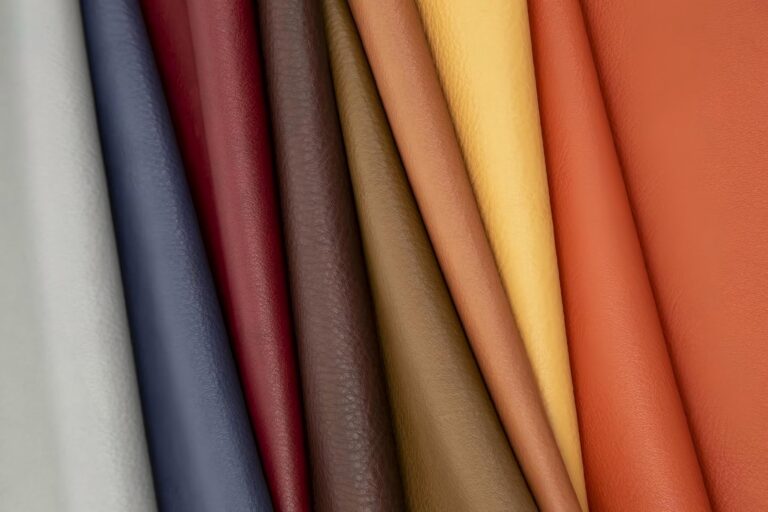
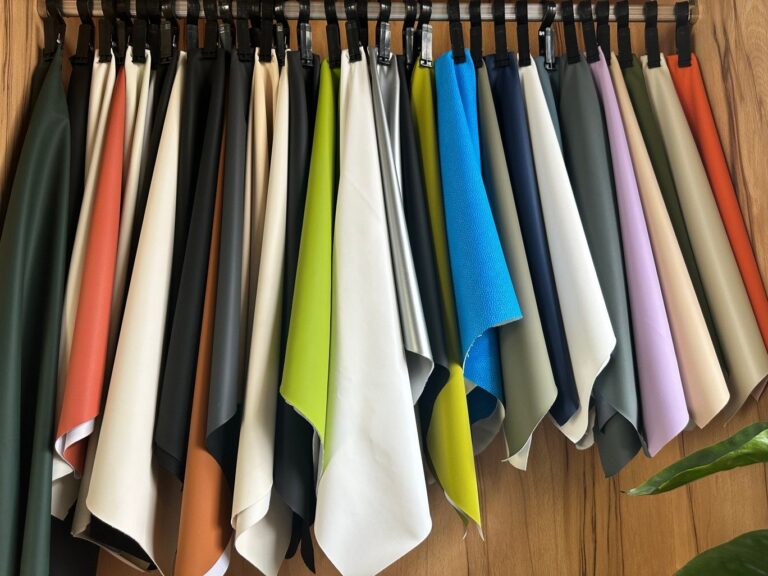
Multi-color leather sample stack — vegans choosing leather alternatives should evaluate chemical composition, not just color and texture.
The Lab Data: What’s in Your Vegan Leather
The table below summarizes what independent lab testing reveals about the four material types marketed to vegans as leather alternatives. The data comes from ISO 16000-6 VOC emission testing, REACH SVHC analysis, ISO 12947-2 Martindale abrasion testing, and ISO 5402 flex resistance testing.
| Material | Hidden Chemicals | Martindale | Service Life | Recyclable |
|---|---|---|---|---|
| PU Leather | DMF (0.3-1.0%) | 20K-50K | 3-5 yrs | Limited |
| PVC Leather | Phthalates (30-40%) | 100K-150K | 2-5 yrs | No |
| Plant-Based | PU binder (DMF risk) | <20K | 1-5 yrs | Limited |
| Silicone Leather | None | 200K+ | 10+ yrs | 100% |
The data is unambiguous. Three of four “vegan leather” materials contain hidden chemicals that contradict the environmental values many vegans hold. Only silicone leather — less than 1% of the vegan leather market — contains zero hidden chemicals, lasts 10+ years, and is 100% recyclable. The Vegan Society defines veganism as seeking to exclude all forms of animal exploitation and cruelty — but increasingly, vegans are asking whether petroleum-based synthetics with toxic residues align with the broader ethical framework.
The Real Vegan Alternative: Silicone Leather
Silicone leather is the only material that satisfies both definitions of vegan: it contains no animal ingredients (certified) and it aligns with environmental ethics (verified). Made from silicone resin — derived from silica, the second most abundant element on Earth — and polyester base fabric, the material is produced through a solvent-free dry coating process. No DMF. No phthalates. No petroleum-derived polymers. No toxic emissions.
The certifications verify every claim: REACH compliance (zero restricted substances), ISO 10993 biocompatibility (safe for direct skin contact), FDA 21 CFR 177.2600 (food-contact safe), and EN 71 (toy-safe). The material lasts 10+ years with 200K+ Martindale cycles — meaning a single silicone leather product replaces 3-5 PU leather products over the same period. Fewer replacements mean less production, less waste, and less resource extraction. That is what a genuinely vegan material looks like.

Vegan belt material texture — everyday products like belts reveal the durability and composition gap between PU and silicone leather.
For vegans, the material quality comparison should be straightforward: choose the option that is both animal-free and verified safe, durable, and recyclable. According to PETA’s leather industry resource, the animal leather industry involves significant ethical and environmental concerns. But the solution isn’t automatically any material labeled “vegan” — it’s the material that aligns with the full ethical framework, verified by lab data.
Action Checklist for Vegan Consumers
Whether you’re a vegan consumer or a B2B brand serving vegan customers, here’s how to verify that your “vegan leather” actually aligns with vegan values.
1. Ask for the DMF test report. If the supplier cannot provide ISO 16000-6 VOC emission data showing DMF below 0.3%, the material is conventional solvent-based PU with compliance risk.
2. Check for phthalate disclosure. PVC leather must disclose phthalate content. If the supplier says “phthalate-free PVC,” ask for the test report. Prop 65 lists six phthalates commonly found in PVC.
3. Request the Martindale abrasion certificate. A 10+ year product needs 200K+ cycles. If the material tests at 20K-50K, it’s a 3-5 year product — not a sustainable choice.
4. Verify recyclability claims. Ask for the end-of-life documentation. PU leather has limited recyclability. PVC is not recyclable. Only silicone leather is 100% recyclable with verified reprocessing data.
5. Look beyond the PETA label. PETA-Approved Vegan verifies animal-free status. It does not verify sustainability, chemical safety, or durability. Require OEKO-TEX Standard 100, ISO 10993, or REACH compliance documentation in addition to any vegan certification.
The conversation about vegans and leather is evolving. What started as a binary question — animal or not — has become a material science question about what “vegan” actually delivers. PU leather is vegan but contains DMF. PVC leather is vegan but contains phthalates. Plant-based leather is vegan but relies on PU binders. Only silicone leather is vegan, verified safe, durable for 10+ years, and 100% recyclable. That’s not marketing. That’s lab data.
About TOPSUN
TOPSUN manufactures silicone leather that is certified vegan and cruelty-free — produced through a solvent-free dry coating process with zero DMF, zero phthalates, and zero petroleum-derived polymers. Our materials carry REACH compliance, ISO 10993 biocompatibility certification, FDA food-contact approval, and 100% recyclability verification — enabling vegans and B2B brands serving vegan customers to choose a material that aligns with the full ethical framework, backed by certified lab data.