Walk into any furniture showroom and ask ten salespeople to explain leather grades. You’ll get ten different answers — and most will be wrong. The leather industry thrives on terminology confusion: “genuine leather” sounds premium but is often the lowest quality tier. “Full-grain” means something entirely different from “top-grain.” And “bonded leather” contains as little as 10% actual leather fiber.
For B2B buyers, this confusion translates directly into sourcing mistakes. Specifying the wrong grade means warranty claims, customer complaints, and budget overruns. This article covers all about leather — from raw hide to finished material, through six quality tiers, tanning chemistry, and the performance testing that separates marketing claims from measurable durability.
All About Leather: From Hide to Finished Material
Understanding how leather is made step by step reveals why two products labeled “leather” can perform completely differently. The process starts with animal hides — primarily cowhide, which accounts for approximately 65% of global leather production, followed by calf, goat, sheep, and pig skins. Each species offers distinct grain texture, fiber density, and tactile characteristics.
The production pipeline follows five core stages. Leather processing begins with beamhouse operations — soaking to rehydrate and clean hides, liming to remove hair, and deliming to prepare fibers. The hides then enter pickling, where acid and salt lower pH to make them receptive to tanning agents. Tanning itself stabilizes the hide permanently, transforming perishable raw material into durable leather. Finally, finishing operations — dyeing, embossing, coating — determine the surface appearance and performance characteristics.
The critical step for B2B buyers is understanding that the specific section of the hide used determines the grade. Hides are split horizontally into layers — the top layer retains natural grain and maximum strength, while lower layers are weaker and require more processing to achieve a leather-like appearance. This split is where quality divergence begins. For those exploring silicone leather as an alternative, the same substrate-splitting logic applies — the base fabric quality and coating thickness determine the final material’s performance envelope.

Base fabric moving through the coating line — the production stage where substrate quality and coating chemistry determine final material grade.
The 6 Quality Tiers Decoded
Leather quality is classified into six tiers, each representing a different layer or processing level of the original hide. Knowing these types of leather grades prevents the most common B2B sourcing mistake: paying full-grain prices for corrected-grain performance. For a deeper reference, our types of leather guide covers additional classification details.
| Grade | Source Layer | Durability Level | Typical Use | Price Range |
|---|---|---|---|---|
| Full-Grain | Top layer, unsanded | Maximum | Premium furniture, boots, bags | $$$$$ |
| Top-Grain | Top layer, sanded | High | Designer handbags, jackets | $$$$ |
| Corrected-Grain | Split, embossed | Moderate | Mid-range upholstery | $$ |
| Genuine Leather | Lower splits | Low–Moderate | Budget accessories | $ |
| Split Leather | Flesh side | Low | Suede, lining | $ |
| Bonded Leather | Fiber scraps + binder | Very Low | Low-cost covers | $ |
“Genuine leather” is a grade, not a compliment. It refers to the lowest tier of real animal hide — lower splits with minimal natural fiber strength. Marketing teams exploit the word “genuine” to imply quality, but the specification means budget-tier material.

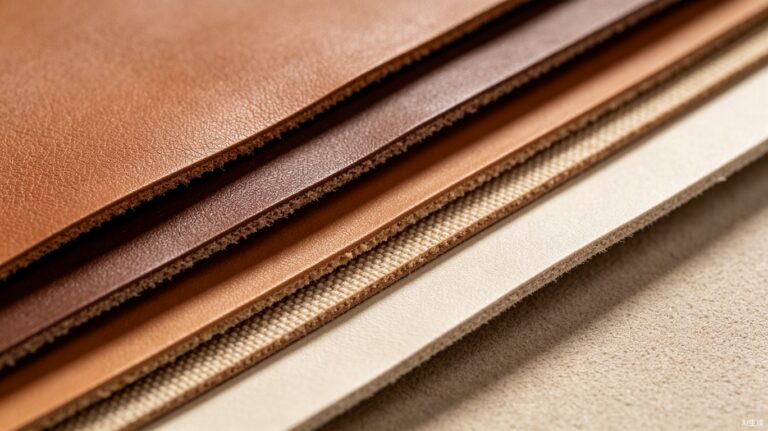
Genuine leather texture — the natural grain pattern that distinguishes full-grain from corrected-grain material.
Tanning Methods: Why the Process Changes Everything
Leather tanning methods define the material’s character, environmental footprint, and aging behavior. Two processes dominate the industry: vegetable tanning and chrome tanning.
Vegetable tanning uses natural tannins extracted from tree bark, leaves, and fruit. It’s a slow process — taking 30–60 days — that produces firm, earthy-toned leather favored for heritage goods, belts, and equestrian equipment. The material develops a patina over time, which appeals to premium brands but creates batch-to-batch color inconsistency that complicates B2B scaling.
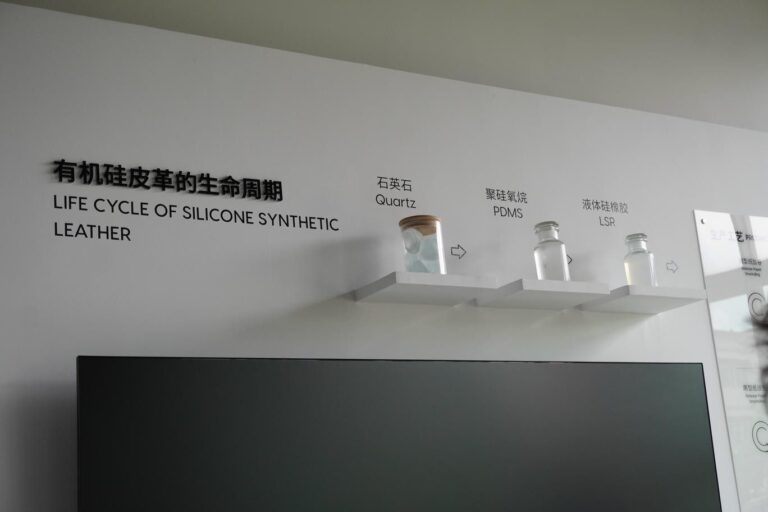
Chrome tanning uses chromium salts to stabilize hides in as little as 24 hours. It produces softer, more pliable leather with consistent color and superior water resistance. However, chromium tanning raises environmental concerns — chromium VI compounds are regulated under REACH and require specialized wastewater treatment. For projects where both consistency and environmental compliance matter, full silicone leather construction offers a third path: solvent-free coating that requires no tanning agents at all.

Lychee-texture silicone leather macro closeup — the embossed grain pattern that mimics natural full-grain leather without animal sourcing.
All About Leather Performance: Testing Beyond Appearance
Appearance tells you nothing about durability. When comparing synthetic leather vs genuine leather, the metrics that matter are quantifiable — and they’re measured through standardized testing that every B2B buyer should request before committing to a material.
In our lab testing, we’ve observed that silicone leather consistently outperforms both PU and genuine leather in abrasion resistance. Our Martindale test results show 200,000+ cycles for silicone leather versus 50,000–80,000 for PU and 100,000–150,000 for full-grain genuine leather. The difference comes from the coating chemistry — silicone’s molecular structure resists mechanical breakdown at a fundamental level.
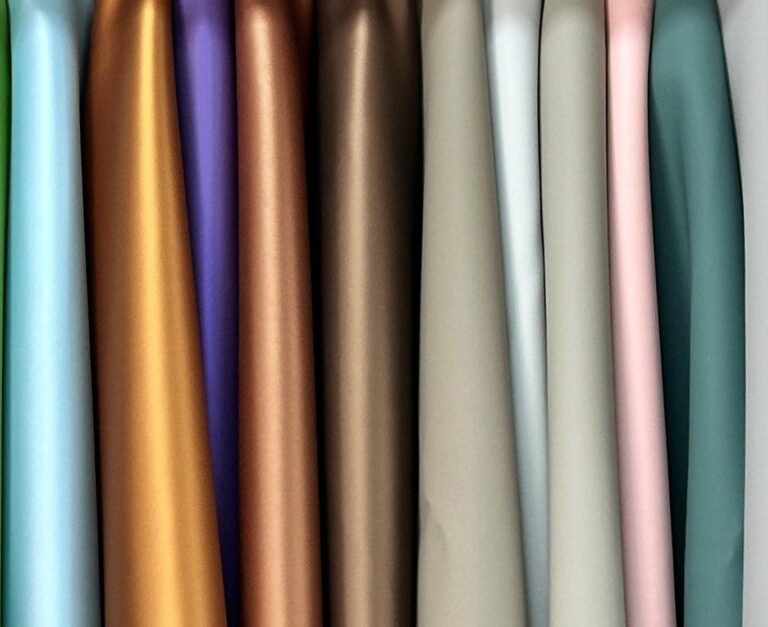
When we spec silicone leather for client projects, the texture options exceed what’s available in genuine leather — 100+ embossed patterns including cowhide, pigskin, and sheepskin replicates, plus custom textures developed on 7–10 day timelines. Color matching achieves Delta E ≤ 1.0 accuracy across production batches, which is impossible with vegetable-tanned genuine leather where dye lot variation is inherent. For more on TOPSUN’s capabilities, visit our about page.

Physical testing laboratory — where Martindale, flex, tensile, and color fastness data are generated to verify material performance claims.
Silicone leather properties introduction — covering the performance advantages that position it beyond traditional leather grades.
Request Material Specifications
Frequently Asked Questions
What is the difference between full-grain and top-grain leather?
Full-grain leather is the top layer of the hide with its natural grain completely intact — no sanding or correction. It offers maximum durability and develops a patina. Top-grain leather is also from the top layer but has been lightly sanded to remove imperfections, then coated with a finish for uniform appearance. It’s more consistent but slightly less durable than full-grain.
Is silicone leather considered real leather?
No. Silicone leather is a synthetic material — a silicone elastomer coating applied to a fabric substrate. It contains no animal hide. However, it outperforms many genuine leather grades in abrasion resistance, hydrolysis resistance, and environmental compliance, making it a preferred alternative for B2B buyers who need leather-like performance without animal sourcing or tanning limitations.
Knowing All About Leather Means Knowing the Alternatives
The leather industry’s terminology complexity serves sellers more than buyers. Understanding the six quality tiers, the two dominant tanning methods, and the performance metrics that actually matter — Martindale cycles, flex resistance, hydrolysis stability — gives procurement teams the leverage to specify confidently. For further reading on what leather is made of at the chemical level, our dedicated guide covers the molecular details.
Silicone leather represents the next chapter in the all about leather conversation. It delivers full-grain-level durability through synthetic chemistry, eliminates the environmental liabilities of chrome tanning, and provides the batch consistency that genuine leather cannot. For B2B buyers who’ve been burned by “genuine leather” that wasn’t genuine quality, that combination matters.
About TOPSUN
TOPSUN develops and manufactures silicone leather as a next-generation alternative in the all about leather conversation, providing B2B buyers with a material that combines the durability of full-grain leather and the consistency of synthetic production across automotive, furniture, fashion, and healthcare applications.
Available in 100+ textures and unlimited Pantone-matched colors, certified to ISO 10993 biocompatibility and EN 13773 Class 4 flame retardancy, with 10+ year service life backed by 200K+ Martindale abrasion test cycles. Free A4 swatches shipped worldwide.