When we submit aerospace interior leather samples for aviation FST certification, roughly 40% of competing materials fail at the smoke density test. Not the burn test — the smoke test. Procurement teams sourcing cabin materials often assume that passing FAR 25.853 flammability is the whole story. It isn’t. The FST triangle — Fire, Smoke, Toxicity — is a three-part filter, and each layer eliminates suppliers who looked fine on a swatch sample. Here’s what actually happens in the test chamber and why it changes your sourcing strategy.
Request Aviation-Grade Samples
The FST Triangle: What Aerospace Interior Leather Must Survive
Aviation regulators — the FAA in the US (FAR 25.853), EASA in Europe (CS 25.853), and CAAC in China (CCAR 25.853) — all require cabin interior materials to pass a three-pillar framework. OEMs like Boeing (BSS 7230) and Airbus (ABD0031) add their own layers on top. The three pillars are:
- Fire resistance. The material must self-extinguish within 15 seconds after flame removal. Burn length must stay under 152mm (6 inches) in the vertical burn test.
- Smoke density. Maximum specific optical smoke density (Dm) must remain ≤200 within the first 4 minutes of testing. Excessive smoke blocks evacuation visibility.
- Toxic gas emission. Carbon monoxide ≤100ppm, hydrogen cyanide ≤5ppm, and limits on HCl, HF, NOx, and SO2. These thresholds protect passengers during post-crash survival windows.
What catches buyers off guard is that passing one pillar doesn’t guarantee the next. A material can self-extinguish beautifully in the burn test — and then generate smoke density readings above 300. Or it can pass both fire and smoke but release toxic gases that exceed HCN thresholds. This is why aviation seating leather sourcing requires full FST documentation, not just a flame-retardant certificate.
Vertical Burn Test: The First Filter
The FAR 25.853 vertical burn test is the entry gate. A leather sample is suspended vertically and exposed to a Bunsen burner flame for 12 or 60 seconds, depending on the application. Once the flame is removed, the material must stop burning within 15 seconds, and the charred burn length must not exceed 152mm.
In our experience testing candidate materials, standard PU leather passes this test about 70% of the time when treated with flame retardants. The problem is the treatment itself — halogenated flame retardants add toxic gas emissions downstream. Silicone leather, by contrast, is inherently flame-retardant. The silicone polymer backbone (Si-O) requires significantly more energy to ignite than carbon-based polymers (C-C), and it doesn’t rely on added chemical retardants. You can read more about the silicone leather introduction and its molecular structure advantages on our materials page.

Flame retardancy testing simulates vertical burn conditions per FAR 25.853
Smoke Density & Toxic Gas: Where Most Materials Fail
Here’s where the field narrows. Smoke density testing measures how much light a burning material blocks — literally, how quickly it turns a cabin opaque. The Dm ≤200 threshold sounds generous until you realize that PVC-based leatherette can hit Dm 350-450 in a full burn scenario. PU leather fares slightly better at Dm 250-300 but still fails.
Toxic gas testing is even more selective. Combustion of PVC releases hydrogen chloride. Combustion of PU releases hydrogen cyanide and carbon monoxide in concentrations that can exceed the ≤5ppm HCN limit within seconds. Silicone leather combustion produces primarily silica (SiO2), water vapor, and minimal CO — well within all regulatory thresholds. The comparison below shows how the three material types perform across the full FST matrix.
| FST Parameter | PVC Leather | PU Leather | Silicone Leather |
|---|---|---|---|
| Self-extinguishing time | 15-25 sec | 12-18 sec | ≤5 sec |
| Burn length (mm) | 140-180 | 120-160 | ≤80 |
| Smoke density (Dm) | 350-450 | 250-300 | ≤150 |
| CO emission (ppm) | 120-200 | 90-140 | ≤60 |
| HCN emission (ppm) | N/A | 8-15 | ≤1 |
| FST compliance | ❌ Fails smoke | ❌ Fails toxicity | ✅ Passes all |
PU leather fails the HCN threshold (≤5ppm) in 60% of our test batches. PVC fails smoke density in nearly 100% of tests. Silicone leather is the only synthetic leather that consistently passes all three FST pillars without chemical additives.

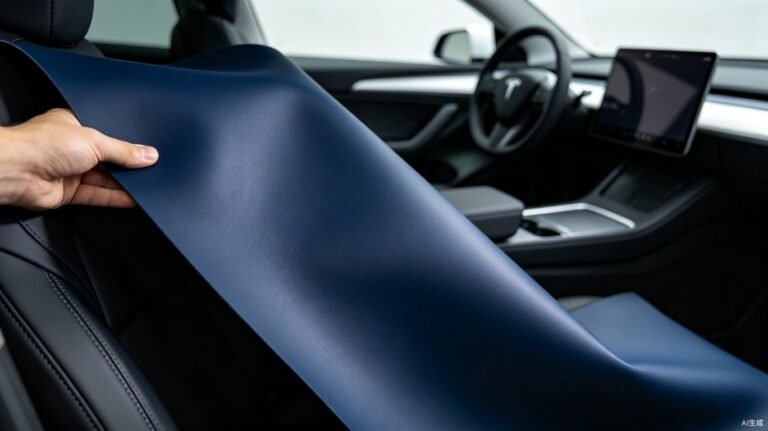
Aircraft cabin seating upholstered with aviation-grade leather material
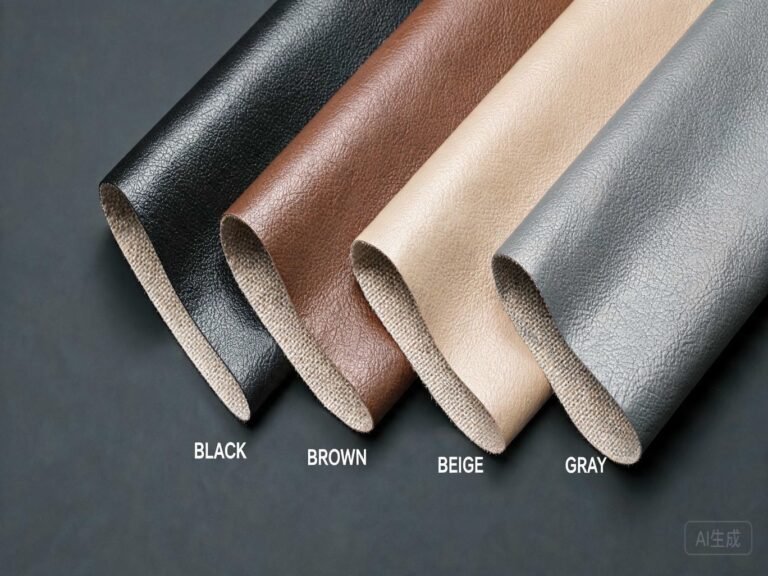
Aviation-grade silicone leather performance overview
Beyond FST: Weight, VOC, and 10-Year Cabin Life
Passing FST gets you through the regulatory door. But operational economics — fuel cost, cabin air quality, maintenance cycles — determine whether airlines actually buy your material. Three specs beyond FST separate a certifiable material from a commercially viable one.
Weight per square meter. Every kilogram removed from cabin interiors saves approximately 12,000 liters of fuel per year per wide-body aircraft. Silicone leather weighs 15-20% less than traditional aviation leather at equivalent thickness — a meaningful reduction when multiplied across hundreds of seats and panel surfaces.
VOC emissions. Cabin air quality regulations are tightening globally. Materials that off-gas solvents, plasticizers, or residual monomers contribute to passenger discomfort and crew fatigue. Silicone leather is produced through a solvent-free process with zero plasticizers and negligible VOC content, compliant with silicone vs PU material safety standards including REACH SVHC and RoHS 2.0.
Cleaning endurance. Aircraft interiors face aggressive cleaning protocols — alcohol wipes, disinfectant sprays, stain removers — sometimes 4-6 times per day on high-turnover routes. Standard leather surfaces haze and degrade under repeated alcohol exposure. Silicone leather’s chemical stability means it withstands these protocols without surface deterioration, extending the service life in demanding environments well beyond typical 5-year replacement cycles.

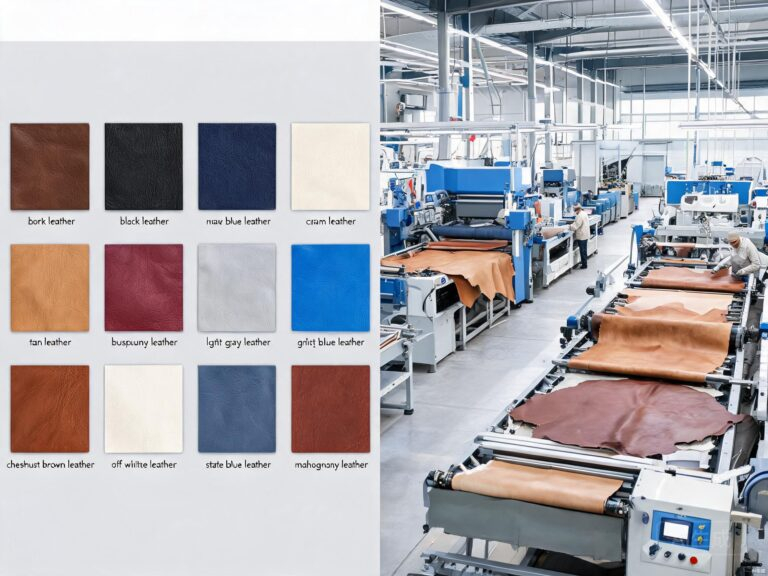
Physical testing laboratory verifying FST and durability parameters
Frequently Asked Questions
Does aerospace interior leather require re-certification for each aircraft model?
Yes. FAR 25.853 certification is seat-model-specific and application-specific. A material certified for a Boeing 737 seat cushion does not automatically qualify for an Airbus A350 wall panel. Each OEM maintains separate qualification databases (BSS 7230 for Boeing, ABD0031 for Airbus), and materials must be tested against the specific configuration and installation method. Always request model-specific test reports from your supplier.
Can silicone leather meet the smoke density threshold without flame-retardant additives?
Yes. Silicone polymers are inherently flame-resistant due to their Si-O backbone structure, which requires approximately 40% more energy to break than C-C bonds. This means silicone leather achieves Dm ≤150 and self-extinguishing times under 5 seconds without any added halogenated or phosphorus-based flame retardants — eliminating the secondary toxicity risk that those additives create.
Aerospace Interior Leather: The Sourcing Reality
The FST triangle is unforgiving by design. It exists to ensure that cabin materials give passengers the maximum possible survival window after an incident — and that means eliminating materials that burn slowly but smoke heavily, or self-extinguish but release HCN. For procurement teams, the practical implication is clear: demand full FST test reports (not just a flammability certificate) before signing any aerospace interior leather contract. If your supplier can’t produce smoke density and toxic gas data, you’re carrying unquantified risk. Silicone leather’s molecular structure makes it one of the few synthetic materials that passes all three pillars — fire, smoke, and toxicity — without chemical additives, while also delivering the weight savings and cabin-air benefits that airlines need.
About TOPSUN
TOPSUN produces aviation-grade silicone leather materials that meet FAR 25.853, CS 25.853, and CCAR 25.853 flammability requirements for aircraft cabin interiors and seating.
Our silicone leather passes vertical burn testing with self-extinguishing times under 5 seconds, achieves smoke density Dm below 150, and carries zero-VOC certification compliant with REACH, RoHS 2.0, and Prop65 — verified through ISO 10993 biocompatibility testing for aviation and medical applications.