Global leather bag sales will reach $58.2 billion in 2026, on the way to $90.4 billion by 2034. Yet the two words buyers rely on most, “genuine leather,” have no agreed test behind them. A bonded split with a plastic coating can carry the same label as a quality leather bag made from the strongest cut on the hide.
Here is the uncomfortable truth from the inspection floor: a quality leather bag is not defined by the grade name on its label. It is defined by four physical tests and one check anyone can run with a fingertip. This article lays out both sides of that comparison, then hands you a judgment table for your next supplier call.
Labels vs. Tests: What Each One Actually Tells You
Most sourcing disputes start when a label claim meets a physical test. The table below puts the two side by side.
| Label claim | What it actually means | Test that verifies it | Pass threshold |
|---|---|---|---|
| “Genuine leather” | A catch-all term. It can describe the weakest split layer with a finish coat. | Cut-edge inspection + tear test | Tear ≥ 20 N; no layered core visible |
| “Full-grain” | Top cut of the hide with intact grain structure. | Tensile test | Roughly 30-50% stronger than split leather |
| “Top-grain” | Sanded and refinished surface for uniform looks. | Bally flex test | 20,000+ cycles with no crack |
| “Premium PU” | Meaningless without coating weight and backing data. | Peel strength (ISO 11644) | Coating-to-backing bond ≥ 2 N/cm |
Notice the pattern. Every label claim has exactly one physical test that either proves it or exposes it. The rest of this article walks through each of those tests.
How to Identify a Quality Leather Bag Without Trusting Labels
The grade system sounds scientific. In practice it is closer to marketing vocabulary. Tanneries and synthetic producers grade their own output, and there is no international body that audits who may print “full-grain” on a tag.
That is why we train buyers to flip the question. Instead of asking what the material is called, ask what it measures. A supplier who answers with numbers has nothing to hide. A supplier who answers with another grade name is selling vocabulary.
There are three quick checks you can run before any lab gets involved:
- Smell: heavy chemical or plastic odor usually signals solvent residues or a thick PVC coating.
- Press test: press the surface with a thumb. Natural grain shows fine irregular wrinkles; a stiff film that stays flat is a heavy finish coat.
- Edge check: the single most reliable method, covered in detail below.
4 Physical Tests That Define a Quality Leather Bag
These are the four measurements we run on every material batch that leaves our factory, and they map directly to how a bag fails in the field.
- Tensile strength (ISO 1421): our Classic collection measures 15+ N/mm. Low tensile values show up later as stretching around hardware and distorted bag shapes.
- Tear resistance: 20+ N for Classic, 35+ N for our Rigid Substrate line. Bags fail at punched holes first, so tear data matters more than tensile for straps.
- Flex endurance (Bally): strap folds see thousands of bend cycles a month. We validate materials well past 20,000 cycles before approving them for bag construction.
- Color fastness (ISO 105): grade 4-5 on our lines. Handles rub against clothing, and dye transfer complaints are among the hardest returns to defend.
In our experience, a supplier who volunteers these four numbers during a first call is also the one whose bulk shipment matches the approved sample. The correlation is not a coincidence.

Tensile testing turns a grade label into a number you can put in a purchase order.
Watch the four performance tests run on real material samples, not marketing swatches.
Full Grain vs Top Grain Leather Bag: Read the Cut Edge
If you only learn one identification skill, make it this one. Look at a raw cut edge, like the seam allowance inside an unlined bag or a punched sample.
Full-grain and top-grain leather show a consistent fibrous texture through the full thickness. Bonded and heavily finished materials show layers: a paper-thin surface film, sometimes a visible fabric core. The physics behind it is real. Full-grain keeps the hide’s densest fiber layer intact, which is why testing labs credit it with roughly 30-50% higher tensile strength than split leather. A full-grain bag that gets basic care can last 20 to 30 years of regular use.
The same logic applies to synthetic materials. A cheap split-and-coat PU hides its weak bond inside the sandwich. Silicone leather cannot delaminate that way because there is no separate coating layer to separate; the polymer structure is continuous. That is a structural claim, not a grade claim, and it is testable.

Natural grain texture versus a uniform finish coat is visible to the trained eye from arm’s length.
Why Premium Synthetics Pass the Same Tests
None of the four tests above are reserved for animal hide. The same bench measures any sheet material a bag is made from, and premium synthetics now post numbers that low-grade leathers cannot match.
Hydrolysis is the clearest example. Standard PU begins breaking down within 3-5 years as moisture attacks the coating bond. In our climate chamber, running 85°C at 85% relative humidity for 14 weeks, full-silicone material shows no delamination, no strength loss and no surface degradation. That accelerated aging maps to a 10-15 year service life in real carry conditions.
The other numbers stack up in the buyer’s favor too. Solvent-free silicone construction returns non-detect VOC results under ISO 16000-6, which matters for bags sold into regulated markets. Our High Performance collection reaches 200,000+ Martindale cycles. For gear aimed at marine or coastal retail, salt-spray endurance past 1,000 hours per ASTM B117 rounds out the picture. The details behind those results are laid out in our hydrolysis-resistant silicone leather overview.
The takeaway is simple. Judge the material by its report, then let the report decide whether it is leather or synthetic. The market has already moved that way: premium synthetics are taking shelf space across every major bag category.
How We Grade Incoming Rolls Before a Bag Is Cut
Grade names do not exist inside a working factory. Lot numbers and test records do. Every incoming roll on our floor passes through a fixed sequence before it is approved for production.
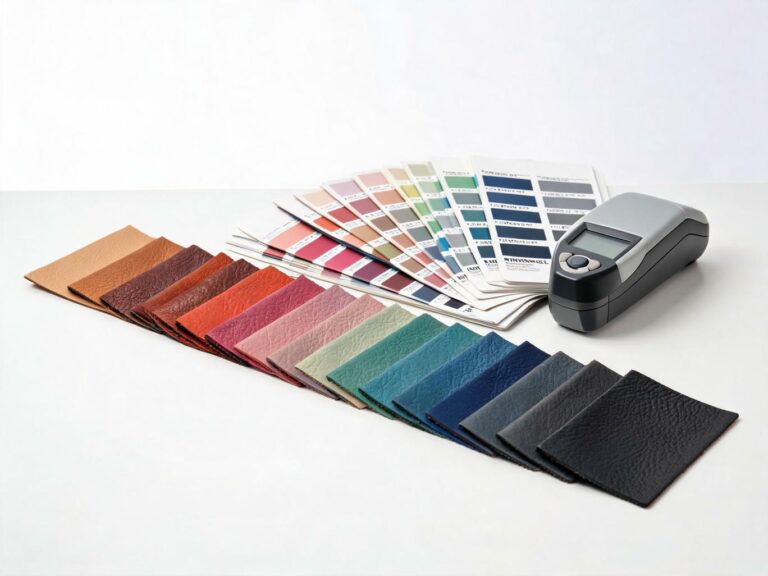
Raw base fabric is checked for weight and weave density. Coating thickness is monitored in line, not sampled at the end. A spectrophotometer controls color to a Delta E tolerance so the roll you receive matches the swatch you approved. Finished rolls then go through Martindale abrasion sampling and a final visual inspection under defined lighting. That sequence is how a “premium” claim becomes a repeatable result, and it is what we mean when we talk about inside our factory production line.
The same discipline applies to material families. If a client is choosing between full-silicone and semi-silicone constructions, we do not hand over a grade chart. We hand over the full silicone vs semi-silicone comparison with the test data for each construction, because the right answer depends on the application, not the label. Clients are also welcome to witness any of these tests in person, or to appoint SGS, BV or TÜV to run them on our floor.

The in-house lab: where grade vocabulary is replaced by recorded numbers.
Two Questions Buyers Keep Asking
Is genuine leather always better quality than synthetic?
No. Grade terms describe where a hide was cut, not how the finished bag performs. A high-spec silicone material with 15 N/mm tensile and verified flex endurance will outlast a low-grade split leather that carries the “genuine” label. Compare test reports, not categories.
Does thicker material always mean better quality?
Thickness without density is just weight. A dense 1.0 mm construction with a strong fiber or microfiber base usually outperforms a thick, loosely backed material. Ask for the spec sheet that lists both thickness and base fabric.
A Judgment Table for Your Next Supplier Call
Print this and keep it next to the phone. Each common phrase maps to one request that separates evidence from vocabulary.
| If the supplier says… | You ask for… |
|---|---|
| “It’s genuine leather.” | A cut-edge photo plus a tear test report |
| “It’s full-grain quality.” | Tensile data tied to a lot number, not the tag |
| “It won’t crack or peel.” | Bally flex cycles and ISO 11644 peel strength from an independent lab |
| “It’s a premium material.” | Named test standards (ISO 1421, ISO 105, ISO 12947) with pass values |
A quality leather bag earns that description at the test bench, long before the label is printed. Suppliers who welcome those four tests are the ones worth flying to visit.
About TOPSUN
TOPSUN runs multi-stage quality control on every silicone leather roll it ships to bag, furniture and automotive brands, from raw-material viscosity testing to final Martindale sampling.
500,000 m monthly capacity, 500 m MOQ, SGS reports with every order, and third-party inspection welcome (SGS / BV / TÜV).
References
1. https://www.intelmarketresearch.com/leather-bag… — Global leather bags market valued at $58.2B in 2026, forecast $90.4B by 2034 (CAGR 5.6%)
2. https://bagsplaza.com/full-grain-leather-vs-top… — Full-grain leather tensile strength 30-50% higher than split leather (citing Leather Industries of America)