A quality inspector at a furniture factory in Vietnam rejected 40% of an incoming PU leather shipment in 2025 — not because the material looked bad, but because the Martindale test results showed the polyurethane coating would fail before the 2-year warranty expired. The supplier insisted it was “genuine leather.” Technically, they were right: it was split leather with a polyurethane coating. But the polyurethane was the component that would fail, not the leather underneath. That shipment contained bonded leather disguised as a higher grade, and the PU content was doing 90% of the structural work. When it broke down, there was nothing underneath to maintain integrity.
This is the core problem with leather and polyurethane as a material category: the leather component provides marketing appeal, but the polyurethane component determines performance and lifespan. Understanding where one ends and the other begins — and which one fails first — is essential for any B2B buyer specifying materials for products that need to last beyond a 2-year replacement cycle.
| Material Grade | PU Content | Martindale Cycles | Typical Lifespan | Primary Failure Mode |
|---|---|---|---|---|
| Bonded leather | 70–90% | 10K–25K | 2–5 years | PU binder delamination |
| Bicast (bycast) | 50–60% | 25K–40K | 5–8 years | PU coating cracks |
| PU-coated genuine (corrected) | 20–30% | 40K–60K | 8–15 years | Surface coating wear |
| PU-coated top-grain | 10–15% | 60K–80K | 15–20 years | Coating edge wear |
| Silicone leather | 0% | 200K+ | 10+ years | None inherent |
Leather and Polyurethane: 5 Grades From Bonded to Full-Grain
The term “leather and polyurethane” covers a spectrum of materials that combine varying amounts of real leather fiber with polyurethane coatings or binders. At one end, bonded leather contains as little as 10–30% leather fiber held together by a PU binder — the rest is polyurethane doing the structural work. At the other end, PU-coated top-grain leather is 85–90% genuine hide with a thin protective polyurethane topcoat applied for uniformity and stain resistance. The polyurethane content inversely correlates with durability: more PU means faster failure.
In our incoming material inspection process, we’ve found that suppliers routinely mislabel these grades. A “genuine leather” label can legally apply to any product containing any amount of leather fiber — including bonded leather that’s 90% polyurethane. The only reliable way to verify the actual grade is through cross-section microscopy and burn testing, which reveal the ratio of leather fiber to PU binder. For B2B buyers, understanding the leather and polyurethane difference at the grade level is the first step in preventing warranty claims 18 months down the line.
Here’s the breakdown of each grade:
- Bonded leather: Ground leather scraps (10–30%) mixed with PU binder and pressed onto a fabric backing. Cheapest to produce, fastest to fail.
- Bicast (bycast): Split leather (lower hide layer) with a thick PU coating bonded on top. Looks uniform and shiny, lasts 5–8 years before the coating cracks.
- PU-coated genuine (corrected grain): Genuine leather with surface imperfections sanded flat, then coated with a thin PU layer for uniform appearance. The leather underneath provides structural integrity; the PU provides aesthetics.
- PU-coated top-grain: The second-highest leather grade, sanded and PU-coated for stain resistance. The thin coating (10–15% by weight) wears gradually but the leather beneath remains functional.
Durability Data: Where Leather and Polyurethane Materials Fail
The Martindale abrasion test (ISO 12947-2) is the industry standard for evaluating surface wear resistance in upholstery materials. The gap between grades is dramatic — and predictable. Bonded leather typically fails at 10,000–25,000 cycles. PU-coated top-grain reaches 60,000–80,000. Silicone leather, which contains no polyurethane at all, exceeds 200,000 cycles verified by SGS testing.
But Martindale only measures surface abrasion. The real killer for leather and polyurethane materials is hydrolysis — the chemical breakdown of the PU polymer chain in the presence of moisture. We’ve tested bonded leather samples that showed coating separation after just 15,000 Martindale cycles when exposed to 70% relative humidity for 6 months. The same material tested in dry conditions survived 25,000 cycles. Humidity cuts the effective lifespan nearly in half, and this acceleration is rarely reflected in supplier spec sheets.

Flex testing reveals where PU coatings crack — the polyurethane layer separates from the leather backing under repeated bending
The polyurethane leather cracking and peeling causes are well-documented in material science. Three mechanisms drive the failure — hydrolysis, UV-driven polymer chain breaking, and plasticizer migration. Each one attacks the PU component, not the leather fiber. A bonded leather product with 90% PU content has 90% of its structural integrity vulnerable to these mechanisms. A PU-coated top-grain with 10% PU has only 10% exposed. This is why higher leather content correlates with longer lifespan — not because leather is inherently superior, but because there’s less polyurethane to fail.
Why the Polyurethane Coating Cracks: Three Failure Mechanisms
Polyurethane coatings fail through three mechanisms that genuine leather doesn’t share. Understanding these is the key to answering the question every procurement team eventually asks: how long does polyurethane leather last? The answer depends less on how the product is used and more on the chemistry of the coating itself.
1. Hydrolysis. Water molecules break the ester bonds in the PU polymer chain, causing the coating to soften, blister, and separate from the backing. This process is irreversible and accelerates dramatically in humid environments. A hotel lobby in Dubai saw an entire set of bicast sofas begin shredding within 14 months — the constant low-humidity HVAC system dried out the PU, while intermittent humidity from cleaning caused hydrolytic stress cycling that fragmented the coating. The chemistry of polyurethane degradation is well-established: ester-based PU formulations are inherently vulnerable to hydrolysis, while ether-based variants resist it longer but still degrade over time.
2. UV degradation. Ultraviolet radiation breaks polymer chains in the PU coating, causing it to become brittle, chalk, and crack. Genuine leather also suffers UV damage, but its collagen fiber structure distributes stress — a crack in leather can be conditioned and arrested. A crack in polyurethane propagates rapidly because the coating has no fiber structure to redirect stress. Once a crack initiates, it spreads.
3. Plasticizer migration. The plasticizers that make PU flexible gradually migrate to the surface and evaporate. The coating first becomes sticky (plasticizers surfacing), then hardens, then cracks. This process happens regardless of use — it’s a chemical clock that starts at manufacture. A bonded leather sofa stored in a climate-controlled warehouse still ages, because the polyurethane binder is slowly losing its plasticizers whether anyone sits on it or not.

Incoming material inspection — the first line of defense against mislabeled PU-coated leather grades
Genuine leather fails differently: it dries out as natural oils evaporate, but this is preventable with conditioning every 3–6 months. PU coating failure is not preventable — it’s inherent to the material chemistry. The coating has a finite lifespan determined by its formulation, not by how carefully the product is maintained. This is why silicone vs PU material comparison testing consistently shows silicone outlasting PU by 3–5× in equivalent conditions.
QC insight: When inspecting incoming leather and polyurethane materials, request the supplier’s Martindale test report AND a hydrolysis resistance test (ISO 11507). If the supplier can’t provide hydrolysis data, assume the worst-case scenario — the PU will fail in half the time listed on the spec sheet.
10-Year TCO: What Leather and Polyurethane Actually Costs
The upfront cost of leather and polyurethane materials creates a false economy. A bonded leather sofa at $800 seems more affordable than a top-grain leather sofa at $3,000 — but the 10-year total cost of ownership tells a different story. Bonded leather needs replacement 2–3 times over a decade. Bicast needs 1–2 replacements. PU-coated top-grain likely survives with conditioning. And silicone leather, with no PU to degrade, survives the full 10 years with zero maintenance.
For furniture upholstery applications, the replacement cost — labor, logistics, customer dissatisfaction, brand damage — far exceeds the material cost difference. A hospitality chain specifying bonded leather for 500 hotel rooms saves $40 per room upfront but faces $200+ per room in replacement costs within 5 years. The math gets worse at scale: 500 rooms × $200 = $100,000 in avoidable replacement costs, plus the brand impact of guests sitting on peeling furniture.

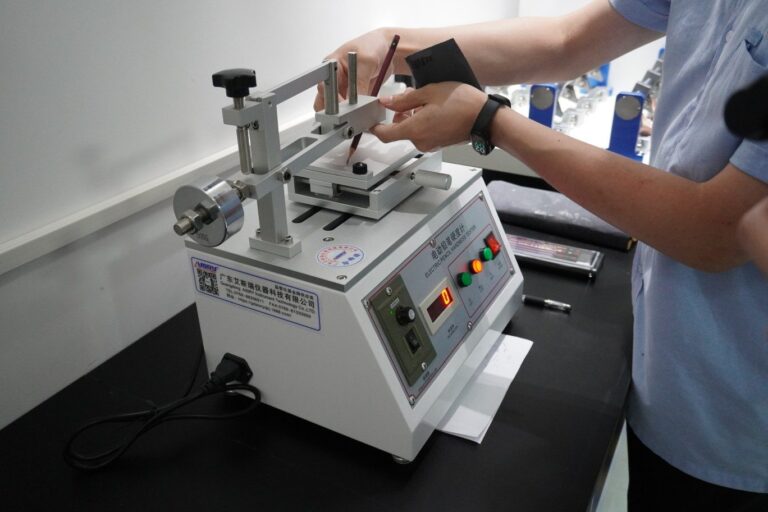
Scratch resistance testing — PU-coated grades show surface failure where the coating breaks through to the backing
For B2B buyers establishing leather and polyurethane material sourcing specifications, the critical metric isn’t upfront cost per meter — it’s cost per year of expected service. Dividing material cost by years of service life reveals the true cost:
- Bonded leather: $8/meter ÷ 3 years = $2.67/meter/year
- Bicast: $12/meter ÷ 6 years = $2.00/meter/year
- PU-coated genuine: $20/meter ÷ 12 years = $1.67/meter/year
- PU-coated top-grain: $35/meter ÷ 18 years = $1.94/meter/year
- Silicone leather: $28/meter ÷ 10+ years = $2.80/meter/year (with zero maintenance cost)
The PU vs genuine leather TCO analysis consistently shows that mid-range materials deliver the best cost-per-year ratio. But silicone leather changes the calculation by eliminating the maintenance cost line item entirely — no conditioning, no protector sprays, no coating renewal.
Silicone Leather: Eliminating the Polyurethane Failure Mode
Silicone leather replaces the polyurethane coating entirely with a silicone polymer that doesn’t share PU’s failure modes. The Si-O (silicon-oxygen) backbone is inherently UV-stable — verified at 1,000+ hours under ASTM G154 with no cracking or yellowing. It’s hydrolysis-proof because the silicone polymer doesn’t contain the ester bonds that water molecules attack in PU. And it contains no plasticizers to migrate, because flexibility is an intrinsic property of the silicone molecular structure, not something added through chemical additives.

Material cross-section comparison — note the uniform silicone layer vs. the layered PU coating structure prone to delamination
For B2B buyers evaluating polyurethane coated leather vs genuine leather durability, silicone leather offers a third option that eliminates the question entirely. Instead of asking “how long will the PU coating last?”, the question becomes irrelevant — there is no PU coating to fail. The material’s 200,000+ Martindale cycles, -40°C to 250°C temperature tolerance, and eco-friendly silicone composition (near-zero VOC, solvent-free process, 100% recyclable) make it the only leather alternative that doesn’t trade one failure mode for another.
See the flex test that PU coatings fail — silicone leather survives 50,000+ flex cycles without surface cracking
The practical implication: products specifying silicone leather don’t need warranty provisions for coating delamination, UV-driven cracking, or plasticizer migration. For automotive interiors, where cabin temperatures can swing from -20°C to 80°C in a single day, the absence of a PU coating that can hydrolyze, UV-crack, or plasticizer-migrate eliminates an entire category of field failure claims.
Material Selection: What to Specify and What to Avoid
The leather and polyurethane material category covers a wide quality spectrum, but every grade that contains PU shares the same structural weakness: the polyurethane component will eventually fail. The question isn’t whether — it’s when, and whether the product’s expected lifespan exceeds that failure point.
| If your project requires… | Avoid | Specify |
|---|---|---|
| Martindale >100K cycles | All PU-coated grades | Silicone leather (200K+) |
| Hydrolysis resistance (humid/wet) | Bonded, bicast | Silicone leather |
| 10+ year outdoor UV exposure | All PU grades | Silicone leather (1,000+ hrs) |
| Food-contact safety (FDA 21 CFR 177) | All PU grades | Silicone leather (FDA compliant) |
| Lowest upfront cost only | Silicone, top-grain | Bonded or bicast (plan for replacement) |
Every leather and polyurethane grade has a place in the market — but that place is defined by how quickly the PU component will fail and whether the product’s expected lifespan is shorter than that failure point. For disposable fashion accessories with a 2-year trend cycle, bonded leather is adequate. For products that need to survive 10+ years of real-world use — automotive interiors, medical equipment covers, marine upholstery, hospitality furniture — the polyurethane component is a liability that silicone leather eliminates entirely.