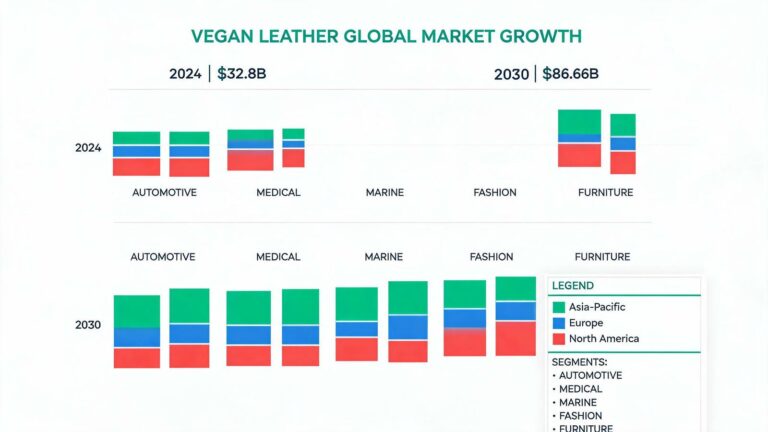
The vegan leather furniture market crossed $32.8 billion in 2026, expanding at 11.4% CAGR toward $86.66 billion by 2035 (Morgan Reed Insights). Vegan leather alternatives also captured 15% of the leather sofa market — up from 9% just one year prior. But here’s what most procurement teams miss: not all vegan leather ages the same way. A PU-covered sofa that looks pristine at delivery can start peeling within 18 months, while a silicone-based leather alternative can exceed 200,000 Martindale abrasion cycles without surface breakdown. The material you specify today determines whether your furniture lasts 3 years or 10.
| Material | Service Life | Martindale Cycles | VOC Emission | 5-Yr Cost/sqm* |
|---|---|---|---|---|
| Silicone Leather | 10+ years | 200,000+ | Zero | Lowest |
| PU Leather | 3–5 years | 30,000–50,000 | Solvent-based | Medium |
| PVC Leather | 2–3 years | 20,000–30,000 | Plasticizer off-gas | High |
| Bio-based (Piñatex etc.) | 2–5 years | Varies widely | Low–moderate | High |
| Recycled Polyester | 3–5 years | 25,000–40,000 | Low | Medium |
*5-year cost includes initial purchase + replacement + maintenance. Lower lifespan = higher frequency of replacement.
Explore Furniture Upholstery Options
What Counts as Vegan Leather for Furniture Upholstery?
The term “vegan leather” covers any material that mimics leather without animal hides — but the composition varies enormously. PU leather coats a fabric base with polyurethane; PVC leather uses polyvinyl chloride with plasticizers; bio-based options like Piñatex extract fibers from plant waste; and silicone leather applies a pure silicone coating to textile substrates. For furniture buyers, the question isn’t just what is vegan leather made of — it’s which chemistry holds up under daily sofa use.

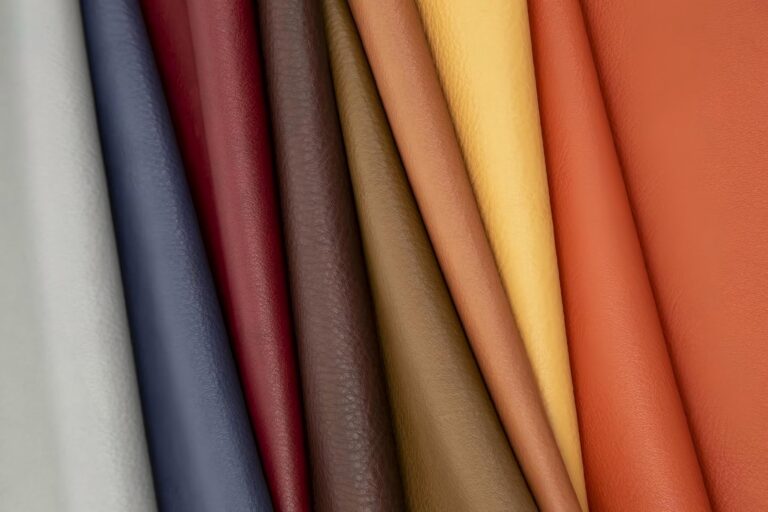
Material swatches on a factory display rack — texture and color consistency matter at scale
In our experience sourcing for furniture OEMs, the single biggest specification error is treating all vegan leather as interchangeable. A hospitality client once specified standard PU for 200 lobby sofas — within 24 months, 40% showed visible peeling at armrest edges. The replacement cost dwarfed the initial per-square-meter savings. Understanding what vegan leather is made of before committing to a bulk order is the cheapest risk mitigation available.
Vegan Leather Furniture: Durability Showdown Across 5 Materials
Durability in furniture isn’t one metric — it’s a cluster. Martindale abrasion resistance tells you how the surface handles friction. Flex resistance measures cracking at stress points like seam folds. Hydrolysis resistance determines whether humidity will break down the coating from inside. UV stability predicts color fading near windows or in sunlit spaces.
Here’s where the materials separate. Silicone leather registers 200,000+ Martindale cycles, flex resistance exceeding 50,000 cycles, and full hydrolysis-proof construction. PU typically lands at 30,000–50,000 Martindale cycles with poor hydrolysis resistance — meaning humid environments accelerate coating breakdown. PVC performs worse on both counts and releases plasticizers over time. When furniture needs to survive how long vegan leather furniture lasts under commercial traffic, these gaps translate directly into replacement cycles.

Martindale abrasion tester — the machine that separates marketing claims from spec-sheet reality
In our own Martindale testing, silicone leather samples show no surface degradation even after 200,000 cycles — roughly equivalent to 10+ years of residential sofa use. PU samples typically develop micro-cracks between 30,000 and 50,000 cycles, which is why PU-covered commercial furniture often needs reupholstering within 3–5 years. For B2B buyers managing warranty claims, this gap is the difference between a profitable contract and a margin-eroding replacement program.
The Hidden Cost of Cheap Synthetic Leather
A PU leather sofa might cost 30–40% less per square meter than silicone leather upfront. But a 5-year total cost of ownership calculation tells a different story. If PU needs replacement at year 4 and silicone runs strong past year 10, the per-year cost of silicone is roughly half. Add labor for reupholstery, logistics for returns, and brand damage from visible wear in commercial settings, and the gap widens further.
This matters most in high-traffic furniture: hotel lobby seating, restaurant booths, and commercial sofa applications where furniture turnover eats into operating margins.
The silicone vs PU comparison becomes less about premium positioning and more about lifecycle economics when replacement labor and logistics enter the equation.
Cleaning and Maintenance: The Overlooked Spec Factor
Furniture buyers often focus on look and feel, then underestimate cleaning protocols. Silicone leather’s non-porous surface repels liquids, resists stains, and tolerates bleach and alcohol disinfectants without surface degradation. PU leather degrades with repeated chemical cleaning — the coating thins, loses gloss, and eventually cracks. PVC is moderately cleanable but stiffens and cracks over time.
For healthcare furniture, hospitality seating, and any environment with strict sanitation requirements, cleaning compatibility should be a gate-pass criterion, not an afterthought. Our cleaning and maintenance guide details protocol differences across material types.

Furniture upholstery in a commercial setting — material choice determines maintenance frequency and replacement timing
Request Free Furniture Swatch Samples
Which Vegan Leather Should Your Furniture Use?
After comparing five material types across durability, cost, and maintenance, the decision comes down to your furniture’s expected service environment:
| If Your Furniture Needs… | Choose | Why |
|---|---|---|
| 10+ year commercial lifespan | Silicone leather | 200K Martindale, hydrolysis-proof, zero VOC |
| Budget residential, 3–5 yr | PU leather | Lower upfront cost, acceptable for light use |
| Strict sustainability mandate | Silicone or bio-based | 100% recyclable or plant-derived |
| Medical / food-contact furniture | Silicone leather | ISO 10993 biocompatibility, FDA compliant |
Vegan leather furniture isn’t a single category — it’s a spectrum where material chemistry determines everything from warranty exposure to end-of-life recyclability. Specify the material that matches your furniture’s real-world lifespan, not just the one with the lowest per-meter price.
About TOPSUN
TOPSUN manufactures silicone leather for furniture and sofa upholstery, serving B2B clients across hospitality, residential, and commercial seating sectors.
200,000+ Martindale cycles verified · Zero VOC emissions · 100+ textures with Pantone-matched colors · 500-meter MOQ with 7–15 day lead time · Free A4 swatches shipped worldwide