On September 27, 2026, the EU Green Claims Directive (ECGT, 2024/825) becomes enforceable — and every leather eco friendly claim your brand has made enters a new regulatory reality. Generic terms like “eco leather,” “sustainable leather,” and “carbon neutral leather” will require verified lifecycle evidence from accredited third parties. Penalties can reach 4% of annual EU turnover. Korea’s Fair Trade Commission already warned four major brands in May 2025 for misleading eco claims on synthetic leather. A German court banned the term “apple leather” in July 2025. Italy fined Armani €3.5 million for unsubstantiated sustainability claims. The era of self-declared leather eco friendly marketing is ending. B2B brands that source, specify, or label leather materials need to know exactly which claims are at risk — and how to substantiate the ones they keep.
Request Brand Compliance Documentation
What ‘Leather Eco Friendly’ Actually Means in 2026
The phrase “leather eco friendly” has never had a standardized definition. It has functioned as a marketing asset — a feel-good label applied to everything from chrome-tanned bovine leather to petroleum-based PU synthetic. The ECGT Directive changes this by requiring that any environmental claim about a product be: (1) specific, not generic; (2) based on full lifecycle evidence; (3) verified by an accredited third party; and (4) relevant to the actual environmental performance of the product.
For B2B leather brands, this means the question is no longer “can we call our leather eco friendly?” but “what verified evidence supports any environmental claim we make about our leather?” The manufacturing process documentation — from raw material sourcing through coating chemistry to end-of-life recyclability — becomes the foundation of any defensible claim.
7 Eco Friendly Leather Claims Now at Risk
Based on ECGT prohibitions, FTC Green Guides enforcement, and recent court rulings across the EU and Asia, here are seven leather eco friendly claims that B2B brands can no longer safely make without substantiation.
| Claim at Risk | Why It’s Banned | Enforcement |
|---|---|---|
| “Eco leather” / “Green leather” | Generic claim without verified lifecycle evidence | EU ECGT Sep 2026 |
| “Carbon neutral leather” | Offset-based claims banned; actual reductions required | EU ECGT Sep 2026 |
| “Sustainable leather” | Must demonstrate recognized excellent environmental performance | EU ECGT Sep 2026 |
| “Apple leather” / plant-based names | Misleading if material is synthetic with plant additive | Cologne Court Jul 2025 |
| “Bio-leather” / “Bio-based” | Must disclose bio-based percentage; cannot imply biodegradability | FTC + EU ECGT |
| “Environmentally conscious” | Vague qualifier without substantiation | KFTC May 2025 |
| Self-created eco labels | Labels must be based on certification scheme or public authority | EU ECGT Sep 2026 |

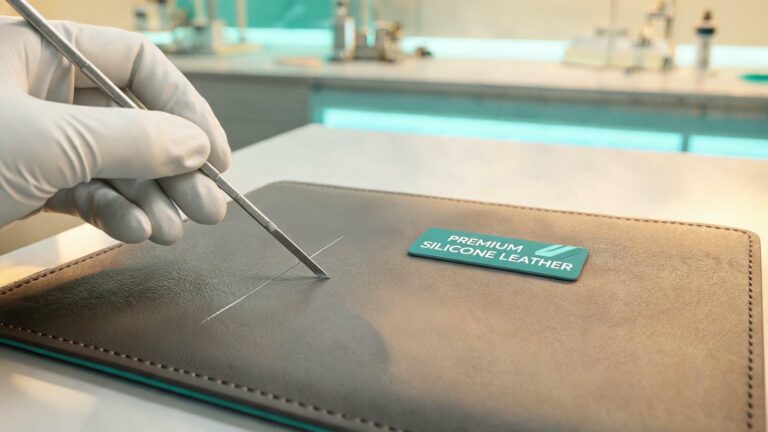
Finished leather texture detail — material appearance alone cannot substantiate an eco friendly claim under 2026 regulations.
The pattern across all seven claims is the same: generic, self-declared, or offset-based environmental assertions are no longer sufficient. Brands must either produce verified evidence or remove the claim. The EU Commission’s Green Claims framework establishes the evidence standard — and it applies to any business marketing to EU consumers, regardless of where the company is headquartered.
The EU Green Claims Directive: Enforcement Timeline
The ECGT Directive was adopted on February 28, 2024, and published in the Official Journal on March 6, 2024. Member states must transpose it into national law by March 27, 2026. Enforcement begins September 27, 2026. The timeline gives B2B brands roughly 12 months from now to audit their leather eco friendly claims, gather lifecycle evidence, and either substantiate or remove non-compliant marketing language.
In parallel, the US FTC Green Guides continue to enforce against deceptive environmental claims under Section 5 of the FTC Act. In 2022, Kohl’s and Walmart paid $2.5M and $3M respectively for misleading green claims. Updated Green Guides guidance is pending, with expected tightening of substantiation standards for recyclability and compostability claims.
Regulatory Timeline: Leather Eco Friendly Claims
May 2025: KFTC warns 4 brands for misleading eco claims on synthetic leather.
Jul 2025: Cologne Court bans “apple leather” as misleading.
Mar 2026: EU member-state transposition deadline for ECGT.
Sep 2026: ECGT enforcement begins. Generic eco claims, offset-based carbon claims, and self-created labels all become high-risk.
Dec 2026: EU Deforestation Regulation expected to apply to leather supply chains for large enterprises.
How B2B Brands Are Verifying Eco Friendly Claims
Forward-thinking B2B brands are not waiting for enforcement to begin. They are building claim substantiation frameworks now, using certifications that the ECGT recognizes as independent verification. The key is selecting certifications that cover the specific environmental attribute being claimed — not collecting labels generically.
For chemical safety claims, OEKO-TEX Leather Standard (revised April 2025) tests for harmful substances including heavy metals, formaldehyde, and restricted chemicals. For tannery environmental performance, the Leather Working Group (LWG) audits manufacturing practices. For recycled content claims, the Global Recycled Standard (GRS) provides chain-of-custody verification. For full environmental management systems, our certified production process follows ISO 14001 principles — but ISO 14001 alone does not verify product-level claims.
For carbon footprint data, a 2025 ACS study reported bovine leather at 187.1 kg CO2e/kg finished leather and vegan leather at 14.9 kg CO2e/kg. On a per-square-meter basis, genuine leather averages ~5 kg CO2/m2, PU leather ~4-8 kg CO2/m2, and silicone leather ~3-5 kg CO2/m2. The Higg Material Sustainability Index revised bovine leather’s Global Warming Potential score from 36.8 to 14.6 points in October 2024 — still significantly higher than synthetic alternatives.

Finished leather rolls in warehouse storage — logistics and packaging data feed into lifecycle assessment for eco friendly claim substantiation.
Silicone leather offers a unique advantage in this verification landscape. The material is produced through a solvent-free dry coating process with zero VOC emissions, zero DMF, and zero phthalates — properties verified through REACH compliance, ISO 10993 biocompatibility testing, and FDA 21 CFR 177.2600 certification. The comparison with conventional leather and synthetics shows that silicone leather’s environmental claims can be substantiated with existing certified test data — no new lifecycle studies required.
Your Brand Protection Checklist
For B2B brands specifying leather eco friendly materials, the compliance window closes in September 2026. Here’s what to do now.
1. Audit every environmental claim in your current marketing. Search your website, product datasheets, and spec sheets for generic terms: “eco,” “green,” “sustainable,” “carbon neutral,” “environmentally friendly.” Flag each one for substantiation or removal.
2. Map each claim to a certification. No certification means no claim. OEKO-TEX for chemical safety, GRS for recycled content, LWG for tannery practices, ISO 14001 for environmental management. If you can’t map a claim to a recognized certification, remove it.
3. Request lifecycle assessment data from suppliers. Ask for carbon footprint per kg or m2, water usage, and VOC emission test reports. Suppliers who cannot provide this data cannot support your eco friendly claims in an audit.
4. Eliminate offset-based carbon claims. “Carbon neutral leather” based on purchased offsets is banned under ECGT. Replace with actual emission reduction data verified by an accredited body.
5. Source materials with built-in compliance. The most efficient path to ECGT-ready marketing is specifying materials whose environmental performance is already certified. Silicone leather ships with REACH, ISO 10993, FDA, and zero-VOC documentation — covering the evidence chain from raw material through finished product.

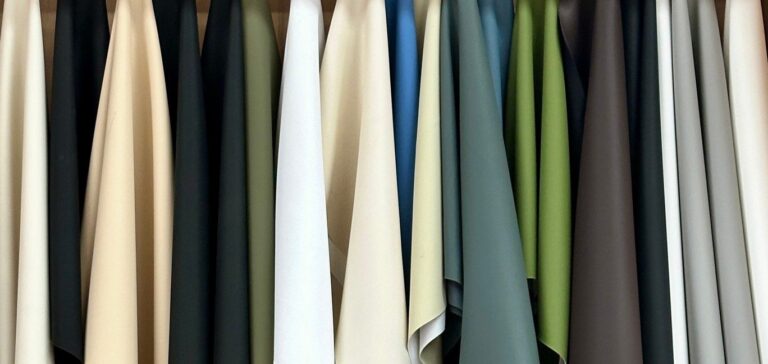
Material swatch samples for B2B evaluation — request certified test documentation alongside physical samples to verify eco friendly claims.
The leather eco friendly landscape in 2026 rewards brands that can prove their claims and penalizes those that can’t. Penalties under ECGT can reach 4% of annual EU turnover — Italy caps fines at €10 million per violation, France adds criminal liability for repeat offenders. The brands that thrive will be those that treat environmental claims as procurement specifications, not marketing copy — backed by certified data, third-party verification, and materials designed for compliance from the chemistry up.
About TOPSUN
TOPSUN produces silicone leather using a solvent-free dry coating process that delivers zero VOC emissions, zero DMF, and zero phthalates — with full REACH compliance, ISO 10993 biocompatibility certification, and FDA 21 CFR 177.2600 food-contact approval. Every order ships with certified test documentation, enabling B2B brands to make substantiated leather eco friendly claims under the EU Green Claims Directive without additional lifecycle studies.