Can you legally call your product “eco vegan leather” after September 2026? If you’re sourcing PU-based materials with solvent coatings, the answer is probably no. The EU Green Claims Directive — enforceable from 27 September 2026 — explicitly bans unsubstantiated environmental claims, and generic labels like “eco-friendly” are first on the restricted list. For procurement teams, this means the material spec sheet now carries legal weight.
| Certification | What It Verifies | Silicone Leather | PU Leather | Regulatory Weight |
|---|---|---|---|---|
| ISO 16000-6 | VOC emissions in test chamber | Zero detected | Solvent residue | High — EU E1 / VDA 277 |
| REACH SVHC | Restricted substances compliance | Compliant | DMF flagged | High — EU mandatory |
| EU Ecolabel | Overall environmental impact | Compatible | Not eligible | Medium — voluntary |
| PFAS-free | No per- or polyfluoroalkyl substances | Inherently | May contain | Rising — EU REACH restriction |
See TOPSUN’s full environmental certification stack →
Request Compliance Documentation Pack
Why “Eco Vegan Leather” Stopped Meaning Anything
The phrase “eco vegan leather” has become a marketing liability. Under the EU Green Claims Directive (2024/825), member states must transpose the rules by 27 March 2026, with enforcement beginning 27 September 2026. The directive prohibits vague environmental claims — “eco-friendly,” “green,” “sustainable” — unless backed by third-party verification. Products already in stock are not exempt.
Here’s the problem: roughly 80% of materials marketed as eco vegan leather are polyurethane (PU) formulations that rely on solvent-based coating processes. These materials carry DMF residues, emit VOCs above EU E1 thresholds, and cannot substantiate the “eco” claim under the new directive. A Korean greenwashing enforcement case in 2024 already resulted in regulatory action against brands marketing petroleum-based synthetics as “eco leather” — and EU regulators are watching.
The distinction that matters is not whether a material contains no animal products — nearly all synthetic leather qualifies as “vegan.” The real question is whether the eco vegan leather you source can survive a compliance audit. That comes down to three things: base chemistry, manufacturing process, and verifiable certification data.

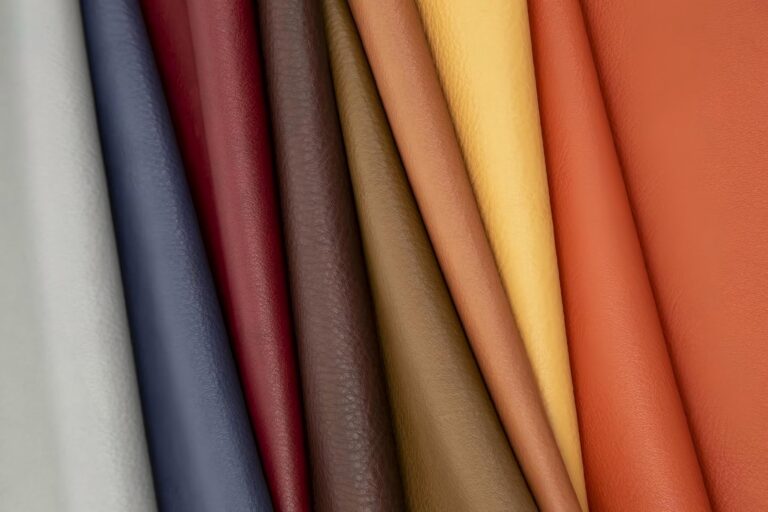
Silicone leather swatches in warm neutral and green tones — zero-VOC, solvent-free production
The 5 Certifications That Actually Verify Eco Claims
If you’re evaluating eco vegan leather for procurement, these are the certifications that carry regulatory and market weight:
- ISO 16000-6 (VOC emissions): The gold standard for indoor air quality. Materials are tested in emission chambers for total volatile organic compounds. Silicone leather returns zero detectable VOCs; PU typically shows solvent residues from DMF and toluene.
- REACH SVHC compliance: EU regulation 1907/2006 restricts substances of very high concern. Silicone formulations contain none; PU coatings may flag DMF, phthalates, or plasticizers on the SVHC candidate list.
- GRS (Global Recycled Standard): Verifies recycled content and chain of custody. Relevant if your sustainability claims include recycled material percentages — increasingly required by retail buyers.
- USDA Biobased Certification: Confirms renewable bio-based content. Most relevant for plant-derived formulations; less applicable to silicone or petroleum-based synthetics.
- EU Ecolabel: Multi-criteria environmental label covering the full product lifecycle. PU and PVC are generally ineligible due to solvent chemistry; silicone leather meets compatibility criteria.
In our testing laboratory, we run ISO 16000-6 chamber emission tests on every silicone leather batch. The results consistently show zero detectable VOCs — a claim backed by SGS and Intertek test reports. This is not marketing language; it is a measurable, verifiable data point that holds up under the Green Claims Directive’s substantiation requirement.
When comparing silicone vs PU leather for environmental compliance, the chemistry gap is stark: silicone is inherently solvent-free, while PU requires solvent carriers that leave residual emissions traceable in chamber tests.
PFAS Ban Timeline: What Changes for Vegan Leather Sourcing
The PFAS regulatory landscape is shifting rapidly. The EU REACH restriction on PFHxA and related substances was adopted in 2025, with implementation dates staggered across product categories. Textiles face restrictions from October 2026; leather and hides in non-clothing products from October 2027. Germany has already enacted a broader PFAS ban effective July 2026.

Water-based PU production — lower solvent load than traditional PU, but still not PFAS-guaranteed
For vegan leather specifically, the risk is real. PFAS compounds are sometimes used in synthetic leather for water resistance, stain repellency, and surface durability. PU and PVC formulations may contain PFAS as processing aids or performance additives — and suppliers rarely disclose this voluntarily. If your PFAS compliance documentation consists of a supplier’s self-declaration, that will not satisfy the new REACH restriction.
Silicone leather is inherently PFAS-free. The chemistry of silicone polymers does not require fluorinated compounds for water resistance or durability — those properties are built into the molecular structure. This eliminates an entire category of regulatory risk from your supply chain.
The EU Textile EPR directive, in force since 16 October 2025, adds another layer: producers must finance collection, sorting, and recycling of textile products at end-of-life. Materials that are 100% recyclable and have documented end-of-life pathways will face lower EPR fees — another cost factor that rarely appears on a spec sheet but shows up in the total cost of ownership.
Carbon Footprint Data: Silicone vs PU vs Animal Leather
The numbers tell a clear story. A 2025 study published in ACS Sustainable Chemistry & Engineering found that bovine leather generates 187.1 kg CO₂e per kg of finished material, compared to 14.9 kg CO₂e for synthetic alternatives. Other lifecycle assessments place processed animal hide at approximately 17 kg CO₂e/m², PU synthetic leather at 7–15.8 kg CO₂e/m², and silicone leather at 3–5 kg CO₂e/m².

Finished leather rolls in kraft paper packaging — no plastic wrapping, fully recyclable end-to-end
The carbon advantage of silicone leather comes from its manufacturing process. Our solvent-free dry coating method eliminates the energy-intensive solvent recovery and chemical mixing stages that dominate PU production. The result: lower energy input per square meter, no solvent emissions to abate, and no chemical waste requiring treatment.
When regulators ask for lifecycle data under the Green Claims Directive, you need numbers like these — not a logo. The directive requires claims to be substantiated with “widely recognized evidence” appropriate to the claim. A self-attested “eco” label will not survive; an SGS-tested carbon footprint figure will.
About TOPSUN
TOPSUN manufactures silicone leather using a solvent-free dry coating process, delivering zero-VOC, 100% recyclable materials for B2B brands navigating tightening ESG mandates and greenwashing regulations across the EU and North American markets.
Our materials carry ISO 10993-5 biocompatibility certification, REACH compliance, FDA food-contact approval, and ISO 16000-6 zero-VOC test reports — a compliance stack that withstands the EU Green Claims Directive’s substantiation requirements.
Your Eco Vegan Leather Compliance Checklist
Before you sign your next material sourcing contract, verify these five things:
- 1. Demand ISO 16000-6 test reports — not supplier self-declarations. If the material cannot produce a third-party VOC emissions test, the “eco” claim has no legal basis after September 2026.
- 2. Check PFAS status in writing — request a REACH SVHC statement that specifically addresses PFAS compounds, not a generic “no harmful substances” letter. The PFAS ban timeline starts October 2026 for textiles.
- 3. Verify recyclability claims — ask for end-of-life documentation. The EU EPR directive makes producers financially responsible for waste management; non-recyclable materials cost more.
- 4. Audit the manufacturing process — solvent-based coating disqualifies “eco” claims. Confirm solvent-free or water-based methods with factory documentation.
- 5. Map certifications to claims — each environmental claim on your product must trace back to a specific certification. “Eco vegan leather” without a GRS, OEKO-TEX, or ISO 16000-6 report attached is a legal risk.
The era of marketing-driven eco labels is ending. Eco vegan leather that survives the 2026 regulatory shift is defined not by what it’s called, but by what it can prove — in a test chamber, on a spec sheet, and under audit.
Download VOC Test Reports & Samples
Is PU leather actually eco vegan leather?
No — not under the EU Green Claims Directive. PU leather uses solvent-based coating processes that leave VOC residues traceable in ISO 16000-6 chamber tests. While PU is vegan (no animal products), the “eco” claim requires substantiation that PU formulations typically cannot provide. Silicone leather, by contrast, is both vegan and substantiated as eco-friendly through zero-VOC test data.
When does the EU Green Claims Directive take effect?
Member states must transpose the directive by 27 March 2026, with enforcement beginning 27 September 2026. From that date, generic environmental claims like “eco-friendly,” “green,” or “sustainable” without third-party verification are prohibited. Products already in stock are not exempt — brands must update packaging and marketing materials before the enforcement date.