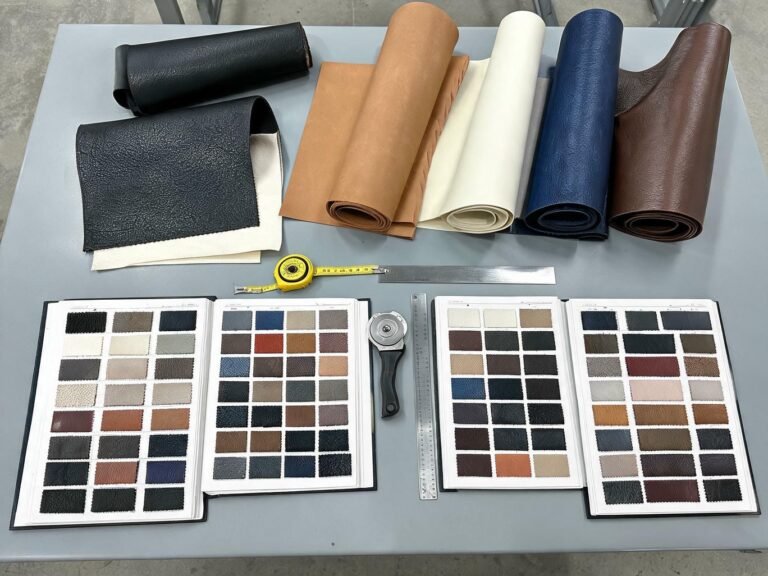
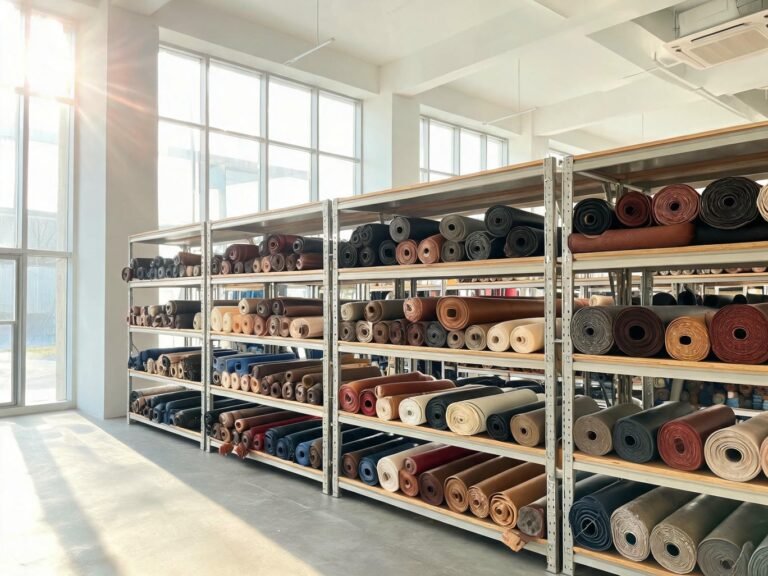
15-30%. That is the percentage of genuine leather yardage that becomes waste — off-cuts, belly trim, neck wrinkles, brand marks, and insect damage that cannot be used in any upholstered product. For a 200-room hotel furniture project requiring 2,000 square feet of finished leather, that means purchasing 2,600-2,850 square feet of hide to account for yield loss. At $11-15 per square foot for commercial-grade genuine leather, the waste alone costs $6,600-$12,750 — money spent on material that goes directly to landfill. Roll-based synthetic leather changes this equation entirely: with uniform rectangular rolls at 1,350-1,800mm width, yield waste drops below 3%.
Leather Yardage: What the Number Actually Buys You
The term “leather yardage” creates an immediate problem: leather doesn’t come in yards. It comes in irregularly shaped hides, averaging 45-55 square feet for a standard cowhide. The industry-standard conversion formula — one linear yard of 54-inch fabric equals 18 square feet of leather — accounts for average hide waste in its ratio, but the formula assumes uniform hide quality and consistent patterns. In practice, hide-to-hide variation in size, shape, and defect distribution makes actual yield unpredictable.
The industry conversion formula (1 yard = 18 sq ft) provides a baseline, but procurement teams should understand what drives the gap between purchased leather yardage and usable leather yardage. Three factors determine yield: hide shape irregularity (15-20% loss), defect distribution (5-10% loss for belly, neck, and brand areas), and pattern matching requirements (additional 5-10% loss when directional grain or color matching is required). These factors compound: a project buying 1,000 sq ft of hide may extract only 650-750 sq ft of usable material.
Roll-based materials — PU, PVC, microfiber, and silicone leather — eliminate this problem at the source. A standard silicone leather roll measures 1,350-1,800mm in width and 30-50 meters in length, providing 40-90 square meters of continuous, defect-free material per roll. Silicone leather roll goods deliver consistent quality across the entire surface, with no belly, neck, or brand-mark waste. The yield calculation becomes a simple rectangle: width × length × utilization rate, where utilization rate exceeds 97% for standard upholstery patterns.
Genuine Hide vs Roll Goods: The Yield Gap
The yield gap between genuine hide and roll goods represents the single largest hidden cost in leather procurement. The table below quantifies the difference using data from commercial furniture production runs.
| Factor | Genuine Hide | PU Roll | Silicone Roll |
|---|---|---|---|
| Material Shape | Irregular hide, 45-55 sq ft | Rectangular roll, 1,400mm width | Rectangular roll, 1,350-1,800mm |
| Defect Waste | 15-30% (belly, neck, brand, insect) | 3-5% (edge trim only) | Under 3% (edge trim only) |
| Pattern Matching Loss | 5-10% additional (grain direction) | 0-2% (consistent texture) | 0-1% (consistent texture, Delta E ≤ 1.0) |
| Effective Yield | 60-75% | 93-97% | 97%+ |
| Cost per Usable Sq Ft | $15-$25 (after waste adjustment) | $3-$6 | $5-$8 |
| Batch Consistency | Variable (hide-to-hide color drift) | Good within batch | Delta E ≤ 1.0 across all batches |
| MOQ | Per hide (no partial) | 1,000-3,000 meters | 500 meters |
| 5-Year TCO (per sq ft) | $25-$45 | $8-$15 | $6-$10 |
How Leather Yardage Calculations Distort Project Budgets
Most project budgets calculate leather cost using a simple formula: required square footage × price per square foot. This formula systematically understates actual cost by 20-40% because it ignores yield loss. A furniture manufacturer specifying 500 square feet of genuine leather at $12/sq ft budgets $6,000 for material. After 25% yield loss, they need to purchase 625 sq ft at $7,500 — a $1,500 overrun that appears nowhere in the initial budget.
The distortion worsens for large projects. A 200-room hotel renovation requiring 10,000 square feet of finished genuine leather faces $30,000-$50,000 in hidden waste costs. Leather hide pricing in 2026 has increased 8-12% year-over-year, making yield optimization more critical than price negotiation. A 5% improvement in yield saves more than a 10% discount on per-unit price.
Roll-based materials eliminate this budget distortion entirely. When you order 500 meters of silicone leather at 1,400mm width, you receive 700 square meters of usable material — not 700 square meters minus 25% waste. The procurement calculation becomes transparent: required area ÷ roll width = meters needed, with a 3% safety factor. Leather yardage supplier audits should verify whether the supplier quotes gross or net yardage, and whether the material format (hide vs roll) has been factored into the price comparison.
Leather Yardage: Which Material Maximizes Your Yield?
The decision framework for maximizing leather yardage yield follows three criteria:
Criterion 1 — Material format: If the material comes in irregular hides, yield loss of 15-30% is unavoidable regardless of cutting efficiency. If it comes in rolls, yield loss drops to under 5%. This single factor has more impact on total cost than any price negotiation.
Criterion 2 — Batch consistency: If the material varies hide-to-hide in color or grain, additional yardage must be purchased for pattern matching. Silicone leather’s Delta E ≤ 1.0 batch consistency eliminates this requirement entirely — every roll matches every other roll within imperceptible color difference.
Criterion 3 — Cutting efficiency: CNC cutting and automated nesting software can reduce waste by 3-8% compared to manual cutting, but only on materials with consistent thickness and flat surface. Genuine hide’s variable thickness and surface irregularities prevent automated cutting optimization. Silicone leather roll goods are fully compatible with automated cutting systems, enabling maximum nesting efficiency.
The yield advantage of roll-based silicone leather compounds over the project lifecycle. Higher yield means less material purchased, less waste disposed, lower cutting labor costs, faster production cycles, and fewer color-matching rejects. When the 10+ year service life is factored in, the total cost advantage per usable square foot ranges from 2.5x to 4.5x compared to genuine leather hide.
TOPSUN supplies silicone leather in roll format at 1,350-1,800mm width, 500-meter MOQ, and 16,000 meters of daily output across 10+ automated production lines. Pantone-matched colors at Delta E ≤ 1.0 ensure zero pattern-matching waste, and free A4 swatches are available worldwide via DHL or FedEx for yield testing before project commitment.
Frequently Asked Questions
How is leather yardage calculated?
For genuine leather, the industry-standard formula is: 1 linear yard of 54-inch fabric = 18 square feet of leather. This formula already accounts for approximately 25% hide waste from irregular shape, belly, neck, and defect areas. For roll-based materials like silicone leather, yardage is calculated as: required area ÷ roll width = meters needed, with only a 3% safety factor for edge trim. The roll format eliminates the yield loss that makes genuine hide yardage calculations unpredictable.
How much leather yardage do I need for a sofa?
A standard 84-inch three-seat sofa requires approximately 270-280 square feet of genuine leather (including waste), equivalent to 15-16 linear yards of fabric. For silicone leather roll goods at 1,400mm width, the same sofa requires approximately 14-15 meters of material with under 3% waste. The difference in material purchased is 25-30% less for roll goods, directly reducing project cost.