Buying synthetic leather by the yard is one of the most common procurement decisions for upholstery shops, furniture manufacturers, automotive interior specialists, and accessory makers. The market is enormous — and incredibly fragmented. Prices range from $2/yard for budget PVC to $40+/yard for premium silicone or microfiber synthetic leather, and quality varies even more dramatically.
Having managed material sourcing for a contract furniture manufacturer for years, I’ve learned that buying synthetic leather by the yard looks simple on the surface — browse a catalog, pick a color, place an order. But the reality is full of pitfalls: inconsistent quality between batches, hidden MOQs, misleading “premium” labels, and suppliers that vanish when warranty claims come up. This guide covers everything B2B buyers need to know to source synthetic leather by the yard with confidence.
Current Pricing: Synthetic Leather by the Yard (2026)
Before we get into quality and sourcing strategy, let’s ground this in real numbers. Based on current market data from direct factory quotes and wholesale platforms, here’s what you can expect to pay per linear yard for the main categories of synthetic leather:
| Material Type | Price / Yard | Typical MOQ | Best For |
|---|---|---|---|
| Budget PVC Vinyl | $2 – $6 | 300–1,500 yds | Budget commercial, disposable products |
| Standard PU Leather | $8 – $18 | 50–500 yds | Budget furniture, fashion accessories |
| Premium PU Leather | $18 – $30 | 100–500 yds | Automotive, mid-tier furniture |
| Microfiber Synthetic | $20 – $40+ | 200–1,000 yds | Premium automotive, high-end furniture |
| Silicone Leather | $25 – $50+ | 50–300 yds | Healthcare, marine, commercial furniture |
| Plant-Based (cactus, etc.) | $30 – $60+ | 500–2,000 yds | Fashion, luxury accessories (limited) |
Prices are approximate per linear yard (54″ width) for standard colors in typical MOQ quantities. Custom colors, textures, and performance treatments add 15–40%. Volume pricing for 5,000+ yard orders can be 20–35% lower.
Sourcing reality: In the wholesale synthetic leather market, buyers often find prices 30–50% lower than genuine leather options — but the quality spread is enormous. The cheapest material at $2/yd will cost you more in warranty replacements and rework than the savings you captured upfront.

Synthetic leather by the yard is sold in roll form — typical roll lengths are 30–50 yards, with width ranging from 54″ to 60″ depending on material type.
The 3 Most Common Sourcing Mistakes (And How to Avoid Them)
Mistake 1: Buying on price alone
This is the #1 mistake new buyers make. A $5/yard PVC vinyl looks like a bargain — until it cracks and peels in 18 months, and you’re paying for reupholstery, customer returns, and brand damage. I once had a client who saved $8,000 on a hotel lobby furniture order by choosing budget PU instead of premium grade. Eighteen months later, all 120 chairs were peeling, and the reupholstery cost was $45,000. Always calculate total cost of ownership, not just material cost per yard.
Mistake 2: Ignoring batch-to-batch consistency
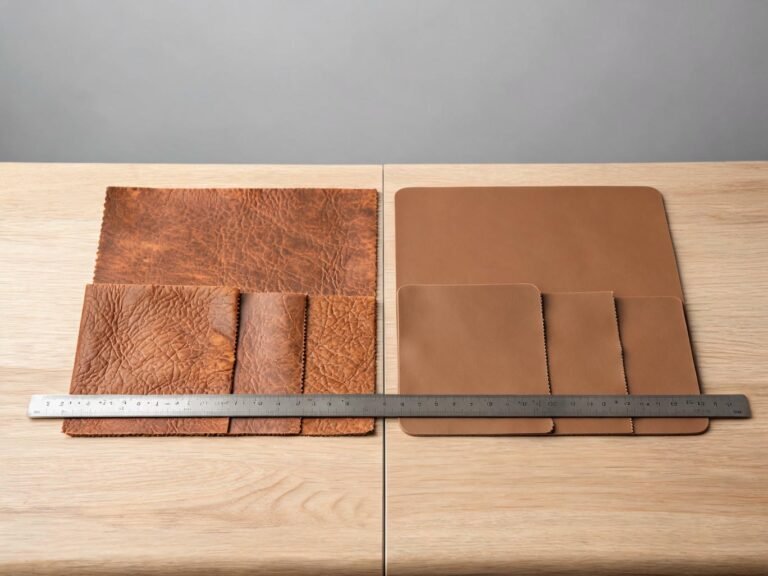
Low-cost synthetic leather suppliers often have poor process control, which means color, thickness, and even texture can vary significantly between production batches. If you’re ordering 500 yards for a furniture line and then reordering 300 yards six months later, the two batches might not match. For furniture and automotive applications where visual consistency matters, this is a serious problem. Always ask about color matching guarantees and request a “batch sample” with each reorder, not just the initial swatch.
Mistake 3: Not verifying roll yields and dimensions
Some suppliers advertise 54″ width but actually deliver 52″ usable width after trimming the selvage edges. Some short-yard rolls — a 50-yard roll might actually contain 47 yards. These discrepancies might sound small, but they add up in production. A 4% shortfall on a 1,000-yard order is 40 yards of material you paid for but can’t use. Always specify minimum usable width and length tolerances in your purchase order, and audit incoming rolls on a random basis.
Understanding MOQs for Synthetic Leather by the Yard
Minimum order quantities (MOQs) are one of the most frustrating aspects of buying synthetic leather by the yard, especially for smaller manufacturers or custom upholstery shops. Here’s how MOQs typically break down by material type and order scenario:
| Order Type | Standard MOQ | Price Premium | Lead Time |
|---|---|---|---|
| Stock color (ready to ship) | 10–50 yards | Standard price | 3–7 days |
| Custom color (standard formula) | 300–500 yards | +10–20% | 15–25 days |
| Custom texture / embossing | 500–2,000 yards | +20–40% | 25–40 days |
| Full custom formulation | 2,000–5,000 yards | +30–60% | 40–60 days |
MOQ negotiation tips:
- If you’re just below a supplier’s MOQ, ask about “end-of-roll” or “stock lot” material — many suppliers sell partial rolls at discount to clear inventory.
- For custom colors, consider ordering more than you need of a color you’ll use across multiple products — the volume discount often exceeds the carrying cost.
- Some suppliers will accept lower MOQs for first-time orders as a “trial” — you just have to ask.
- If you’re consistently ordering across multiple SKUs, combine them to hit volume pricing tiers.

Synthetic leather is produced in continuous rolls on coating lines — MOQs exist because changing colors and formulations requires production line downtime and material waste.
Where to Buy Synthetic Leather by the Yard (B2B Options Ranked)
1. Direct from Manufacturer (Best for Volume)
Buying directly from the factory gives you the lowest per-yard cost, the most control over quality, and the ability to customize formulations. The downside is higher MOQs (typically 500+ yards for custom orders) and the need to manage logistics, quality inspection, and communication yourself. Best for established manufacturers with consistent volume and the resources to audit suppliers.
2. Wholesale Distributors (Best for Mid-Volume)
Distributors stock multiple brands and materials in warehouse locations closer to your production facility. They offer lower MOQs than factories, faster delivery, and consolidated shipping across multiple materials. The price is 15–30% higher than factory-direct, but the convenience and flexibility often justify it. Good for mid-sized upholstery shops and furniture manufacturers ordering 50–500 yards at a time.
3. Online B2B Platforms (Best for Discovery)
Platforms like Alibaba, Made-in-China, and Global Sources offer access to thousands of synthetic leather suppliers. They’re great for initial market research, price comparison, and discovering new materials. However, quality is highly variable, and verifying supplier reliability takes time. Use these platforms for discovery and initial sampling, not for large production orders without a factory audit.
How to Calculate How Much Synthetic Leather You Need
Calculating yardage requirements accurately prevents both waste and shortages. Here’s the basic method for upholstery applications:
- Measure each piece — Lay out pattern pieces and calculate the total square footage required.
- Convert to linear yards — Divide total square feet by the usable width in feet (typically 4.5′ for 54″ wide material), then divide by 3 to get yards.
- Add waste factor — Pattern matching, defects, and cutting waste typically add 10–20%. Complex patterns with grain direction requirements can add 25–35%.
- Round up to full rolls — Most synthetic leather comes in 30–50 yard rolls. Round up to the nearest roll size and account for partial roll waste.
Quick example: A standard dining chair requires approximately 1.5–2 yards of 54″ wide synthetic leather. A sofa needs 10–18 yards depending on size and style. A car seat set requires 5–8 yards. Always order extra — running out mid-production and needing a reorder costs far more than the extra material.
Quality Inspection Checklist for Incoming Shipments
Never accept a shipment of synthetic leather by the yard without inspecting it first. Catching quality issues before you cut into the material saves thousands in rework costs. Here’s what to check:
- Roll length — Verify each roll’s actual length against the packing list using a measuring wheel or scale.
- Color consistency — Compare against your approved swatch under standard lighting (D65 daylight). Check both the beginning and end of each roll for color drift.
- Thickness — Spot-check thickness at multiple points across the width and length using a caliper or thickness gauge. Tolerance should be ±0.05mm for premium grades.
- Surface defects — Unroll and inspect for scratches, bubbles, pinholes, streaks, and uneven coating. Mark defect locations and deduct from the billable length.
- Backing quality — Check the base fabric for uniformity, tears, or delamination from the coating.
- Documentation — Confirm you received the correct material grade, color code, and batch number with matching test reports.

Quality inspection is non-negotiable when buying synthetic leather by the yard — catching defects before cutting saves far more than the inspection costs.
Is It Time to Upgrade from Standard PU to Silicone Leather?
If you’ve been buying standard PU synthetic leather by the yard and dealing with warranty claims, fading, or hydrolysis cracking, it might be time to evaluate silicone leather as an upgrade. Here’s the quick ROI math:
Say you currently buy premium PU at $20/yard and it lasts 5 years. Silicone leather at $35/yard lasts 12+ years. Your cost per year drops from $4.00/yard/year to $2.92/yard/year — that’s a 27% reduction in annualized material cost, plus savings from reduced warranty claims, less reupholstery labor, and better customer satisfaction. For commercial applications where replacement labor costs dwarf material costs, the savings are even more dramatic.
Not sure if silicone leather is right for your application? Explore our application guides to see where silicone leather is already replacing PU and PVC in industries like automotive, healthcare, marine, and furniture.
Get Sample Yardage for Testing
About TOPSUN
TOPSUN supplies high-performance silicone synthetic leather by the yard to B2B buyers in furniture manufacturing, automotive interiors, healthcare, marine, and consumer electronics — with flexible MOQs starting at 50 yards for standard colors, custom Pantone matching, and full technical documentation for every shipment.
MOQ from 50 yards · 40+ standard colors · Custom Pantone matching · Full TDS with every order · ISO & REACH certified