The cowhide quote for our lounge collection came back at nine dollars a square foot, and the sample hides were beautiful. What the quote didn’t say: roughly a third of every hide would end up on the cutting-room floor, the bellies stretch too much for seat panels, and no two hides in the lot matched under gallery lighting. When you specify cowhide for upholstery, you are not just buying a material — you are buying an animal-shaped geometry problem. Here is the math, the anatomy, and where roll goods quietly win.
Order Free Hide-Texture Swatches
What Cowhide for Upholstery Really Costs Per Sofa
Upholstery fabric sells by the linear yard; cowhide sells by the animal. The industry conversion bridges the two: one linear yard of 54-inch fabric equals about 18 square feet of leather to purchase, according to upholstery yield calculators. A heavily tufted 88-inch sofa runs around 16 fabric yards — 288 square feet of leather. A tight-back 84-inch club sofa needs about 15 yards, or 270 square feet. Against an average full hide of 45–55 square feet, the arithmetic starts to bite before you touch a single price list.
Now stack the losses. Only 60–75% of a hide is suitable for primary upholstery surfaces, and experienced planners add roughly 20% for the irregular shape — which is why a standard 3-cushion sofa consumes 3–4 full hides even though its panel area suggests fewer. Genuine bovine leather runs $4–12 per square foot, with cutting yields of 70–75% against 95–99% for synthetics, per procurement comparisons. Run the numbers on our own quote: at $9 quoted and 65% usable, the effective cost per square foot actually upholstered was closer to $14. Nobody prints that line on the invoice.

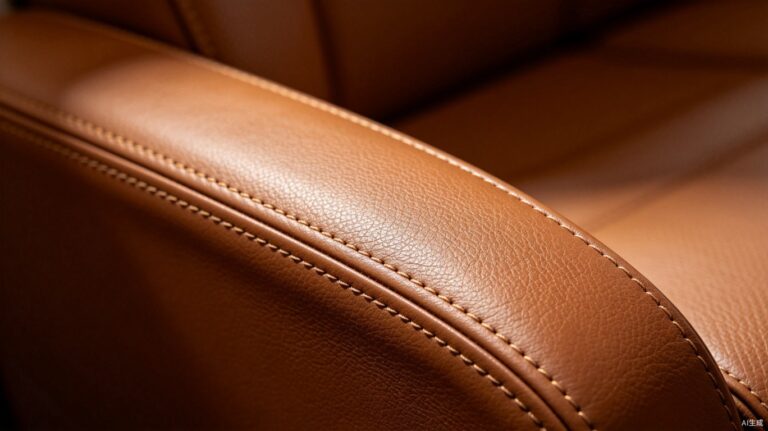
A genuine cowhide sofa photographs beautifully — the question is how many hides the cutting list consumed.
Hide Anatomy: Why Only 60–75% of a Cowhide Is Usable
Every hide is a map, and upholsterers read it the way sailors read a coast. The back and butt carry the densest fiber structure and the tightest grain — that is where seat cushions and arms get cut. The belly flanks are loose and stretchy, fine for back panels and welt but hopeless under seating loads. Then comes the biology problem: no two animals grow identical grain depth, stretch, or color, even inside a single tannery lot. Sorting and matching hides is genuinely skilled labor, and its cost is inside every genuine-leather quote whether the supplier itemizes it or not. If your program spans multiple grades, the differences between full-grain and top-grain furniture specs decide both look and lifespan — full-grain keeps the entire grain layer and ages 15–30+ years into a patina, while sanded top-grain trades a little of that for uniformity.
| Cut zone | Fiber character | Why it matters | Best upholstery use |
|---|---|---|---|
| Back & butt | Densest fibers, tightest grain | Carries seating load without stretching | Seat cushions, arms, primary panels |
| Belly | Loose, stretchy, prone to sag | Deforms under load — the classic warranty complaint | Back panels, welt cord, dust covers |
| Neck & axilla | Creased, irregular grain | Natural stretch marks read as defects on show surfaces | Secondary surfaces, accent panels |
| Leg & head areas | Small, varied pieces | Rarely large enough for panels | Piping, small trim, repairs |

Sorting by grain and color is skilled labor — and its cost sits inside every genuine-leather quote.
When Cowhide for Upholstery Wins — and When Roll Goods Do
None of this math makes genuine cowhide a bad choice. For flagship residential pieces, nothing else develops a patina, and full-grain’s 15–30 year potential is real when the piece is conditioned and lived with gently. Genuine hide is also the honest answer when the brand story requires it — no embossed substitute survives close interrogation by a luxury customer. For a deeper read on where genuine leather upholstery still earns its premium, the material’s aging behavior is the deciding evidence.
But high-volume programs flip the equation. Hide supply rides the beef and dairy cycle — leather is a byproduct, so availability and price swing with agricultural markets, not with furniture demand. Roll goods solve the three problems hides can’t: color consistency, yield, and lead time. When furniture clients ask us to replicate a specific hide’s grain depth on silicone leather, we cut a custom embossing roller in 7–10 days and hold the color to ΔE ≤ 1.0 across batches, in 1350–1800 mm widths that cut like fabric. Cutting waste doesn’t disappear on rolls — but it’s geometry-shaped, not anatomy-shaped. If you’re weighing the two constructions for seating programs, our full vs semi silicone leather primer covers the performance deltas, and the furniture and sofa application pages document how each surface performs in daily commercial use.

Roll-form leather: one grain, one color, cut like fabric — consistency manufactured instead of sorted.
How hide-inspired textures are engineered onto rolls — grain depth as a specification, not a lottery.
Frequently Asked Questions
How many cowhides does a standard sofa need?
A 3-cushion sofa typically consumes 3–4 full hides when planners assume a conservative 40 usable square feet per hide. Large tufted pieces around 88 inches run 15–16 fabric yards — 270–288 square feet — which can push the count toward 6. Order every hide as one matched lot, or the visible surfaces won’t agree with each other.
Why does upholstery leather cost more than the same fabric yardage?
Two compounding factors. The 18:1 conversion means each fabric yard requires 18 square feet of leather purchased, and only 60–75% of that purchase ends up on the furniture. Multiply the two, and your effective cost per used square foot runs roughly 1.3–1.7 times the quoted rate — before conditioning, sorting, and lot-matching labor.
Is full-grain cowhide worth it for commercial furniture?
For residential flagship pieces, often yes — the 15–30 year aging curve and patina justify it. Commercial spaces invert the logic: heavy use, cleaning chemistry, and scratch exposure punish unprotected grain, which is why most contract specifiers move to protected finishes or roll-form silicone leather with a hard-wearing embossed grain.
Do the Hide Math Before the Purchase Order
Specifying cowhide for upholstery honestly means multiplying the quoted rate by the waste premium, the lot-matching risk, and the supply cycle behind it. Sometimes the answer still says genuine hide — flagship pieces and patina stories earn their premium. When volume, color consistency, or delivery certainty dominate the brief, roll-form leather with an engineered cowhide grain solves the same design problem with none of the anatomy. Either way, ask every supplier one question before signing: what is the usable yield, per lot, in writing?
About TOPSUN
TOPSUN produces roll-form silicone upholstery leather for furniture and sofa manufacturers, including embossed cowhide-grain textures engineered to the pattern depth each collection specifies.
100+ embossed textures with custom rollers cut in 7–10 days, Pantone and RAL matching held to ΔE ≤ 1.0 across batches, 1350–1800 mm roll widths with consistent quality across the full roll, and free A4 swatches shipped worldwide.