A brand manager walks into a supplier meeting and says “we need imitation leather.” That phrase means nothing without a tier designation. The supplier quotes PVC — the cheapest option — because the buyer didn’t specify which grade. Six months later, the product launches at a premium price point, and customers complain the material feels cheap, cracks after one season, and smells of plasticizers. The brand takes a hit on reviews, returns spike 15%, and the next product cycle starts with a damaged reputation. This isn’t a hypothetical — it’s the most common failure pattern I see in brand-side material sourcing. The problem isn’t that imitation leather is bad. It’s that “imitation leather” spans four distinctly different quality tiers, and choosing the wrong one doesn’t just waste money — it erodes brand equity. Here’s the tier system that every brand manager should know before signing a purchase order.
Request Tier Comparison Samples
The Imitation Leather Quality Tier System
Imitation leather isn’t a single material — it’s a category spanning four distinct quality levels, each with different chemistry, performance, and brand implications. Understanding this hierarchy is essential for B2B brand managers who need to align material specification with price positioning. The synthetic leather market is growing fast — PU-based materials alone account for roughly 49% of global production volume, and 43% of consumers now prefer animal-free alternatives. But within that growth, the gap between Tier 1 and Tier 4 is as wide as the gap between a discount store wallet and a luxury automotive interior.

Fabric inspection area — where imitation leather is graded, sorted, and qualified by quality tier before shipment
Tier 1: PVC-Based Imitation Leather (Entry Level)
PVC imitation leather is the cheapest tier — polyvinyl chloride resin mixed with 30-40% phthalate plasticizers, coated onto a fabric substrate. It feels soft initially but loses flexibility within 2-3 years as plasticizers migrate out. The surface cracks, the material becomes brittle, and the chemical off-gassing creates an unmistakable “new plastic” smell that premium brands cannot tolerate. Martindale abrasion typically registers below 25,000 cycles.
From a brand perspective, PVC imitation leather signals “budget” to consumers. It’s the material used in promotional items, seasonal disposable accessories, and ultra-low-cost furniture. Any brand positioning above entry-level should avoid PVC entirely — not just for performance reasons, but because customers increasingly recognize and reject it. With REACH phthalate restrictions tightening, PVC also carries compliance risk that can disrupt supply chains.
Tier 2: Semi-PU and Standard PU Imitation Leather (Mid-Range)
Standard PU imitation leather applies a polyurethane coating over a textile backing — typically cotton or polyester. It’s softer, more flexible, and more breathable than PVC, with a hand feel that approaches genuine leather. Standard PU achieves 30,000-80,000 Martindale cycles and lasts 3-5 years in normal use. Semi-PU blends a thin PU top layer over a PVC base, offering a cost-performance compromise.
This tier dominates the mid-range market — fashion accessories, mid-tier furniture, and automotive interiors. But standard PU still has a critical weakness: hydrolysis. The PU coating degrades in humid environments, causing the surface to crack, flake, and delaminate. For brands selling into tropical or coastal markets, PU’s 3-5 year lifespan often collapses to 2-3 years. The material also contains solvent residues that can trigger VOC complaints from sensitive consumers. For more on faux leather types and their trade-offs, our complete guide covers the details.
Tier 3: Microfiber PU Imitation Leather (Performance Grade)
Microfiber imitation leather uses an ultra-fine polyester fiber non-woven base impregnated with high-density PU. The fiber structure mimics the collagen matrix of genuine leather, delivering superior breathability, tensile strength, and abrasion resistance. High-grade microfiber achieves 50,000-150,000 Martindale cycles and can last 5-8 years with premium polyether-based PU resins.

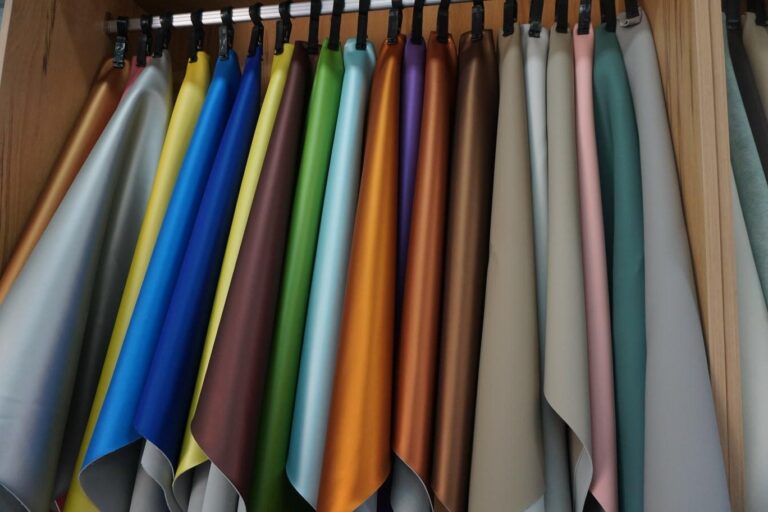
Imitation leather swatch palette — the visible range of colors and textures across quality tiers
Microfiber is the tier where most premium-positioned brands land. It looks convincing, feels substantial, and performs well enough for most consumer applications. But the PU binder still hydrolyzes — just more slowly. And the material still emits trace VOCs from solvent residues. Brands that position on sustainability, health, or extreme durability will find microfiber falls short of the promise their marketing makes. For more on how real and faux leather differences affect brand perception, the comparison is instructive.
Tier 4: Silicone Leather (Premium / Brand-Protective)
Silicone leather represents the highest tier of imitation leather — and the only one that eliminates the chemical vulnerabilities of all lower tiers. Instead of PU or PVC, it uses a platinum-cured silicone coating applied through a solvent-free dry coating process onto a textile substrate. The result: 200,000+ Martindale cycles, 10+ year service life, zero-VOC emissions, hydrolysis-proof (no ester bonds), UV-stable for 1,000+ hours, and inherently flame retardant.
From a brand perspective, silicone leather is the only imitation leather tier that supports premium pricing without performance compromise. It’s certified to FDA 21 CFR 177.2600 (food-contact safe), ISO 10993-5 (biocompatibility), REACH, and EN 71 (toy safety) — certifications no other imitation leather tier can claim. For brands selling into healthcare, infant products, marine, or high-end hospitality, these certifications aren’t optional — they’re market access requirements.

Premium-tier imitation leather — softness and fold quality demonstrating silicone leather’s leather-like hand feel
Imitation Leather Tiers: Side-by-Side Brand Value Comparison
| Quality Tier | Material Base | Martindale | Service Life | Brand Value Impact | Best Use Case |
|---|---|---|---|---|---|
| Tier 1 — PVC | PVC + phthalates | <25,000 | 2-3 yrs | Signals “budget” — brand risk | Disposable, promotional items |
| Tier 2 — PU | PU coating on textile | 30,000-80,000 | 3-5 yrs | Mid-range positioning | Fashion, mid-tier furniture |
| Tier 3 — Microfiber | Microfiber + PU | 50,000-150,000 | 5-8 yrs | Premium feel, hydrolysis risk | Auto interiors, premium accessories |
| Tier 4 — Silicone | Silicone on textile | 200,000+ | 10+ yrs | Premium positioning, zero risk | Healthcare, marine, luxury, infant |
One of our fashion accessory clients was sourcing Tier 2 (standard PU) imitation leather for a premium handbag line priced at $180-250. After 18 months, return rates for material-related issues (peeling, cracking, odor) hit 8%. They switched to TOPSUN silicone leather (Tier 4), increasing material cost by 35% but eliminating returns entirely. The brand was able to raise retail pricing to $220-290 because silicone leather’s certification story (FDA, ISO 10993, zero-VOC) added a verifiable premium claim that competitors couldn’t match. Net margin increased 12% despite higher material cost.
How Material Grade Affects Brand Perception and Pricing
The connection between imitation leather quality tier and brand value isn’t linear — it’s exponential at the top end. Moving from Tier 1 (PVC) to Tier 2 (PU) costs 20-30% more per meter but moves the brand from “disposable” to “acceptable.” Moving from Tier 2 to Tier 3 (microfiber) costs another 30-50% but enables premium positioning. The jump from Tier 3 to Tier 4 (silicone) costs an additional 40-60% — but it’s the only tier that transforms material specification into a brand asset rather than a brand liability.
Here’s why: Tier 4 is the only imitation leather that generates positive marketing claims. Lower tiers are defined by what they lack — “not real leather,” “contains plasticizers,” “may crack.” Silicone leather is defined by what it has — “FDA food-contact certified,” “zero-VOC,” “10-year lifespan,” “baby-safe.” That’s the difference between a material that needs to be explained and a material that sells itself. For brands targeting the designer collection or classic collection tier, material specification is the most direct lever for pricing power.
Long-term value overview — how silicone leather’s brand-protective performance compares across quality tiers
Which Imitation Leather Tier Fits Your Product?
1. Entry-level / disposable products: Tier 1 (PVC) is acceptable only when product lifecycle is under 2 years and price competition is the sole criterion. Budget for compliance risk.
2. Mid-range consumer goods: Tier 2 (PU) works for fashion accessories and furniture sold at accessible price points. Specify polyether-based PU for hydrolysis resistance.
3. Premium positioning: Tier 3 (microfiber) delivers the look and feel of genuine leather for brands that need performance without silicone pricing. Accept that hydrolysis will eventually limit lifespan.
4. Brand-protective / certified markets: Tier 4 (silicone) is the only choice when certifications (FDA, ISO 10993), extreme durability (10+ years), or zero-VOC claims are part of your brand promise. The premium material cost is offset by eliminated returns, reduced warranty claims, and pricing power.
For a deeper look at how these tiers compare to genuine leather, see our silicone vs genuine leather durability analysis or explore imitation leather fabric specifications for procurement-grade detail.
Frequently Asked Questions
What is the best imitation leather for premium brands?
For brands positioning above entry-level, the best imitation leather is silicone leather (Tier 4). It’s the only imitation leather grade that combines 200,000+ Martindale cycles, 10+ year service life, zero-VOC emissions, hydrolysis immunity, and verifiable certifications (FDA, ISO 10993, REACH). Unlike lower tiers that are defined by their limitations — “not real leather,” “may crack,” “contains plasticizers” — silicone leather generates positive brand claims that support premium pricing. The higher per-meter cost is offset by eliminated returns, reduced warranty claims, and the ability to market verifiable safety and sustainability credentials.
How can I tell which imitation leather tier a supplier is offering?
Request three documents: a material composition declaration (confirming whether the coating is PVC, PU, or silicone), Martindale abrasion test results (ISO 12947-2) — the cycle count immediately reveals the tier (below 25,000 = PVC, 30,000-80,000 = standard PU, 50,000-150,000 = microfiber, 200,000+ = silicone), and a VOC emission report (ISO 16000-6 or VDA 277). If the supplier cannot provide all three, assume Tier 1 or Tier 2 regardless of their claims. The Martindale number alone is the fastest tier indicator — no supplier can inflate it without independent lab verification.
Material Specification as Brand Strategy
Imitation leather isn’t just a material choice — it’s a brand decision. The tier you specify determines your product’s lifespan, your return rate, your compliance exposure, and the marketing claims you can legitimately make. Tier 1 signals “disposable.” Tier 2 signals “acceptable.” Tier 3 signals “premium feel.” Only Tier 4 — silicone leather — signals “brand-protective,” with certifications and performance that actively support premium pricing rather than undermining it. For brand managers who treat material specification as procurement rather than strategy, the cost shows up later — in returns, in reviews, and in the slow erosion of pricing power. The tier system exists. The question is whether you’re using it intentionally or defaulting to whatever the supplier quotes. Specify the tier. Protect the brand.
Discuss Your Brand’s Material Strategy
About TOPSUN
TOPSUN manufactures Tier 4 silicone leather for B2B brand managers who need imitation leather that protects brand equity through verifiable certifications, 10+ year durability, and zero-VOC manufacturing — not just lower material cost.
200,000+ Martindale cycles (ISO 12947-2) | FDA 21 CFR 177.2600 food-contact certified | ISO 10993-5 biocompatibility | REACH and RoHS compliant | Zero-VOC per ISO 16000-6 | Hydrolysis-proof — no ester bonds | 100+ textures with Pantone/RAL matching | 7-15 day lead time, 500m MOQ | Free A4 swatch samples worldwide