Red leather fabric is the most warranty-claim-prone color in the entire synthetic leather industry. Of all pigments used in coated fabrics, red is the most photochemically unstable — the conjugated double bonds in red dye molecules absorb UV radiation and break down faster than any other color. An automotive interior specified in red PU leather can show visible ΔE shifts within 6 months of sun exposure. A furniture brand that launched a red sofa line told us they received more color-fade complaints in 90 days than for all other colors combined in a full year.
If you’re sourcing red leather fabric for B2B applications — automotive interiors, furniture, hospitality, or fashion accessories — color fastness isn’t optional. It’s the single specification that determines whether your product looks premium at month 3 or looks like a faded display model. This article breaks down the testing standards, ΔE thresholds, and material science that procurement teams need to specify red leather fabric that stays red.
Request Red Leather Fabric Samples

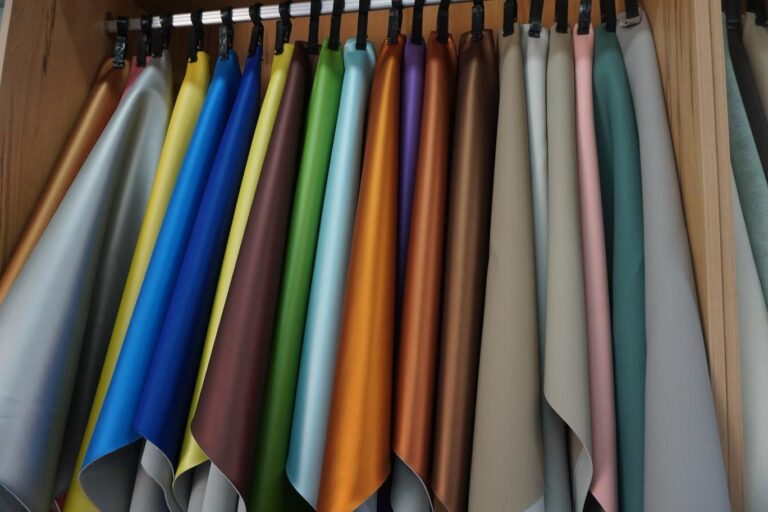
Red silicone leather — the pigment chemistry that determines whether this color holds for years or months
Why Red Fades: The Photochemistry Behind Color Degradation
Red pigments — whether azo dyes, anthraquinone reds, or quinacridone reds — share a molecular structure with extended conjugated double bond systems. These systems absorb light in the blue-green region of the spectrum, which is why we perceive them as red. But the same electronic structure that makes red pigments absorb visible light also makes them absorb UV radiation, which carries enough energy to break chemical bonds in the dye molecule. When UV photons break these bonds, the pigment molecule changes structure, and the reflected color shifts.
In conventional PU and PVC synthetic leather, red dye is dispersed into the polyurethane or PVC coating layer. When UV light penetrates the coating, the dye degrades — and because the coating itself also undergoes UV-induced degradation (yellowing, embrittlement), the color shift compounds. The result: a red that shifts toward orange, pink, or brown within months of installation in sun-exposed environments.
This is why a red car interior exposed to daily sunlight through windshield glass shows fading within 12-18 months for PU leather, while beige or gray interiors in identical conditions show minimal change. For more on how different colors perform in automotive applications, see our analysis of black leather fabric thermal fading and blue faux leather color stability.
The UV-color paradox: The most vibrant reds require the longest conjugated molecular chains — which are also the most UV-vulnerable. A brighter, more saturated red means a more fragile pigment molecule. This is why specifying “red” without color fastness requirements is a procurement failure.
Color Fastness Standards Every B2B Buyer Must Specify
Color fastness isn’t a marketing claim — it’s a measurable, testable property with international standards behind it. When specifying red leather fabric, your PO should reference at minimum the following test methods and acceptance criteria:
| Test Standard | What It Measures | Acceptance for Red Leather | Silicone Leather Result |
|---|---|---|---|
| ISO 105-B06 | Color fastness to artificial light (xenon arc) | Grade 4+ (min.) | Grade 4–5 |
| SAE J2412 | Automotive interior material UV aging | ΔE ≤ 3.0 after 1,000 hrs | ΔE ≤ 1.5 |
| ISO 105-X12 | Rubbing fastness (dry + wet) | Grade 4+ (dry), Grade 3+ (wet) | Grade 4–5 (dry), Grade 4 (wet) |
| ASTM G154 | UV resistance (fluorescent UV) | No visible change at 1,000 hrs | 1,000+ hrs, no change |
The critical metric is ΔE (Delta E) — the total color difference between the original and aged sample, measured with a spectrophotometer. A ΔE of 1.0 or below is imperceptible to the human eye. A ΔE of 3.0 is clearly visible as a different shade. For automotive interiors, SAE J2412 is the benchmark — if your supplier can’t provide a test report showing ΔE after 1,000 hours of xenon arc exposure, you’re buying on hope, not data.

Color fastness tester — where ΔE numbers replace subjective color judgments
Pantone Matching and Batch Consistency for Red Leather Fabric
Color fastness determines whether red stays red over time. Color matching determines whether red is the right red on day one. For B2B manufacturers producing furniture lines, automotive interior kits, or branded retail displays, the initial color match must be precise and repeatable across every production batch.
At TOPSUN, red leather fabric is matched to Pantone or RAL references with ΔE ≤ 1.0 accuracy — measured by spectrophotometer, not by eye. This means the red you approve in the sample stage is the red you receive in production batch 1, batch 10, and batch 50. Our color customization process uses automated pigment dispensing on 10+ automated production lines, eliminating the human variation that causes batch-to-batch drift.
Why does this matter? A furniture OEM producing a 5,000-unit red sofa order doesn’t just need one roll of red leather fabric — they need 50+ rolls, and if the shade shifts between rolls, the finished sofas won’t match in a showroom. One European furniture brand we supply was previously rejecting 15% of their red PU leather deliveries for being “too orange” or “too dark” — because their supplier mixed pigment manually and couldn’t control ΔE below 3.0. After switching to our spectrophotometer-verified matching, rejection rate dropped to zero.

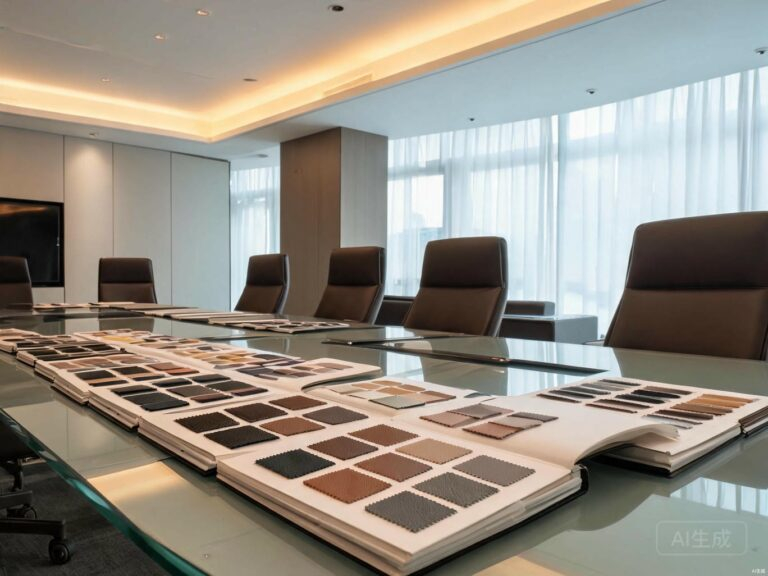
Pantone-matched red leather samples — ΔE ≤ 1.0 verified before production approval
Silicone vs PU vs PVC: Red Color Retention Comparison
The material matrix matters as much as the pigment choice. Silicone chemistry provides inherent UV stability that PU and PVC cannot match. Here’s how the three dominant synthetic leather materials perform when dyed red and exposed to identical UV aging conditions:
| Material | UV Hours to Visible Fade | ΔE after 1,000 hrs (SAE J2412) | Surface Degradation |
|---|---|---|---|
| PVC leather (red) | 200–400 hrs | 5.0–8.0 | Cracking + yellowing |
| PU leather (red) | 400–600 hrs | 3.5–6.0 | Yellowing + gloss loss |
| Silicone leather (red) | 1,000+ hrs | ≤ 1.5 | No visible change |
The difference is chemistry, not quality control. Silicone’s Si-O backbone is inherently UV-stable — UV photons at wavelengths encountered in real-world conditions don’t carry enough energy to break Si-O bonds. Polyurethane’s C-O and C-N bonds are more susceptible. PVC plasticizers migrate and degrade under UV, causing both color shift and surface cracking. When the matrix degrades, the pigment it holds degrades with it — regardless of pigment quality.
Procurement reality check: A supplier offering “UV-stable red PU leather” is selling an additive — typically a UV absorber (benzotriazole or HALS) mixed into the PU coating. These additives deplete over time. Silicone leather’s UV resistance is intrinsic to the polymer itself — it doesn’t deplete because there’s nothing to deplete.
Color fastness test — red silicone leather vs PU after accelerated UV exposure
Applications Where Red Leather Fabric Demands Highest Color Stability
Not every red leather fabric application faces the same UV exposure risk. But several B2B use cases demand maximum color fastness — and in each, the cost of fading is measurable in warranty claims, brand damage, and replacement logistics:
• Automotive interiors: Dashboard, door panel, and seat trim in red face direct sunlight through glass — the worst-case UV environment. Automotive OEMs require SAE J2412 compliance with ΔE ≤ 3.0, and many specify ≤ 2.0 for premium programs.
• Hospitality furniture: Hotel lobby sofas, restaurant booth seating, and bar stools in red are high-visibility branding elements. Fading red in a luxury hotel lobby signals neglect — and triggers reupholstery cycles that a durable material would eliminate.
• Retail and display: Visual merchandising uses red as an attention color — window displays, store fixtures, and branded seating. Color consistency across multiple store locations requires batch-to-batch ΔE control, not just initial color match.
• Fashion accessories: Red handbag covers, device cases, and wearables demand rub fastness (ISO 105-X12) in addition to UV stability — the red must survive both light exposure and daily contact transfer.
For automotive applications specifically, our silicone automotive leather meets both FMVSS 302 flame retardancy and SAE J2412 color fastness requirements — a combination that PU and PVC struggle to achieve simultaneously. For furniture and hospitality, the Classic Collection delivers the same color stability in thicknesses from 0.8mm to 2.0mm.
FAQ: Red Leather Fabric Color Stability
How long does red leather fabric last before fading?
It depends entirely on the material. Red PU leather typically shows visible color shift (ΔE > 3.0) after 400-600 hours of accelerated UV exposure — equivalent to 6-12 months in a sun-exposed automotive interior. Red PVC leather fades even faster, at 200-400 hours. Red silicone leather shows ΔE ≤ 1.5 after 1,000+ hours — imperceptible to the human eye, equivalent to years of real-world sun exposure.
Can UV absorber additives make red PU leather as stable as silicone?
No — they extend the timeline but don’t match silicone’s inherent stability. UV absorbers (benzotriazoles, HALS) work by absorbing UV energy before it reaches the pigment. But these additives migrate, evaporate, and deplete over time — typically within 2-3 years of real-world exposure. Once the additive is consumed, the underlying PU and its pigments degrade at the same rate as untreated PU. Silicone’s UV resistance comes from the polymer backbone itself (Si-O bonds), which doesn’t deplete.
Stop Specifying Red Without Test Data
Red leather fabric is a procurement decision where aesthetics and durability intersect at the molecular level. The pigment chemistry, the polymer matrix, and the testing standards all determine whether your red product looks premium for years or generates warranty claims within months. Specify ISO 105-B06 grade 4+, SAE J2412 ΔE thresholds, and ASTM G154 exposure hours on your PO — and require batch-specific test reports. If your supplier can’t provide them, the red you see today isn’t the red your customers will see next year.
Silicone leather eliminates the color degradation variable at the polymer level. For B2B applications where red must stay red — automotive, hospitality, retail, fashion — the material science points one direction. For related color stability insights, see our analysis of blue leather fabric and our guide on thermal fading in leather fabric.
Get Fade-Proof Red Leather Samples
About TOPSUN
TOPSUN manufactures silicone leather with inherent UV stability for red leather fabric applications — delivering ΔE ≤ 1.5 after 1,000+ hours of SAE J2412 accelerated aging, Pantone-matched color accuracy with ΔE ≤ 1.0, and batch-to-batch consistency verified by spectrophotometer for automotive, furniture, and retail B2B brands.
UV-stable red · ISO 105-B06 Grade 4–5 · SAE J2412 ΔE ≤ 1.5 · Pantone/RAL matching · ΔE ≤ 1.0 accuracy · 1,000+ hrs no fading · 200,000+ Martindale cycles · ISO 10993 certified · 500,000+ m monthly capacity