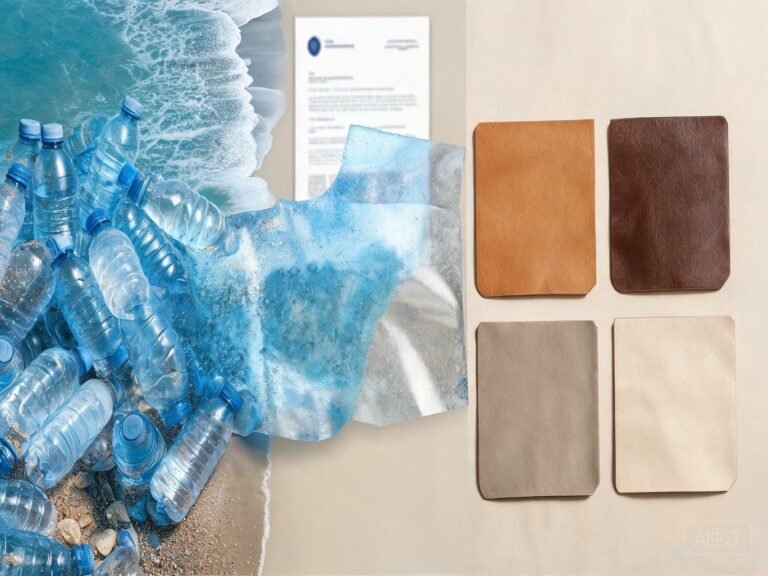
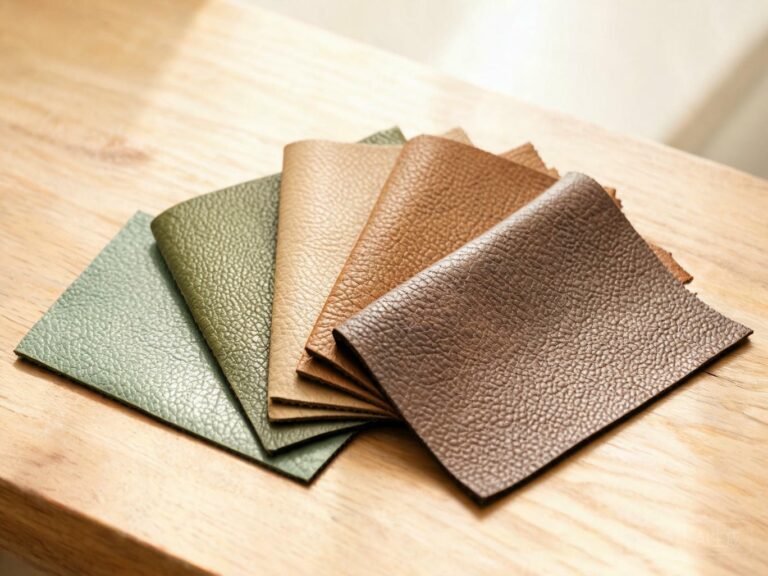
“Ocean bound plastic leather” sounds like a complete sustainability solution — leather made from plastic rescued from the ocean. The reality is more specific, and more complicated. Ocean bound plastic (OBP) certification covers plastic waste collected within 50 kilometers of coastlines or from waterways flowing into oceans. When this plastic becomes “leather,” it typically appears as the fabric backing — the polyester substrate underneath the coating. The coating on top, the part you actually see and touch, is usually still conventional polyurethane. So a product labeled “ocean bound plastic leather” may be 40% recycled ocean plastic and 60% petroleum-derived polyurethane.
This article examines the OBP certification chain, explains the backing-versus-coating material split that most marketing doesn’t disclose, and shows how silicone leather combined with OBP-certified backing fabric creates the only genuinely circular synthetic leather — where both the coating and the substrate are sustainable.
Request Ocean Bound Plastic Leather Samples

Fabric backing rolls — where ocean bound plastic enters the synthetic leather supply chain, as recycled PET substrate
What Ocean Bound Plastic Certification Actually Covers
Ocean Bound Plastic (OBP) certification is administered by Zero Plastic Oceans (ZPO) and verified by third-party bodies including SCS Global Services. The certification covers the collection, processing, and chain of custody of plastic waste that meets specific geographic criteria — collected within 50 km of coastlines or from rivers and waterways that transport plastic to the ocean. The certification doesn’t cover what happens to the plastic after it’s collected — only that it was genuinely collected from qualifying locations and tracked through the supply chain.
| Certification Layer | What It Verifies | What It Doesn’t Verify |
|---|---|---|
| OBP Collection | Plastic collected within 50 km of coastline/waterways | What the plastic is used for after collection |
| GRS (Global Recycled Standard) | Recycled content percentage + chain of custody | Environmental impact of the coating material |
| TC (Transaction Certificate) | Batch-level traceability from collector to manufacturer | The non-recycled portion of the finished material |
The critical gap: none of these certifications verify the coating material. A synthetic leather with OBP-certified recycled PET backing and a polyurethane coating can carry the “ocean bound plastic” label — but the PU coating, which represents 40–60% of the finished material by weight, is virgin petroleum plastic that will hydrolyze, shed microplastics, and end up in a landfill. The OBP certification covers the backing; the coating is unverified. For B2B buyers, understanding this split is essential for credible sustainability reporting. See our related analysis of environmentally friendly fabrics for broader context.
The 40-60 problem: In a typical “ocean bound plastic leather” product, the recycled PET backing fabric accounts for 40–50% of material weight. The polyurethane coating — the surface you see, touch, and that determines the product’s lifespan and end-of-life pathway — accounts for the remaining 50–60%. The ocean plastic is in the layer you don’t see; the petroleum plastic is in the layer that fails first.
How Ocean Bound Plastic Enters the Leather Supply Chain
The journey from ocean-bound waste to leather backing involves multiple processing stages, each adding cost and complexity. Here’s the supply chain path:
• Collection: Plastic waste (primarily PET bottles and fishing nets) is collected from coastal zones within 50 km of shorelines or from river systems. Collection is typically done by local communities or organized collection programs, with GPS-tagged batch documentation.
• Sorting and cleaning: Collected plastic is sorted by type (PET, HDPE, nylon), washed to remove salt, sand, and organic contamination, and shredded into flakes. Ocean-sourced plastic requires more intensive washing than land-based recycling due to salt contamination and marine biofouling.
• Pelletizing and spinning: Cleaned flakes are melted and extruded into pellets, then melted again and spun into polyester yarn. Each ton of recycled PET yarn saves approximately 6 tons of petroleum and diverts plastic from marine environments.
• Weaving into fabric: The recycled polyester yarn is woven or knitted into fabric substrates — the backing material that will receive the silicone coating. This fabric is functionally identical to virgin polyester fabric in strength, weight, and dimensional stability.
• Coating: The OBP-certified fabric backing is coated with either polyurethane (conventional) or silicone (TOPSUN’s process). This is the decision point that determines whether the finished material is partially sustainable (OBP backing + PU coating) or fully circular (OBP backing + silicone coating).

Base fabric unwinding — where the recycled PET backing meets the silicone coating line
Silicone + OBP: The Only Fully Circular Synthetic Leather
When TOPSUN coats an OBP-certified recycled PET backing with silicone, the finished material achieves circularity on both layers:
• Backing layer (fabric): OBP-certified recycled polyester — diverts plastic from marine environments, certified chain of custody from collection point to finished fabric.
• Coating layer (silicone): Silicone polymer derived from silica (sand) — not petroleum, no plasticizers, no solvents, zero VOC, inherently UV-stable, 100% recyclable through mechanical/thermal processes.
No other synthetic leather combination achieves this. OBP + PU coating means the backing is recycled but the coating is petroleum plastic that will hydrolyze and end up in landfill. OBP + PVC is worse — the PVC coating introduces chlorine, phthalates, and dioxins. Only OBP + silicone means both layers are either recycled (backing) or inherently sustainable (coating), and both layers have viable end-of-life pathways. For more on the broader circular economy framework, see our silicone leather circular economy analysis and our eco-friendly silicone leather page.
| Material Combination | Backing Circularity | Coating Circularity | Overall Rating |
|---|---|---|---|
| OBP PET + PU coating | Recycled (certified) | Petroleum (not recyclable) | Partial |
| OBP PET + PVC coating | Recycled (certified) | Petroleum + chlorine | Poor |
| Virgin PET + silicone | Virgin petroleum | Sustainable (silica-based) | Partial |
| OBP PET + silicone | Recycled (certified) | Sustainable (silica-based) | Fully circular |
B2B Procurement: Verification Checklist for Ocean Bound Plastic Leather
If your brand is sourcing “ocean bound plastic leather,” here’s what to verify before accepting the sustainability claim:
• 1. OBP certification with batch numbers: Request the OBP certificate from the backing fabric supplier, with transaction certificates (TC) matching your purchase order batch. Without TC-level traceability, the OBP claim is unverifiable.
• 2. Coating material disclosure: Ask: “What is the coating material, and what percentage of finished weight does it represent?” If the answer is polyurethane, your “ocean bound” material is still majority petroleum plastic by weight.
• 3. GRS certification scope: GRS covers recycled content — verify that the scope includes the specific product you’re buying, not just the supplier’s overall certification. GRS requires ≥ 20% recycled content for the “recycled” label; ask what percentage your material actually contains.
• 4. End-of-life pathway for both layers: Can the backing be recycled? Can the coating be recycled? If only one layer has a viable recycling pathway, the material is partially circular — not fully circular.
• 5. ISO 14001 environmental management: The manufacturer should hold ISO 14001 certification for their production facility — verifying that the environmental management extends beyond raw material sourcing to production processes.
Eco-certifications — the verification framework behind credible ocean bound plastic claims
FAQ: Ocean Bound Plastic Leather
Is ocean bound plastic leather actually sustainable?
It depends on the coating. If the backing is OBP-certified recycled PET and the coating is polyurethane, the material is partially sustainable — the backing diverts ocean plastic, but the coating is still petroleum plastic that will hydrolyze and end up in landfill. If the coating is silicone, the material is fully circular — both layers are either recycled or inherently sustainable. Always ask for the coating material disclosure alongside the OBP certificate.
What percentage of ocean bound plastic leather is actually from the ocean?
Typically 30–50% by weight — the backing fabric portion. The coating (50–70% by weight) is usually virgin polyurethane or PVC. GRS certification requires a minimum of 20% recycled content for the “recycled” label. Always verify the actual percentage in your specific material, not the marketing claim. The most meaningful metric is what percentage of the total material weight is either recycled or inherently sustainable — and for silicone + OBP combinations, that figure is 100%.
Verify Both Layers — Not Just the Label
Ocean bound plastic leather is a positive development in the synthetic leather industry — it diverts plastic from marine environments and creates economic incentives for coastal cleanup. But the label alone doesn’t tell the full material story. A product with OBP backing and PU coating is better than one with virgin backing and PU coating — but it’s not a complete sustainability solution. Silicone leather coated on OBP-certified backing is the combination that achieves circularity on both layers: recycled ocean plastic in the backing, inherently sustainable silica-based polymer in the coating, and viable recycling pathways for both. For B2B brands building credible ocean plastic programs, specifying the coating material is as important as certifying the backing origin. For more on sustainable material combinations, see our analysis of environmentally friendly fabric standards.
Get Fully Circular Leather Samples
About TOPSUN
TOPSUN manufactures silicone leather that can be specified with OBP-certified recycled PET backing fabric — creating the only fully circular synthetic leather where both the backing (recycled ocean-bound plastic) and the coating (silica-based silicone polymer) are either recycled or inherently sustainable, with viable recycling pathways for both layers, for B2B brands requiring verifiable material provenance and complete end-of-life circularity.
OBP-compatible backing · 100% recyclable silicone coating · Zero VOC · Solvent-free · GRS-compatible · ISO 14001 · REACH · FDA · 10+ year lifespan · 500,000+ m monthly capacity