“I need 500 yards of leather.” This sentence means something fundamentally different depending on whether the buyer is sourcing genuine leather hides or synthetic leather rolls. A yard of genuine leather is a cut from an irregularly shaped hide with natural defects, thickness variations, and 20–30% waste. A yard of synthetic leather is a straight cut from a continuous roll with consistent width, thickness, and near-zero waste. Both are called “a yard” — but the usable area, the cost per usable square foot, and the production planning reality diverge dramatically.
This article breaks down the unit economics of buying leather by the yard — genuine vs synthetic — and provides the calculation framework that production planners need to compare true costs per usable area, not per nominal yard.

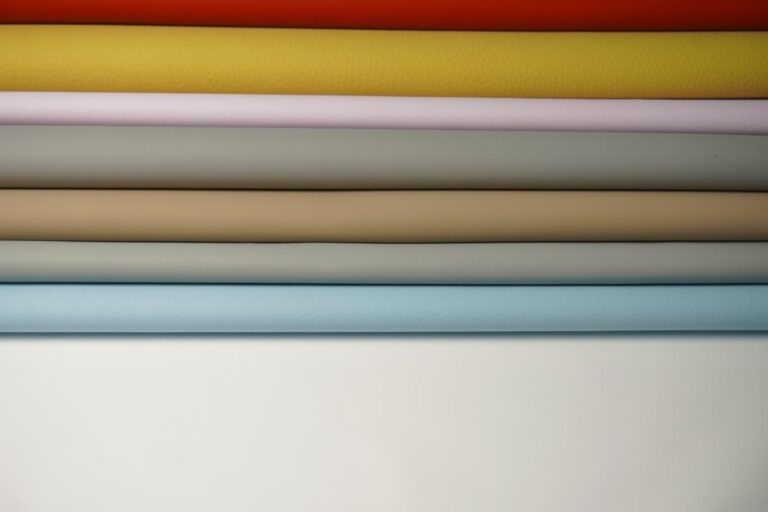
Finished leather rolls — continuous, consistent, zero-waste cutting from edge to edge
What Is a Leather Yard? The Measurement That Means Two Things
In the leather industry, a “yard” is a unit of area measurement — specifically, one square yard (36 inches × 36 inches = 0.836 square meters). But how that yard is delivered depends entirely on the material source:
• Genuine leather (hide-based): A “yard” of genuine leather is cut from an animal hide — an irregularly shaped piece of skin that varies in thickness, grain density, and surface quality across its area. A standard cowhide yields approximately 45–55 square feet (5–6 square yards) of material, but only 60–80% of that area is usable for production. The remaining 20–40% consists of belly edges, neck wrinkles, brand marks, insect bites, and other natural defects that require cutting around or downgrading.
• Synthetic leather (roll-based): A “yard” of synthetic leather is a straight cut from a continuous roll. The roll has a standard width — typically 54 inches (137 cm) for furniture and fashion applications, or 1350–1800 mm for industrial applications. One linear yard of a 54-inch-wide roll equals 1.5 square yards (1,944 square inches). The usable area is 95%+ because there are no natural defects, no thickness variations, and no grain inconsistency. What you order is what you cut.
| Metric | Genuine Leather (per hide) | Synthetic Leather (per roll) |
|---|---|---|
| Total area | ~45–55 sq ft (5–6 sq yd) | 50+ linear yards at 54″ width |
| Usable area | 60–80% (natural defects) | 95%+ (no defects) |
| Thickness variation | ±0.2–0.5mm across hide | ±0.05mm across roll |
| Color consistency | Variable (each hide unique) | Consistent (ΔE ≤ 1.0 for silicone) |
| Waste buffer needed | 20–30% extra for pattern matching | 5% for cutting efficiency |
The yield illusion: If your production planner orders “500 yards of genuine leather” and “500 yards of synthetic leather” for the same product line, the genuine leather order will yield approximately 350–400 usable yards after waste, while the synthetic order will yield 475+ usable yards. The PO says 500 yards in both cases — but the production output differs by 20–35%. This is why material consumption forecasts based on nominal yardage are consistently wrong for genuine leather.
True Cost Per Usable Yard: The Calculation Buyers Should Run
The per-yard price quoted by a supplier is the nominal cost — what you pay per yard of material as ordered. The true cost is per yard of material that actually ends up in a finished product. Here’s how to calculate it:
• True Cost = Nominal Price ÷ Usable Yield
For genuine leather at $20/yard with 70% usable yield: True cost = $20 ÷ 0.70 = $28.57 per usable yard.
For synthetic leather at $12/yard with 95% usable yield: True cost = $12 ÷ 0.95 = $12.63 per usable yard.
The gap widens further when you account for the waste buffer: ordering 500 usable yards of genuine leather requires purchasing 650–715 nominal yards (at 70–77% yield), while 500 usable yards of synthetic requires only 526 nominal yards. The procurement budget — and the warehouse space, and the freight cost — scales with nominal yardage, not usable yardage. See our leather factory supplier guide for more on evaluating supplier pricing.
| Material | Nominal Cost/Yard | Usable Yield | True Cost/Usable Yard | Yards to Order for 500 Usable |
|---|---|---|---|---|
| Genuine (full-grain) | $25–50 | 70% | $35.71–71.43 | 715 |
| Genuine (split) | $8–18 | 75% | $10.67–24.00 | 667 |
| PVC leather | $1.5–3 | 95% | $1.58–3.16 | 526 |
| PU leather | $3–6 | 95% | $3.16–6.32 | 526 |
| Silicone leather | $8–15 | 97% | $8.25–15.46 | 515 |
The true cost comparison reveals that genuine full-grain leather is 2.3–4.6× more expensive per usable yard than silicone leather — not the 2–3× that nominal pricing suggests. When procurement teams compare nominal yardage prices without adjusting for yield, they consistently underestimate genuine leather’s true cost and overestimate synthetic leather’s premium. For more on factory-level production economics, see our factory production overview.
Roll Width and Pattern Nesting: The Hidden Efficiency Variable
Beyond yield, the roll width determines how efficiently patterns can be nested — and this varies by material. TOPSUN produces silicone leather in widths from 1350 mm to 1800 mm (53–71 inches), which covers the standard 54-inch specification for furniture and fashion applications while also accommodating wider industrial requirements. Wider rolls mean fewer seams, less edge waste, and higher pattern nesting efficiency — especially for large-format products like sofa upholstery or automotive door panels.
Genuine leather hides have a maximum usable width of approximately 48 inches at the butt (the widest section along the spine), tapering to 24–30 inches at the belly. This means any pattern wider than 48 inches requires seam joining — which adds labor cost, creates visible seam lines, and reduces yield further. Synthetic leather rolls at 54+ inches accommodate wider patterns without joining, reducing both material waste and labor cost per unit.

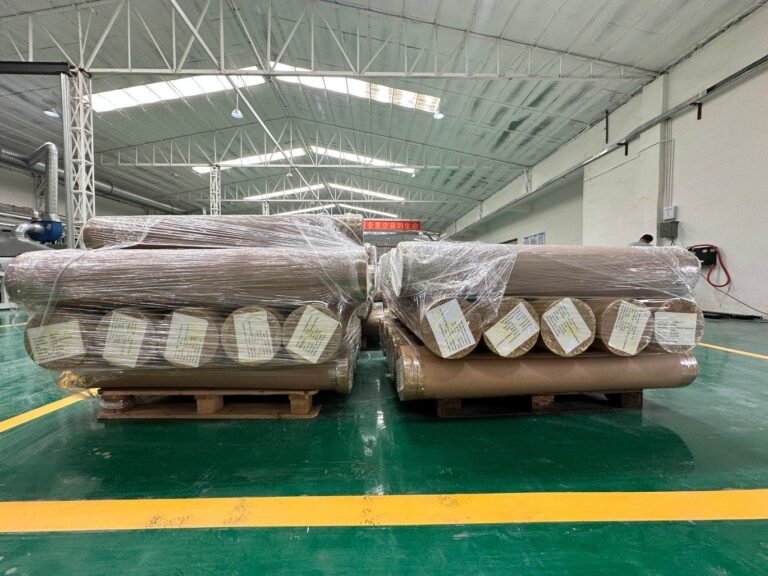
Production floor — continuous rolls in consistent widths, the efficiency advantage of roll-based sourcing
MOQ and Order Sizing for Leather Yard Purchasing
Minimum order quantities for leather yard purchasing vary dramatically by supplier type and material:
• Small-batch synthetic leather distributors: MOQ as low as 1 yard — suitable for prototyping and sample development. Prices are $2–4/yard higher than factory-direct due to distributor markup.
• Synthetic leather factories (PU/PVC): MOQ typically 300–1,000 meters. Factory-direct pricing: $1.2–6/meter depending on material type and specification.
• Silicone leather manufacturer (TOPSUN): MOQ 500 meters, lead time 7–15 days, monthly capacity 500,000+ meters. Factory-direct pricing with custom color (Pantone/RAL), custom texture (100+ patterns), and custom embossing (7–10 days for new patterns). See our samples center for A4 swatch requests.
For production planners calculating order quantities: convert your pattern’s surface area to square yards, divide by the material’s usable yield, add 5% safety buffer for synthetic leather (or 25% for genuine), and round up to the MOQ. This calculation prevents the most common procurement mistake — ordering nominal yardage that falls short of production requirements after yield loss.
Factory production capacity — 500,000+ meters monthly, the scale behind reliable leather yard fulfillment
FAQ: Leather Yard Purchasing
How many yards of leather do I need for my project?
Calculate the total surface area of your pattern in square yards, then divide by the material’s usable yield (0.70 for genuine leather, 0.95 for synthetic). Add a 5% safety buffer for synthetic or 25% for genuine. For example, a sofa upholstery pattern requiring 15 square yards of finished material needs approximately 16.5 yards of synthetic leather (15 ÷ 0.95 × 1.05) or 26.8 yards of genuine leather (15 ÷ 0.70 × 1.25). The difference is significant — and it’s why production forecasts that don’t account for yield are consistently off.
What is the standard width of synthetic leather rolls?
The industry standard is 54 inches (137 cm) for furniture and fashion applications. TOPSUN produces silicone leather in widths from 1350 mm to 1800 mm (53–71 inches), accommodating both the standard 54-inch specification and wider industrial applications. Wider rolls reduce seam joining and improve pattern nesting efficiency. Always verify the roll width on your PO — a “yard” of 54-inch-wide material contains 1.5 square yards, while a “yard” of 71-inch-wide material contains 1.97 square yards. The per-yard price means nothing without the width specification.
Order by Usable Area, Not by Nominal Yardage
The B2B procurement lesson from leather yard economics: never compare materials by nominal per-yard price without adjusting for usable yield. Genuine leather’s 20–30% waste rate and 25% ordering buffer inflate its true cost well beyond the quoted price. Synthetic leather’s 95–97% yield and 5% ordering buffer make it more efficient than the nominal comparison suggests. And silicone leather — at $8–15/yard with 97% yield, 10+ year lifespan, and consistent roll-to-roll quality — delivers the lowest true cost per usable yard per year of service among all leather types that last more than a decade. For more on supplier evaluation and pricing red flags, see our leather suppliers red flags guide.
Get Roll-Based Leather Samples
About TOPSUN
TOPSUN manufactures silicone leather in continuous rolls at 1350–1800 mm width with 97% usable yield and ΔE ≤ 1.0 batch-to-batch consistency — delivering the highest usable-area-per-yard efficiency in the synthetic leather industry for B2B production planners who calculate true cost by usable output, not nominal yardage.
1350–1800mm roll width · 97% usable yield · ΔE ≤ 1.0 consistency · 500m MOQ · 7–15 day lead time · 500,000+ m monthly capacity · 200,000+ Martindale · 10+ year lifespan · ISO 10993 · REACH · FDA