A furniture brand we worked with was buying leather by the yard at $6.50/yard from a supplier they’d used for three years. When we deconstructed the actual unit economics — roll width, MOQ tier, yield loss, reject rate — their true cost per usable square yard was $9.80. That’s a 51% gap between the price on the quote sheet and the cost on the P&L. The difference wasn’t fraud; it was the invisible costs that “leather by the yard” pricing obscures. Most B2B buyers compare per-yard or per-meter quotes and assume the lowest number wins. But per-yard price is a marketing number. Real procurement cost is a function of five variables that quote sheets rarely itemize — and suppliers who benefit from that opacity aren’t rushing to itemize them for you.

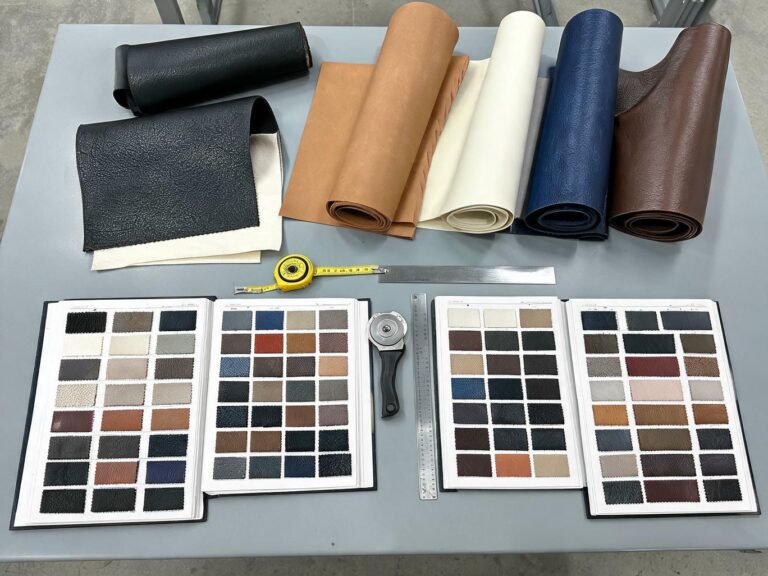
Leather rolls on the production floor — the per-yard price you see is only the beginning of the true cost calculation
Leather by the Yard: The 5 Cost Variables Quote Sheets Hide
1. Roll Width Determines Real Coverage
A “yard” of leather isn’t a fixed area — it depends on roll width. Standard synthetic leather comes in 54/55 inches (137–140cm), but premium manufacturers offer 1350mm, 1500mm, and up to 1800mm widths. A yard of 54-inch leather gives you 0.42 m². A yard of 60-inch leather gives you 0.47 m² — 12% more material for the same linear yard. When a supplier quotes $6/yard at 54″ and another quotes $6.50/yard at 60″, the second supplier is actually 8% cheaper per square meter. Always convert to cost per square meter before comparing.
| Roll Width | Area per Linear Yard | Cost at $6/Yard | True Cost per m² | Effective Discount |
|---|---|---|---|---|
| 48″ (122cm) | 0.37 m² | $6.00 | $16.22 | Baseline |
| 54″ (137cm) | 0.42 m² | $6.00 | $14.29 | 12% cheaper |
| 60″ (152cm) | 0.47 m² | $6.00 | $12.77 | 21% cheaper |
| 72″ (183cm) | 0.56 m² | $6.00 | $10.71 | 34% cheaper |
This is why TOPSUN offers silicone leather in widths up to 1,800mm — wider rolls mean more usable material per linear yard, less seaming in upholstery, and lower true cost per finished part. A buyer comparing $6/yard at 54″ against $6.80/yard at 72″ might think the first option is cheaper. It isn’t. The 72″ roll delivers a true cost of $12.19/m² vs $14.29/m² — the “more expensive” quote is 15% cheaper per unit of actual coverage.
2. MOQ Tiers Create Price Cliffs
Leather by the yard pricing is tiered by minimum order quantity. The same material costs dramatically different amounts depending on how much you order:
- 1–30 yards (sample/retail tier): $8–15/yard — includes cutting, packing, small-lot handling
- 50–100 yards (small production): $5–9/yard — moderate handling overhead
- 500+ yards (B2B manufacturer tier): $2.50–6/yard — bulk pricing, full roll only
- 1,000+ yards (volume contract): $2–4.50/yard — contract pricing, annual commitment
The price cliff between 100 yards and 500 yards can be 40–50%. A furniture startup ordering 150 yards per month pays $7/yard — but if they commit to a 500-yard quarterly order instead of monthly, the price drops to $4.50/yard. That’s $375/month in savings on the same material, achieved purely by changing order frequency. TOPSUN’s MOQ is 500 meters at B2B manufacturer pricing — contact our samples center for a tiered quote.

Factory-direct leather supply — eliminating distribution layers reduces per-yard cost by 20–35%
3. Yield Loss: The Invisible 15–25%
When you buy leather by the yard, you pay for every square inch — but you don’t use every square inch. Yield loss comes from three sources: nesting waste (gaps between cut parts), edge trimming (the first and last 10cm of every roll are irregular), and defect exclusion (color variation marks, coating irregularities). Synthetic leather typically yields 80–90% usable material; genuine leather yields 60–70% due to natural defects. The 10–20% you pay for and throw away is baked into your per-unit cost — but it’s never on the quote sheet.
To calculate true cost: True Cost per m² = (Per-Yard Price ÷ Area per Yard) ÷ Yield %. At $6/yard, 54″ width (0.42 m²/yard), and 85% yield: $6 ÷ 0.42 ÷ 0.85 = $16.80/m². Compare that to the “headline” cost of $14.29/m² — the yield loss adds $2.51/m², or 17.6%. Silicone leather’s consistent surface quality and 100+ texture options mean yield rates of 88–92% are achievable with optimized nesting, reducing waste cost below typical PU leather.
4. Reject Rate: The Cost of Bad Leather
A 5% reject rate means you buy 5% more leather than you ship as finished product. Rejects come from batch-to-batch color variation (Delta E > 2.0), coating defects (bubbles, pinholes), dimensional instability (shrinkage after cutting), and edge delamination. Each rejected part cost you the full per-yard price plus cutting labor. On a 1,000-yard order at $5/yard with 5% rejects: 50 yards wasted = $250 in material alone, plus labor. Specifying materials with batch consistency (Delta E ≤ 1.0, like TOPSUN’s Pantone-matched silicone leather) drives reject rate below 1%, saving $200+ per 1,000 yards.
5. Distribution Markup: Who’s Between You and the Factory?
Every hand between the factory and your dock adds 10–20%. Factory → Export agent → Importer → Distributor → You: that’s 3 markups, adding 33–60% to the factory price. Factory-direct purchasing eliminates 2–3 layers, reducing per-yard cost by 20–35%. TOPSUN sells factory-direct — no distributor, no importer, no agent markup. The price you get is the price that leaves the factory gate, plus freight. See our MOQ and pricing structure for transparent per-tier pricing.
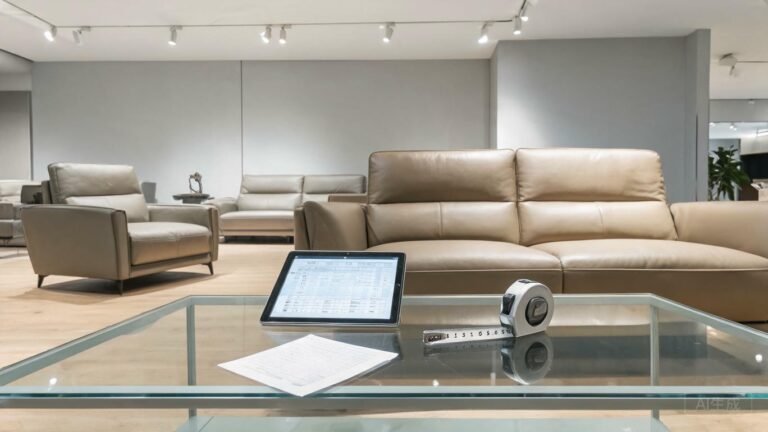
Long-term cost savings — why factory-direct leather by the yard at a higher per-yard price can deliver lower total procurement cost
Leather by the Yard: Material Type Price Comparison
Here’s a transparent price map for the major synthetic leather types sold by the yard, at B2B manufacturer pricing (500+ yard MOQ, factory-direct):
| Material Type | Price/Yard (B2B) | Typical Width | Service Life | True Cost/m² (85% yield) |
|---|---|---|---|---|
| PVC Leather | $2.00–3.50 | 54″ | 2–3 years | $5.60–9.80 |
| PU Leather | $2.50–5.00 | 54″ | 3–5 years | $7.00–14.00 |
| Microfiber Leather | $4.00–7.00 | 54″ | 5–7 years | $11.20–19.60 |
| Silicone Leather | $5.00–9.00 | 54–72″ | 10+ years | $10.50–16.80 (72″) |
| Genuine Leather | $8.00–15.00 | Variable | 5–10 years | $16.80–42.00 (65% yield) |
The service life column is the real differentiator. PVC at $5.60/m² with a 2.5-year life costs $2.24/m²/year. Silicone at $10.50/m² (72″ width, 88% yield) with a 10-year life costs $1.05/m²/year — less than half the annual cost of PVC. The per-yard price is higher; the lifecycle cost is lower. This is the calculation that separates procurement from purchasing: purchasing buys the cheapest material; procurement buys the material with the lowest lifetime cost.
About TOPSUN: Factory-Direct Leather by the Yard
TOPSUN supplies silicone leather by the yard — or by the meter, roll, or container — factory-direct from our 60,000+ m² facilities in Dongguan, Yichang, and Xiangyang. Our B2B pricing starts at 500-meter MOQ with transparent tiered discounts for volume commitments. Roll widths of 1,350–1,800mm mean more usable area per linear unit than standard 54″ rolls. Batch-to-batch color consistency is held to Delta E ≤ 1.0, minimizing reject rate. Every roll ships with a technical data sheet and batch number for full traceability. Browse our product collections or request free A4 swatches shipped worldwide via DHL/FedEx.
Leather by the Yard: Frequently Asked Questions
How much does leather by the yard cost?
B2B factory-direct pricing ranges from $2/yard for PVC to $15/yard for premium genuine leather. Silicone leather runs $5–9/yard at 500+ yard MOQ. Always calculate true cost per m² by accounting for roll width and yield loss — the headline per-yard price can understate true cost by 35%.
What is the minimum order for leather by the yard?
For B2B manufacturer pricing, the MOQ is typically 500 yards/meters. Below that, sample-tier pricing applies (30–80% premium). TOPSUN’s MOQ is 500 meters, with free A4 samples available for evaluation before placing a production order.
How wide is a roll of leather?
Standard synthetic leather rolls are 54/55 inches (137–140cm). Premium manufacturers offer wider rolls: 1,350mm, 1,500mm, and up to 1,800mm. Wider rolls deliver more usable material per linear yard — a 72″ roll provides 34% more coverage per yard than a 48″ roll at the same per-yard price.
How do I calculate true cost per square meter?
Formula: (Per-Yard Price ÷ Area per Yard) ÷ Yield %. For example: $6/yard at 54″ width (0.42 m²/yard) and 85% yield = $6 ÷ 0.42 ÷ 0.85 = $16.80/m². Compare this number across suppliers, not the per-yard headline price.
The Bottom Line
Leather by the yard pricing is designed to be compared at face value — and that’s exactly where most buyers lose money. The per-yard number is the tip of an iceberg: roll width, MOQ tier, yield loss, reject rate, and distribution layers sit underneath, adding 20–50% to the true procurement cost. The buyer who converts every quote to cost per usable square meter — factoring in width, yield, and reject rate — consistently pays less than the buyer who compares per-yard headlines. And the buyer who calculates lifecycle cost per year (true cost ÷ service life) discovers that premium materials like silicone leather can be cheaper than budget PVC over a 10-year horizon. Price is what you see. Cost is what you pay. Value is what you get. Specify all three.
Ready for transparent, factory-direct leather pricing?
TOPSUN provides tiered B2B pricing on silicone leather — 500m MOQ, widths up to 1,800mm, Delta E ≤ 1.0 batch consistency. Free A4 samples shipped worldwide via DHL/FedEx. Contact info@topsunsiliconeleather.com or WhatsApp +44 744 461 7933.
Related: Leather MOQ & Pricing Guide | Leather Sample Ordering Guide | 5-Year Upholstery TCO | Samples Center