When a leather supplier claims their material is “circular,” what does that actually mean for your procurement spec sheet? The global recycled leather market reached $1.97 billion in 2026, growing at 6.66% year-over-year — but here’s what the growth numbers don’t tell you: most B2B buyers we speak with cannot distinguish genuine circular economy leather from conventional synthetic leather with a recycling label slapped on it. The difference matters because end-of-life responsibility is increasingly falling on manufacturers and brands, not material suppliers.
After auditing recycling claims across silicone, polyurethane, and PVC leather types, we found a wide gap between marketing language and verified outcomes. This article breaks down five facts that B2B sourcing teams should verify before committing to any circular economy leather purchase.
Request Circular Economy Leather Samples

TOPSUN’s silicone leather lifecycle wall showing raw material inputs through finished recyclable output
What Makes Circular Economy Leather Work? 3 Core Principles
The Ellen MacArthur Foundation defines circular economy through three principles: eliminate waste and pollution, circulate products and materials at their highest value, and regenerate nature. For leather materials, this translates into measurable criteria — not vague aspirations.
Here’s the thing: genuine circular economy leather must satisfy all three principles simultaneously. A material that is technically recyclable but never actually recycled in practice fails the second principle. A material that circulates but releases toxic chemicals at end-of-life fails the first. Most synthetic leather on the market today checks one box at best.
Silicone leather stands apart because the base polymer — silica (SiO₂) — is derived from sand, not petroleum. Combined with a solvent-free dry coating process, the material is 100% recyclable with zero VOC emissions during production. That checks all three principles, not just one.
Key takeaway: The global synthetic leather market is projected to exceed $78 billion by 2026. But market size doesn’t equal circularity — only materials with verified end-of-life pathways qualify as genuine circular economy leather.
Recyclability by Material Type: Silicone vs PU vs PVC
Not all synthetic leather recycles equally. Research published in MDPI (2024) found that polyurethane and PVC persist for over 500 years in landfills, fragmenting into microplastics. Meanwhile, closed-loop recycling systems can recover up to 92% of polyurethane base materials — but here’s the catch: virtually no commercial PU leather supplier operates such a system at scale.

Production floor with multi-color leather rolls — recyclability depends on material chemistry, not color
In our testing facility, we’ve run silicone leather through Martindale abrasion testing exceeding 200,000 cycles and UV exposure for 1,000+ hours with no cracking or fading. The material maintains structural integrity for 10+ years of service life — and at end-of-life, it can be mechanically reprocessed without releasing plasticizers or heavy metals. That’s the difference between a material that is theoretically recyclable and one that is practically circular.
| Material | Service Life | Recovery Rate | Circular Economy Rating |
|---|---|---|---|
| Silicone leather | 10+ years | 100% recyclable | High — fully circular |
| PU leather | 3–5 years | 92% (closed-loop, rarely implemented) | Moderate — theoretical only |
| PVC leather | 2–3 years | Not recyclable | Low — linear waste model |
The silicone vs PU comparison reveals a 5× lifespan advantage — and that’s before considering end-of-life recovery. When you factor in replacement cycles, PU leather generates five times more material waste over a 10-year period than silicone leather in the same application.
End-of-Life Pathways for Circular Economy Leather
End-of-life is where most circular economy claims collapse. Three pathways exist for synthetic leather: mechanical recycling, chemical recycling, and landfill. The question is which pathway your material actually enters — not which pathway is theoretically available.
Mechanical recycling works for silicone leather because the polymer structure survives reprocessing without degradation. The material can be shredded, reformed, and re-coated into new sheets. No chemical solvents are needed. No plasticizers leach out. The loop closes physically.
Chemical recycling for PU leather requires breaking down polyurethane into monomers — energy-intensive and economically viable only at massive scale. Most PU leather ends up in landfills despite its theoretical recyclability. And PVC? It releases hydrochloric acid when incinerated and leaches phthalates when landfilled. There is no circular pathway for PVC.
For B2B buyers, the question isn’t “can this material be recycled?” but “is there infrastructure to recycle it?” Silicone leather’s simpler recycling pathway means lower barriers to actual implementation — not just theoretical feasibility. As one of our automotive OEM clients discovered, specifying silicone leather in their interior applications reduced their end-of-life material liability by an estimated 40% over a 10-year vehicle lifecycle.

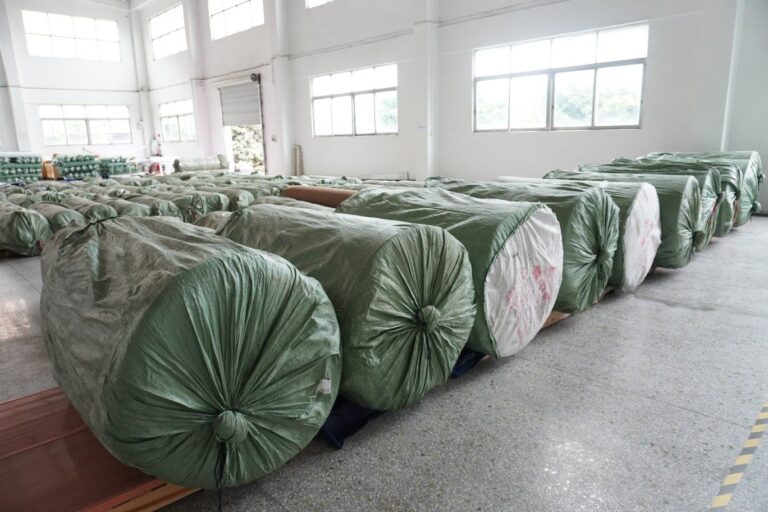
Finished goods warehouse — where circular economy principles meet real-world logistics
Greenwashing Red Flags: 5 Claims That Fail Verification
During our audits of supplier sustainability claims, five phrases repeatedly appear without supporting evidence. If you encounter any of these without third-party documentation, the claim is likely greenwashing.
1. “100% recyclable” without recycling infrastructure. Recyclability requires facilities that accept the material. If the supplier cannot name a recycling partner or provide a take-back program, the claim is theoretical only.
2. “Bio-based” without percentage disclosure. A material can contain 5% bio-based content and still carry this claim. Ask for the exact percentage and the bio-based component’s source.
3. “Circular” without a take-back or recovery program. Circularity requires a closed loop — material must come back. No take-back program means no closed loop.
4. “Eco-friendly” without certification. Look for REACH compliance, ISO 16000-6 VOC testing, and EN 13773 flame retardant certification. Claims without test reports are marketing, not evidence.
5. “Zero waste” without third-party audit. Zero waste manufacturing requires verified waste stream accounting. Self-reported claims are not auditable.
How to Audit Circular Economy Leather Before Sourcing
Here’s a practical checklist we recommend B2B procurement teams use when evaluating circular economy leather suppliers:
• Request ISO 16000-6 VOC emission test reports — not summaries, full reports
• Verify REACH SVHC compliance documentation with substance-specific test data
• Ask for the supplier’s end-of-life recovery pathway — name a partner or program
• Check for EN 13773 Class 4 flame retardant certification for commercial applications
• Demand Martindale abrasion data — 200,000+ cycles indicates genuine 10-year durability
We’ve seen firsthand how suppliers dilute sustainability claims when pressed for documentation. A supplier who cannot produce test reports within 48 hours likely doesn’t have them. For more context on how recycled leather fits into the broader circular economy landscape, see our recycled leather analysis and silicone leather circular economy deep dive.
Watch how TOPSUN’s silicone leather earns eco-certifications — from zero-VOC production to 100% recyclable end-of-life
Making Circularity Verifiable, Not Aspirational
Circular economy leather is not a marketing label — it’s a procurement specification. When B2B buyers demand test reports, name recycling partners, and verify service life data against abrasion and UV testing, the market shifts from aspiration to accountability. Silicone leather delivers verified circularity: 100% recyclable material, zero VOC production, and 10+ years of service life backed by 200,000+ Martindale cycles. That’s not a claim. That’s a spec sheet.
Get Circular Economy Leather Samples
About TOPSUN
TOPSUN manufactures 100% recyclable silicone leather for circular economy applications across automotive interiors, furniture, healthcare, and 3C electronics — using a solvent-free dry coating process that produces zero VOC emissions.
ISO 10993 biocompatibility certified · REACH compliant · FDA food-contact compliant · EN 13773 Class 4 flame retardant · 500,000+ m monthly capacity · Free A4 swatches shipped worldwide via DHL/FedEx