Hospital mattress leather fails for one reason: the cleaning protocol destroys it. Every discharge between patients triggers a terminal clean — bleach solutions, quaternary ammonium, hydrogen peroxide — applied to every surface including the mattress cover. Traditional hospital mattress leather, whether vinyl or PU-coated, cracks under this chemical assault within 12–18 months. The micro-fissures that form become reservoirs for pathogens that the next cleaning cycle cannot reach. For B2B buyers specifying material that must last five years under daily disinfection, the specification must start with chemistry, not aesthetics.
Request Biocompatibility Report
What Makes Hospital Mattress Leather Different from Standard Upholstery
Standard upholstery leather — whether genuine, PU, or PVC — is designed for comfort and appearance under normal wear conditions. Hospital mattress leather is designed for survival under chemical warfare. The difference is not incremental; it is categorical. A material that passes 50,000 Martindale abrasion cycles can still fail catastrophically when exposed to sodium hypochlorite at 5,000 ppm concentration — the standard bleach dilution used in terminal cleaning between patients.
The medical healthcare application requirements demand a material that is simultaneously non-porous (blocking fluid penetration to the foam core), chemically inert (surviving daily disinfection without cracking), biologically safe (non-cytotoxic for prolonged skin contact), and flame-retardant (meeting healthcare facility fire codes). No single traditional leather chemistry meets all four requirements. Silicone-coated leather is the only variant that does.
The 7 Specifications That Determine Infection-Control Survival
1. ISO 10993-5 biocompatibility. The baseline certification for any material in prolonged patient contact. This test evaluates cytotoxicity using the MTT assay — living cells are exposed to material extracts, and viability is measured. A material that kills cells on contact cannot be used on a hospital mattress surface. TOPSUN’s silicone leather passes ISO 10993-5:2009, certified by SGS-CSTC Guangzhou.
2. ISO 22196 / JIS Z 2801 antimicrobial performance. Measures bacterial reduction on the material surface after 24 hours. A qualified medical material requires an R-value > 2, meaning 99%+ bacterial reduction. Silicone leather achieves this intrinsically — its non-porous surface and chemically inert Si–O–Si backbone cannot serve as a nutrient source for microorganisms. Vinyl and PU require chemical antimicrobial additives that deplete with repeated cleaning [$TOPSUN](https://www.dspupvc.com/medical-grade-synthetic-leather.html).

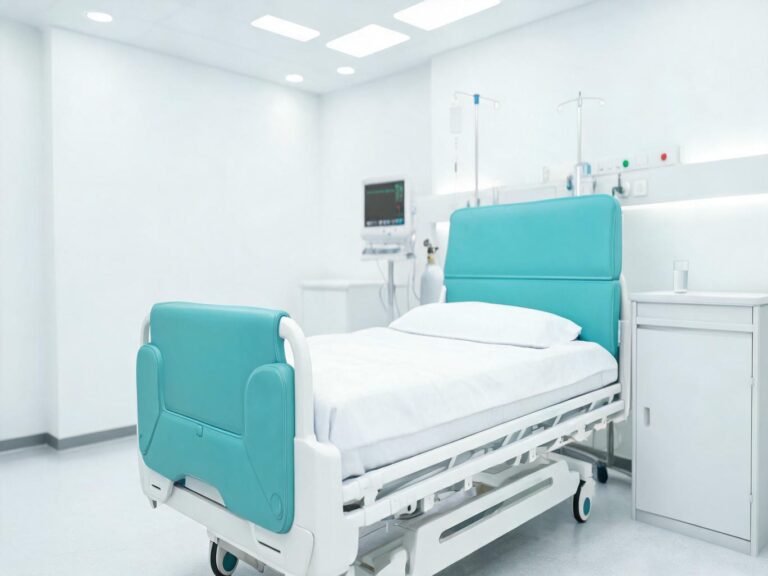
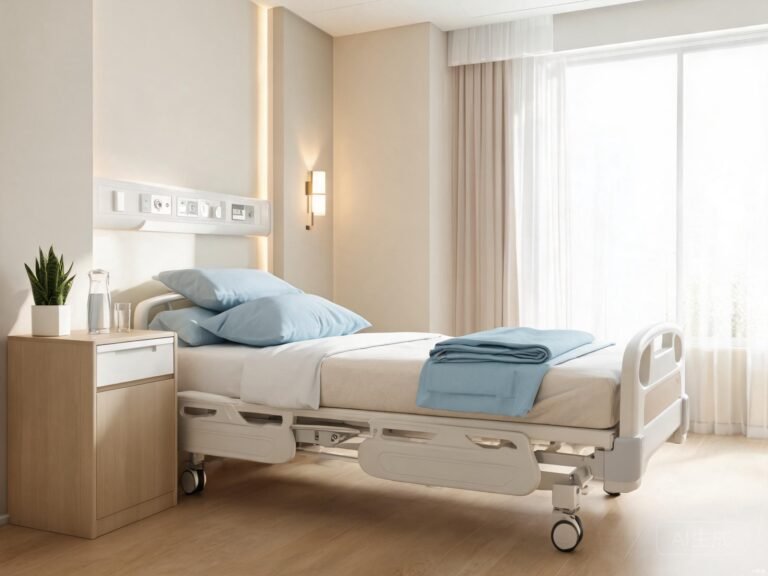
Medical-grade upholstery in clinical use — the material must resist bacterial colonization intrinsically, not through topical additives that wash off under daily disinfection.
3. EN 13773 Class 4 flame retardancy. The highest European fire-safety classification for upholstery. Hospital environments carry elevated fire risk from oxygen equipment, surgical procedures, and patients who cannot self-evacuate. Silicone leather is inherently self-extinguishing — it does not require chemical flame retardant additives that can leach during cleaning. Vinyl and PU are flammable and require additive treatments that deplete over time.
4. Bleach resistance (1:10 sodium hypochlorite). The terminal cleaning standard between patients. PU-coated leather develops micro-fissures within weeks of exposure to bleach solutions at pH > 11 — the hydroxyl ions attack ester bonds in the polyurethane coating. Silicone chemistry has no ester bonds to attack. The surface tolerates repeated bleach application without cracking, discoloration, or structural degradation.
5. Hydrostatic head ≥ 10,000mm. Measures impermeability — the pressure at which water penetrates the material. Hospital mattress covers must block fluid penetration to the foam core, where moisture cannot be disinfected and becomes a permanent pathogen reservoir. Silicone leather’s non-porous surface meets this threshold; woven and microporous PU materials do not without additional lamination layers that delaminate under flex stress.
6. VOC emission (ISO 16000-6 / VDA 277). Hospital patients have compromised respiratory systems. Material that off-gasses solvents, plasticizers, or formaldehyde into the immediate breathing zone is unacceptable. Solvent-free silicone coating produces zero measurable VOC; vinyl off-gasses plasticizers continuously; PU retains solvent residues for months after production. See our eco-friendly credentials for full emission data.
7. Abrasion resistance under wet cleaning (ISO 12947-2). Standard Martindale testing measures dry abrasion. Hospital mattress leather must also survive wet abrasion — the mechanical stress of wiping a saturated surface with friction. Specify ≥ 200,000 dry cycles as a baseline, then request wet-abrasion data. Materials that pass dry testing but fail wet testing will not survive clinical cleaning protocols. Full test data is available on the technical data sheet.

Fire safety testing for healthcare-grade leather — EN 13773 Class 4 is inherent to silicone chemistry, not dependent on additive treatments that deplete under cleaning.
Why Vinyl and PU Fail the Bleach Test
Vinyl (PVC) hospital mattress covers dominate the market by cost. They fail clinically by chemistry. PVC relies on plasticizers for flexibility; bleach accelerates plasticizer migration, causing the material to stiffen and crack within 12–18 months. The cracks are not cosmetic — they are infection-control breaches. Pathogens colonize the fissure network, and no surface wipe can reach organisms embedded in the crack structure.
PU-coated covers fail differently but equally. The ester bonds in polyurethane hydrolyze under the alkaline conditions of bleach solutions (pH > 11). The coating loses elasticity, develops micro-fissures, and delaminates from the textile backing. The failure is molecular, not mechanical — the polymer chains that provide flexibility are chemically broken. For more detail on how these materials compare in clinical settings, see our guides on hospital bed mattress materials and hospital bed upholstery materials.
| Requirement | PU-Coated | Vinyl (PVC) | Silicone | Test Standard |
|---|---|---|---|---|
| Biocompatibility | Not certified | Not certified | ISO 10993-5 certified | ISO 10993-5 |
| Antimicrobial | Additive-based (depletes) | Additive-based (depletes) | Intrinsic (R > 2) | ISO 22196 |
| Flame retardancy | Flammable (additives needed) | Flammable, toxic smoke | Self-extinguishing Class 4 | EN 13773 |
| Bleach resistance | Fails — ester hydrolysis | Fails — plasticizer loss | Passes — no ester bonds | 1:10 NaOCl |
| VOC emission | Solvent residues | Plasticizer off-gassing | Zero | ISO 16000-6 |
| Service life (clinical) | 12–18 months | 12–18 months | 5+ years | Field data |
Silicone-Coated Hospital Mattress Leather: The Chemistry That Survives
Silicone chemistry solves every failure mode that destroys vinyl and PU in clinical environments. The Si–O–Si backbone has no ester bonds for bleach to hydrolyze. It contains no plasticizers to migrate under chemical exposure. It is inherently self-extinguishing without additive flame retardants. The non-porous surface blocks fluid penetration to the foam core and cannot serve as a nutrient source for bacteria or fungi. All of these properties are intrinsic to the molecular structure — they do not deplete with cleaning, because they are not additives.
TOPSUN manufactures ISO 10993-5 certified silicone leather for hospital mattress covers and medical upholstery that withstands bleach, alcohol, and hydrogen peroxide disinfection without surface degradation. The medical-grade silicone leather certification overview documents the full compliance stack — SGS-tested biocompatibility, REACH compliance, FDA food-contact compliance, and EN 71 toy safety, making the material suitable for neonatal through geriatric applications. See our cleaning and maintenance guide for clinical disinfection protocols.

Cleanroom-standard production facility — medical-grade silicone leather requires controlled-environment manufacturing to meet ISO 10993-5 biocompatibility certification.
FAQ
How often should hospital mattress leather be replaced?
Vinyl and PU hospital mattress covers typically require replacement every 12–18 months due to cracking from chemical disinfection. Silicone-coated hospital mattress leather lasts 5+ years under the same cleaning protocols because its chemical structure has no bonds for bleach to attack. The replacement cycle should be determined by visual inspection for surface integrity — cracks, tears, or fluid penetration to the foam core — not by a fixed calendar. Any breach in surface continuity is an infection-control failure that requires immediate replacement regardless of material age.
Hospital Mattress Leather: Chemistry Over Convenience
Hospital mattress leather fails when the cleaning protocol exceeds the material’s chemical tolerance. Vinyl loses plasticizers. PU hydrolyzes at the ester bonds. Both develop micro-fissure networks that become pathogen reservoirs no surface wipe can reach. The specification that prevents this failure is not about thickness, color, or texture — it is about molecular chemistry. Silicone-coated hospital mattress leather eliminates every failure mode at the structural level: no ester bonds, no plasticizers, intrinsic flame retardancy, intrinsic antimicrobial performance, and zero VOC emission. When the spec demands five years of daily disinfection, only one chemistry delivers.