The photo arrived on a Tuesday morning: last year’s conference diary, our logo debossed on the front, its diary cover leather peeling at the corners like old paint. It sat on the desk of one of our oldest clients, next to a competitor’s notebook in perfect condition. Four thousand eight hundred more of those diaries are still out there, quietly aging on the desks we most wanted to impress. The uncomfortable lesson: we specified the cover for day one instead of year three. Here is what a diary cover actually endures, how the common cover grades age, and how to specify one that survives the daily commute with your logo on it.
Order Free Cover-Material Swatches
What a Diary Cover Actually Endures
A diary is not a book that sits on a shelf — it is carried every single day. Over a year of normal use, the cover opens and closes roughly 2,000 times, flexing hardest along the spine where the material has almost no support. It rides through 400-plus bag trips, pressed against keys, chargers, and zippers. It meets coffee rings, rain, and the hand oils of its owner, which slowly work into the surface chemistry. In humid cities, add months of ambient moisture. A cover material that only has to look good in a product photo is easy to source; one that has to survive all of this for three years is a genuine specification problem, and it belongs in the same conversation as any other personal accessory material.
2,000 spine flexes, 400+ bag trips, 365 days of hand oils — per year. Year three is where cover grades separate, and where gift-program reputations are decided.

Day one: the unboxing moment your cover material has to live up to for the next three years.
Diary Cover Leather Grades, Ranked by Year-3 Reality
The leather trade sorts hides into grades that behave very differently once they leave the shelf — the standard definitions of full-grain, top-grain, and bonded leather describe how much of the hide’s original surface survives processing. Vegetable-tanned full-grain keeps everything, which is why it develops the patina journal lovers photograph; it also shows every scar and water spot, costs the most, and varies hide to hide. Pigmented top-grain trades some of that character for a uniform, protected surface that resists stains better. Bonded leather — fibers glued and rolled — is the budget tier that surfaces on low-cost diaries and rarely survives heavy flexing. Synthetic PU covers dominate the corporate gift market on price, and premium packaging programs increasingly specify silicone leather instead, for reasons the next section makes obvious.
| Cover grade | Year-1 impression | Year-3 evidence | Typical failure mode | Best program fit |
|---|---|---|---|---|
| Vegetable-tanned full-grain | Rigid, aromatic, distinctive | Visible patina, darkened edges — reads as character | Water spotting; hide-to-hide color variance | Premium retail journals, heritage brands |
| Pigmented top-grain | Smooth, uniform, corporate | Edge wear at spine, surface remains intact | Finish cracking at flex lines in dry heat | Mid-to-premium diaries, consistent large lots |
| PU synthetic | Soft, colorful, cheap at volume | Corner and spine peeling, gray flaking | Hydrolysis: film separates from fabric base | Short-life promotional items only |
| Silicone leather | Soft-touch, matte, premium hand | Surface intact, color stable, easy to wipe | Higher unit price than PU | Corporate gifts, refillables, vegan lines |

Fine pebbled grain hides daily micro-scuffs — one reason texture choice matters as much as grade.
Why PU Covers Peel: The Hydrolysis Clock
The peeling in that Tuesday photo was not a defect in the workmanship — it was chemistry running on schedule. A PU cover is a polyurethane film bonded to a fabric backing, and polyurethane slowly degrades by hydrolysis: ambient moisture attacks the polymer chains and, with them, the bond between film and base. Humid climates run that clock fast — in Singapore-style conditions, PU covers are known to start peeling within a year. Hand oils, pocket heat, and daily spine flexing accelerate it, which is why failure shows up first at exactly the corners and spine your logo sits near. No conditioning routine stops hydrolysis; it can only be slowed. Silicone leather sidesteps the mechanism entirely — the polymer backbone does not hydrolyze — and our hydrolysis-resistant silicone leather page documents the test evidence behind that claim.
Specifying Diary Cover Leather for a Custom Program
A corporate diary program is a branding exercise wearing a material spec, so specify it like one. Start with gauge: covers cut well between 0.6 and 1.2 mm, and thinner constructions down to 0.23 mm exist when the brief demands a slim, soft-cover feel — our ultra-thin collection was built for exactly those lightweight goods.
Then specify the surface: a fine pebbled grain hides three years of micro-scuffs that a flat polished finish wears as scars, and pattern depth is an engineering parameter, not an aesthetic accident — the embossed pattern engineering guide explains how rollers are cut to hold a texture consistently across a full order.
Finish the spec with the branding operations. Debossing and foil stamping need a surface dense enough to hold a crisp logo edge through 2,000 flexes; heat transfers on cheap PU often crack along with the film underneath. Color matching should come with a ΔE commitment across batches, so the diaries ordered for this year’s conference match the reorder next year. And because gift programs increasingly answer to sustainability targets, a vegan, solvent-free cover material with documentation is worth specifying upfront rather than retrofitting into the conversation later.

Custom prints and patterns turn a diary cover into brand real estate — if the surface survives the commute.
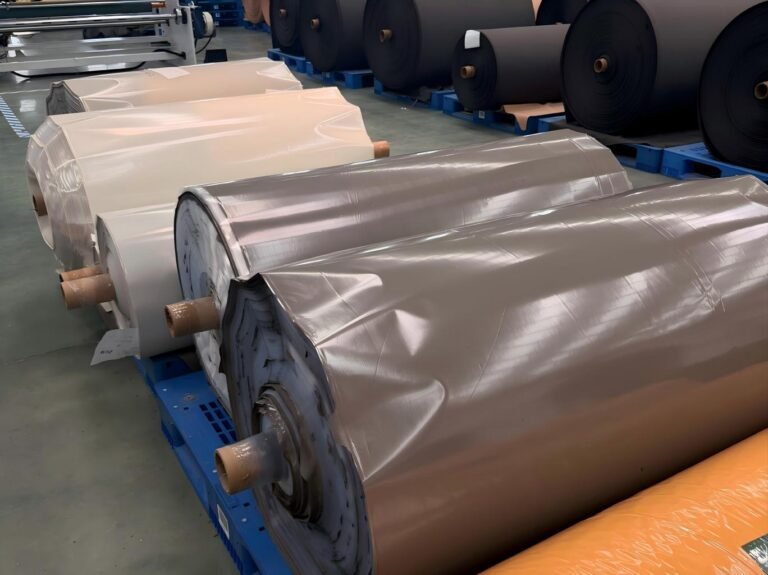
How custom patterns and embossing are engineered onto rolls — cover texture as a repeatable specification.
Frequently Asked Questions
What is the best leather for a diary cover?
For a premium journal that ages into patina, vegetable-tanned full-grain is the classic answer — with natural variance as the price. For corporate programs that need thousands of identical, wipe-clean covers that stay presentable for years, silicone leather fits better: vegan, hydrolysis-proof, and color-stable across batches.
How do you stop a PU diary cover from peeling?
Honestly, you slow it rather than stop it. Keep the cover dry, wipe off hand oils, and keep it away from heat. Peeling is hydrolytic degradation inside the material itself — once the film starts separating from the backing, glue is a temporary fix. Choosing a hydrolysis-proof material is the only durable answer.
Is genuine leather worth it for corporate diaries?
It depends on the message. Genuine hide signals heritage and rewards individual buyers who enjoy patina, but hides vary, stain, and cost more at volume. If the diary is a brand vehicle that must look identical and intact on every client desk for three years, a color-stable engineered cover usually delivers the brand promise more reliably.
Choose Diary Cover Leather for Year Three, Not Day One
The conference photo taught us what a diary cover leather really buys: not the unboxing moment, but every day after it. Specify against the abuse profile — spine flexes, bag trips, hand oils, humidity — and demand year-three evidence, not shelf samples. Full-grain earns its premium when patina is the story; silicone leather earns it when your logo has to stay crisp on four thousand desks through three wet winters. Either way, ask one question before the order goes in: show me this cover at year three.
Get a Custom Diary Cover Quote
About TOPSUN
TOPSUN supplies thin-gauge silicone leather for diary, notebook, and premium packaging cover programs, with surfaces engineered to survive daily carry with branding intact.
Gauges from 0.23 mm for slim soft covers, 100+ embossed textures with custom rollers cut in 7–10 days, Pantone and RAL matching held to ΔE ≤ 1.0 across batches, hydrolysis-proof vegan surface, and free A4 swatches shipped worldwide.