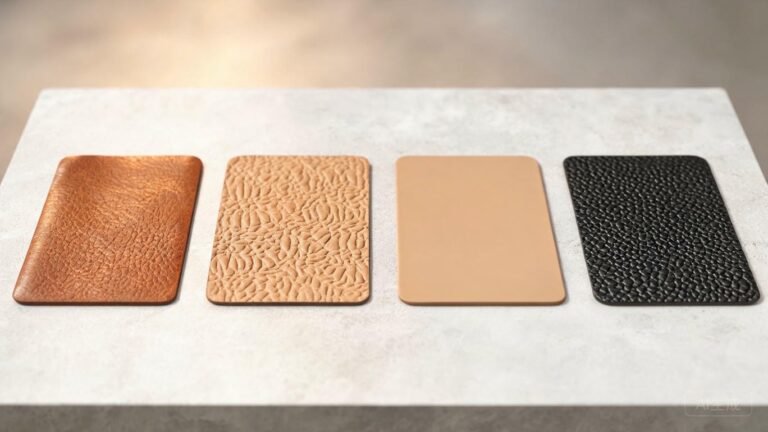
A 0.1mm thickness deviation on a 500-meter sample order is a quality note. The same 0.1mm deviation across a 50,000-meter bulk order is a production crisis — every downstream cutting pattern, seam allowance, and finished product dimension shifts, and the cost of reworking or scrapping affected units can exceed the material savings that justified the bulk purchase. Leather sheet bulk purchasing amplifies quality inconsistencies: what’s a minor issue at sample scale becomes a warranty claim at production scale.
This article provides the seven-point supplier qualification framework that B2B procurement teams should complete before scaling any leather sheet purchase beyond the trial order — covering facility verification, quality consistency, compliance documentation, production capacity, and the contractual safeguards that protect bulk orders from the most common failure modes.
Request Bulk Order Consultation

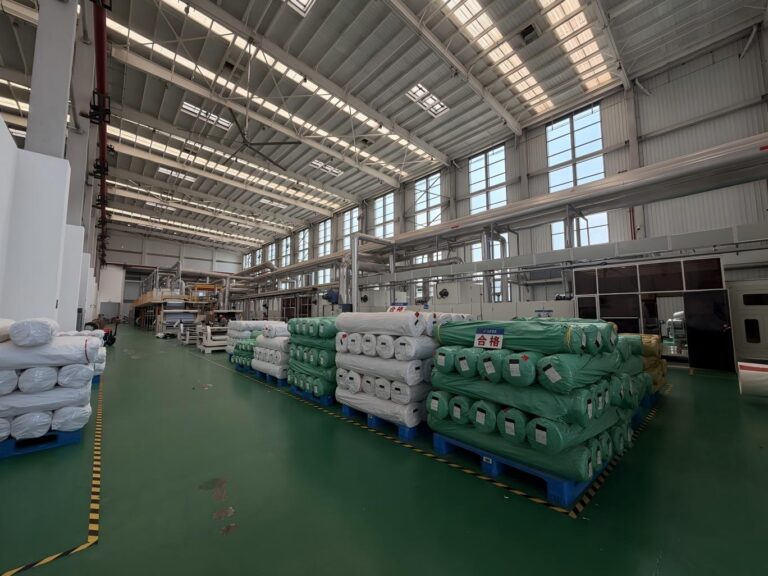
Production line at scale — where bulk order quality is determined by process control, not inspection
Point 1: Factory vs Trading Company — Know Who Makes Your Material
The first qualification question determines everything downstream: are you buying from the factory that manufactures the leather, or a trading company that resells it? The distinction affects pricing transparency, lead time control, customization capability, and quality accountability.
| Factor | Factory (Direct Manufacturer) | Trading Company (Reseller) |
|---|---|---|
| Pricing transparency | Direct cost breakdown | Bundled, limited visibility |
| Lead time control | Direct production scheduling | Dependent on partner factory |
| Customization | In-house formulation, texture, color | Limited to factory’s catalog |
| Quality accountability | Single source of responsibility | Shared between reseller and factory |
| MOQ | Lower (factory capacity allows) | Higher (partner factory minimums) |
TOPSUN operates as a direct manufacturer with 60,000+ m² of production area across three facilities (Dongguan, Yichang, Xiangyang), 10+ automated production lines, and 500,000+ meters monthly capacity. When you order from TOPSUN, the factory that makes your leather is the entity that quotes, produces, ships, and warrants your material — no intermediary layers. For more on our production capabilities, see our factory production overview.
Point 2: Quality Consistency — The Metrics That Matter at Volume
At sample scale, quality is assessed by looking at one piece. At bulk scale, quality is assessed by measuring consistency across thousands of pieces. The metrics that determine bulk quality aren’t the same as sample quality — they’re the tolerances that prevent production disruption:
• Thickness tolerance: ±0.05mm across the roll (ISO 2589). TOPSUN achieves ±0.05mm — industry standard for bulk is ±0.1mm. Tighter tolerance means more consistent cutting, stitching, and finished product dimensions across the entire production run.
• Color consistency (ΔE): ≤ 1.0 batch-to-batch (CIELAB). This means every roll in a 50,000-meter order matches the approved sample to a degree that’s imperceptible to the human eye. For brands producing multi-location retail displays or multi-unit furniture orders, ΔE ≤ 1.0 eliminates the “different shade” complaint that plagues bulk genuine leather orders.
• Physical property uniformity: Tensile strength ≥ 10–15 N/mm and tear strength ≥ 15–20 N must be consistent across the entire roll — not just at the sample point. Request batch-level test reports with your PO number to verify that production-scale material matches sample-scale performance.
The amplification principle: At 500 meters, a 5% defect rate means 25 meters of unusable material — manageable. At 50,000 meters, the same 5% means 2,500 meters — enough to derail an entire production schedule and trigger expediting costs. Bulk purchasing demands tighter tolerances, not looser ones.
Point 3: Compliance Documentation — Verify Before You Commit Volume
Bulk orders cross borders, enter regulated markets, and face customs inspections. The compliance documentation that was optional at sample scale becomes mandatory at production scale. Before committing to a bulk purchase, verify that your supplier can provide:
• REACH compliance certificate — confirming no SVHC (Substances of Very High Concern) above regulatory thresholds. Required for EU market access.
• ISO 10993-5 biocompatibility test report — for applications involving skin contact (furniture, wearables, medical). TOPSUN’s silicone leather is SGS-certified for in vitro cytotoxicity.
• FDA 21 CFR 177.2600 compliance — for food-contact applications. Required if the leather is used in food packaging, restaurant seating, or kitchen surfaces.
• RoHS compliance — confirming no heavy metals (lead, cadmium, mercury, hexavalent chromium) above thresholds. Required for electronic product housings and accessories.
• Batch-specific test reports — not generic certificates. The test report number must match your PO batch to prove the material you receive was actually tested. For the full compliance matrix, see our certificates page.

Quality control in production — where compliance documentation is generated, not fabricated
Point 4: Production Capacity and Lead Time — Can They Scale With You?
A supplier who delivers 500 meters in 7 days may not deliver 50,000 meters in 7 weeks. Production capacity — not sample turnaround — determines whether your bulk order ships on schedule. Qualify your supplier’s capacity by verifying:
• Monthly capacity: TOPSUN produces 500,000+ meters monthly across 10+ automated lines. Verify that your supplier’s stated capacity exceeds your peak monthly demand by at least 30% — the buffer that accounts for their other customers’ orders and maintenance downtime.
• Lead time at scale: TOPSUN’s standard lead time is 7–15 days. Ask your supplier for lead time at your specific order volume — not their best-case sample turnaround. Bulk orders may require additional production runs, quality checks, and shipping logistics that extend the timeline.
• Custom production capability: For custom colors (Pantone/RAL matching), custom textures (100+ patterns), and custom embossing (7–10 days for new rollers), verify that the supplier has in-house engineering and tooling capability — not outsourced customization that adds lead time and quality risk.
Point 5: Sample-to-Production Consistency — The Trial Order Protocol
Never commit to a bulk order without a trial production run. The trial order validates that the factory can reproduce sample-level quality at production scale — with the same formulations, equipment settings, and quality controls. TOPSUN’s recommended process:
• Step 1 — Sample approval: Request A4 swatches in your specified color, texture, and thickness. Free worldwide via DHL/FedEx. Verify ΔE against your Pantone/RAL reference, measure thickness, and approve the physical sample.
• Step 2 — Trial production (500m MOQ): Place a minimum order for 500 meters. This validates color consistency, thickness uniformity, and roll-to-roll quality at production scale. Inspect every roll — not just the first and last.
• Step 3 — Bulk quotation: Submit confirmed specifications with target order quantity. Receive detailed quote including unit price, tooling charges for custom texture, and estimated lead time within 24 hours.
• Step 4 — Mass production: With trial order validated, scale to full production volume with confidence that quality will match the approved sample. For more on the sample ordering process, see our samples center and our custom manufacturing overview.
Quality control at production scale — the inspection process that protects bulk orders
Point 6: Contractual Safeguards — What Your PO Must Include
A purchase order is a contract. For bulk leather sheet orders, the PO should include specifications that protect you from the most common bulk-order failure modes:
• Material specification: Polymer type (silicone), thickness (e.g., 1.0mm ±0.05mm per ISO 2589), width (e.g., 137cm ±1cm), backing fabric type and weight.
• Color specification: Pantone/RAL reference number, ΔE ≤ 1.0 acceptance, spectrophotometer verification method.
• Performance requirements: Martindale ≥ 200,000 cycles (ISO 12947-2), flex ≥ 50,000 cycles (ISO 5402), color fastness Grade 4+ (ISO 105-B06).
• Compliance documentation: List the required certifications and specify that test reports must carry batch numbers matching the PO.
• Defect tolerance: Maximum defect rate per roll (typically ≤ 3%), defect definition (what constitutes a rejectable defect), and remediation process for out-of-spec material.
Point 7: Warranty and Post-Sale Support
Bulk orders generate post-sale support needs — from quality issues discovered during production to additional material needed for rework. Verify your supplier’s warranty terms and support infrastructure before committing volume:
• Warranty period: TOPSUN offers 12 months warranty against manufacturing defects. Verify that your supplier’s warranty covers the full production cycle, not just the shipment date.
• Remediation process: What happens when a roll is out of spec? Is replacement material shipped immediately, or does the dispute process take weeks? TOPSUN’s process: inspect the claim within 48 hours, ship replacement material within 7 days for confirmed defects.
• Engineering support: For custom formulations, textures, or applications, does the supplier have in-house engineers (TOPSUN: 10+ engineers) who can troubleshoot production issues with your manufacturing team?
• Communication: Direct contact with production and quality teams — not just sales representatives. Email (info@topsunsiliconeleather.com) and WhatsApp (+44 744 461 7933) for international buyers. See our contact page and FAQ for more.
FAQ: Leather Sheet Bulk Purchasing
What is the minimum order quantity for leather sheet bulk purchasing?
TOPSUN’s MOQ is 500 meters — the minimum volume that validates production-scale quality while remaining accessible for mid-sized B2B orders. Below 500 meters, the cost of production setup, quality control, and shipping logistics makes per-meter pricing uncompetitive. Above 500 meters, per-meter pricing decreases with volume. For custom colors and textures, the MOQ remains 500 meters with custom embossing rollers produced in 7–10 days.
How do I verify a leather supplier before placing a bulk order?
Complete the seven-point qualification framework: verify factory vs trading company status, confirm quality consistency metrics (thickness ±0.05mm, ΔE ≤ 1.0), review compliance documentation (REACH, ISO 10993, FDA, RoHS), verify production capacity exceeds your demand by 30%+, complete a 500m trial order to validate sample-to-production consistency, include contractual safeguards in your PO, and confirm warranty and post-sale support terms. For more on supplier evaluation, see our supplier red flags guide and factory supplier guide.
Qualify First, Scale Second
Bulk leather sheet purchasing rewards procurement teams who qualify suppliers before scaling volume and punishes those who discover quality issues after the full order ships. The seven-point framework in this article — factory verification, quality consistency, compliance documentation, production capacity, trial order protocol, contractual safeguards, and warranty support — is the minimum due diligence for any bulk purchase exceeding the MOQ. TOPSUN operates as a direct manufacturer with 500,000+ meters monthly capacity, ISO 10993/REACH/FDA compliance, ΔE ≤ 1.0 batch consistency, and a trial-order-first protocol that lets B2B buyers validate quality at production scale before committing to full volume. For the complete product range, see our product collections and silicone leather introduction.
Start Your Bulk Order Qualification
About TOPSUN
TOPSUN manufactures silicone leather at bulk production scale — 500,000+ meters monthly capacity across 10+ automated lines, 60,000+ m² facility area, 500m MOQ with trial-order validation protocol, ΔE ≤ 1.0 batch consistency, ±0.05mm thickness tolerance, full compliance documentation (ISO 10993, REACH, FDA, RoHS), and direct factory-to-buyer communication — for B2B procurement teams who qualify suppliers before scaling volume.
500,000+ m/month · 60,000+ m² · 10+ automated lines · 500m MOQ · 7–15 day lead · ΔE ≤ 1.0 · ±0.05mm · ISO 10993 · REACH · FDA · RoHS · 12-month warranty · 10+ engineers · 100+ brands served