The Silicone Leather Manufacturing Process: Nine Steps, Zero Solvents
The silicone leather manufacturing process converts liquid silicone rubber (LSR) and a textile substrate into a finished roll-good material through a solvent-free dry coating method. Unlike chrome tanning — which requires 15,000 liters of water per hide and produces chromium-laden wastewater — or PU coating — which uses solvent-based polyurethane that releases VOC emissions throughout the curing cycle — the silicone leather process uses no water in the coating stage, no solvents at any step, and produces zero VOC emissions. As a process engineer who has optimized this production line across three facilities totaling 60,000+ m², I will walk through each step from raw material compounding through final QC inspection, with the parameters that determine material quality.
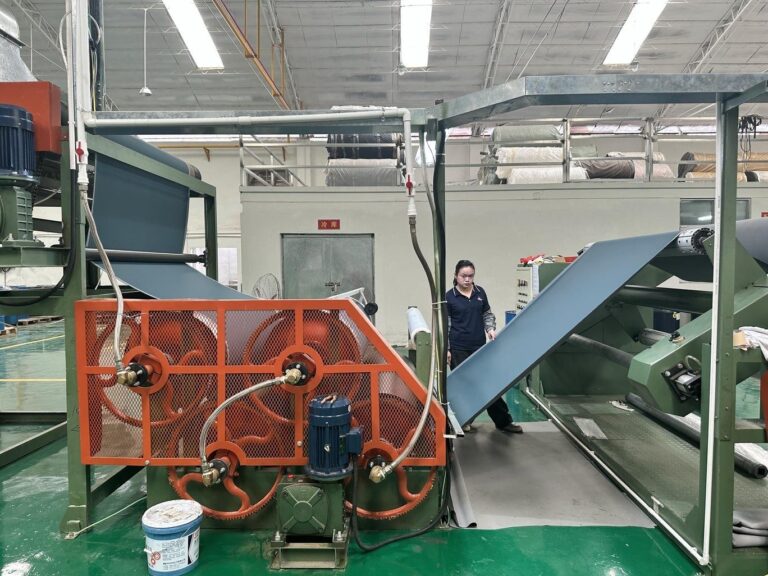
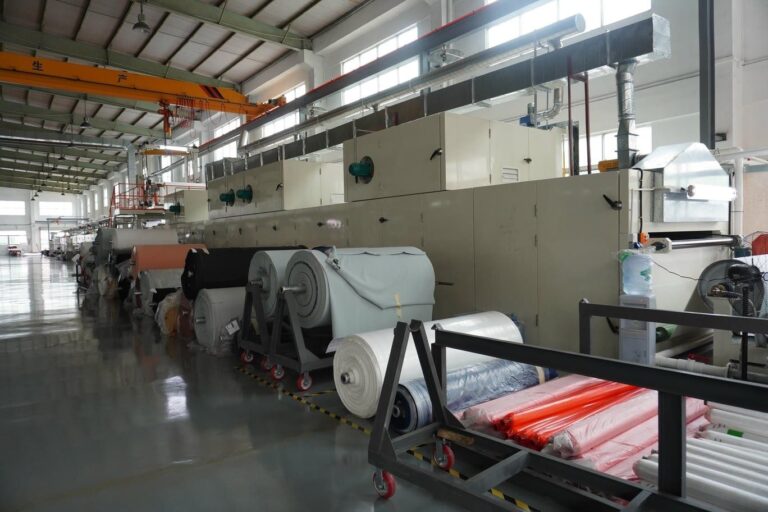
TOPSUN operates the process at three production bases in Dongguan (Guangdong), Yichang (Hubei), and Xiangyang (Hubei), with 10+ automated lines producing 500,000+ meters monthly. The full production process follows nine sequential stages, each with controlled parameters that determine the final material’s thickness, texture, color, and performance properties.

Step-by-Step: The Nine-Stage Silicone Leather Manufacturing Process
| Step | Process | Key Parameters | Purpose |
|---|---|---|---|
| 1 | Material compounding | Vacuum: -0.095 MPa; viscosity: 8,000–15,000 mPa·s | Mix LSR + crosslinker + catalyst + pigments |
| 2 | Release paper coating | 2–3 layers; 0.15–0.50 mm/layer; knife-over-roll | Form surface texture and topcoat |
| 3 | Primary curing | 130–150°C; 2–5 min per zone | Crosslink silicone polymer, partially cure |
| 4 | Substrate lamination | Controlled pressure + heat; tacky topcoat | Bond textile base to silicone coating |
| 5 | Secondary curing | 150–200°C; 3–5 zones; 60–120 sec/zone | Complete crosslinking, develop final properties |
| 6 | Embossing / finishing | Release paper texture transfer or custom rollers | Apply surface texture and gloss/matte finish |
| 7 | Release paper separation | Controlled peel; paper rewound for reuse | Reveal finished silicone leather surface |
| 8 | Rewinding and slitting | 1350–1800 mm width; paper cores; stretch wrap | Prepare finished rolls for QC and shipping |
| 9 | QC inspection | Thickness, color (Delta E ≤ 1.0), defects, batch # | Verify compliance with specifications |

Critical Process Parameters That Determine Material Quality
Three parameters in the silicone leather manufacturing process determine whether the finished material meets specification or fails QC: coating thickness consistency, curing temperature profile, and lamination bonding strength. Coating thickness is controlled through knife-over-roll or reverse roll coating, with each layer applied at 0.15–0.50 mm. The total coating thickness determines the material’s abrasion resistance, flexibility, and hand-feel — too thin and the surface wears prematurely; too thick and the material becomes rigid. Our process controls thickness to ±0.02 mm tolerance across the web width.
Curing temperature controls the degree of crosslinking in the silicone polymer. Undercured silicone remains tacky and lacks mechanical strength; overcured silicone becomes brittle and loses elasticity. The silicone rubber manufacturing process uses a multi-zone oven with 3–5 stages at 150–200°C, with 60–120 seconds dwell time per zone. The temperature profile ramps gradually to prevent thermal shock and ensure uniform crosslinking through the full coating depth.

Environmental Profile: Why This Process Is Fundamentally Different
The silicone leather manufacturing process produces zero VOC emissions because there are no solvents to evaporate. Liquid silicone rubber cures through addition-cure (platinum-catalyzed) or condensation-cure chemistry — the polymer chains crosslink without releasing volatile byproducts. This eliminates the need for the solvent recovery systems, thermal oxidizers, and ventilation infrastructure that PU coating lines require. The process uses no water in the coating stage (chrome tanning uses 15,000 liters per hide). Release paper is reused for multiple cycles before recycling. And the finished material is 100% recyclable — silicone can be repolymerized and the textile base can be recovered.
For B2B buyers who need to document the environmental footprint of their supply chain — whether for LEED certification, EU Ecolabel compatibility, or corporate ESG reporting — the silicone coated fabric production documentation provides the full material and energy flow from raw material to finished roll. The process operates within the environmental parameters of all three TOPSUN facility locations, with compliance verified through third-party environmental audits.

Video: Factory Production Line
See the complete silicone leather manufacturing process from compounding through finished roll:
Factory production line — from silicone compounding to finished roll inspection.
About TOPSUN
TOPSUN operates the silicone leather manufacturing process across 60,000+ m² of production space in Dongguan, Yichang, and Xiangyang. The nine-stage solvent-free dry coating process produces 500,000+ meters monthly across 10+ automated lines, with 500-meter MOQ and 7–15 day lead times. Every roll ships with batch traceability documentation linking it to a specific compounding lot, coating line, curing profile, and QC sign-off. Materials carry ISO 10993-5, FDA 21 CFR 177.2600, REACH, and EN 13773 Class 4 certifications. Request free A4 swatches and a process specification sheet through our samples center. Contact our process engineering team at info@topsunsiliconeleather.com or WhatsApp +44 744 461 7933.
Frequently Asked Questions
What is the difference between silicone leather and PU leather manufacturing?
Silicone leather is manufactured through a solvent-free dry coating process where liquid silicone rubber is coated onto release paper, cured, and laminated with a textile substrate. PU leather is manufactured through a wet or dry coating process using solvent-based polyurethane, which requires solvent evaporation and recovery systems. The silicone process uses no water in the coating stage, produces zero VOC emissions, and requires no chrome tanning. The PU process releases solvent vapors, requires ventilation infrastructure, and produces solvent-laden waste. The fundamental difference is that silicone crosslinks through addition-cure chemistry (no volatile byproducts), while PU relies on solvent evaporation for film formation.
Does the silicone leather manufacturing process use solvents?
No. The process uses 100% solid silicone formulations — liquid silicone rubber mixed with a platinum catalyst crosslinker and pigments under vacuum. Curing occurs through addition-cure chemistry at 130–200°C, where polymer chains crosslink without releasing any volatile compounds. There are no solvents to evaporate, no solvent recovery systems needed, and no VOC emissions throughout the process. This is verified through ISO 16000-6 and VDA 277 testing on the finished material, which show zero detectable VOC content.
Get the Full Process Specification
If your engineering or procurement team needs to understand the silicone leather manufacturing process in detail — for supplier qualification, environmental documentation, or production planning — request our process specification sheet with full parameter data, environmental flow diagrams, and third-party certification reports. TOPSUN also offers factory tours for qualified B2B buyers to inspect the production line, QC protocols, and environmental controls firsthand. Contact us at info@topsunsiliconeleather.com or WhatsApp +44 744 461 7933 to arrange a process documentation package or schedule a factory visit.