Last spring, a brand’s restricted substances list arrived in our inbox with a new line item at the top: DMF residue, per batch, with third-party verification. The buyer who sent it had just watched a competitor’s coated fabric get pulled from two retail programs over solvent traces. Her question was direct. Does your sustainable textile manufacturing hold up when someone audits the chemistry?
Stories like this one now mark the entry point to sustainable textile manufacturing. Brands no longer ask whether a fabric looks green. They ask what the coating line emits, what the water loop returns, and which certificates document both. This article walks through that shift from the factory side, where the real decisions get made.
Why Coating Chemistry Decides Sustainable Textile Manufacturing
The chemistry starts at the coater. Traditional solvent-based PU relies on carriers such as DMF, NMP, and DMAC to move polyurethane onto fabric. Those solvents are classified as carcinogenic, mutagenic, and reprotoxic substances, and they release VOCs throughout the drying stage. A factory can recycle water and mount solar panels, and still carry that line item.
Water use tells the same story from another angle. Processing a kilogram of fiber can consume 100 to 150 liters of water, and solvent-recovery systems add their own energy bill. Add PFAS-based repellents, which account for roughly half of global PFAS use in water-resistant textile coatings, and the chemical footprint compounds. None of it appears on the finished swatch. Recovery systems cannot catch what the chemistry never releases.
This is why compliance teams read coating chemistry first. The route a factory chooses decides which restrictions it can ever meet.

Every drum entering the plant writes a line into the compliance file.
Audit Your Supply Chain Chemistry
What Solvent-Free Production Actually Changes
Solvent-free lines remove the carrier problem at the source. Waterborne PU systems replace DMF with water and cut VOC emissions by up to 98% in published comparisons. Silicone coating takes the step further: the polymer cures without solvent carriers and without plasticizers that later migrate. The emissions conversation shrinks before it starts.
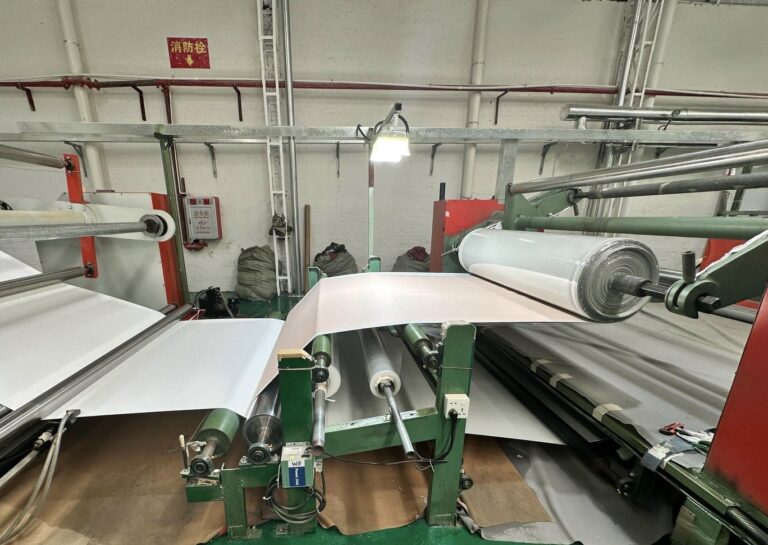
Our own line runs this way. Substrate, coating, and curing stay inside one workflow, so every input traces back to a batch record. Buyers who walk the floor see the same chemistry on the wall chart that they read in the datasheet. The full route is documented in our factory production walkthrough.
Substrate choices extend the same logic upstream. Our PET-based silicone leather supports recycled polyester bases, so the material story begins before the coater even runs.
Near-zero VOC starts with what never enters the line, not with what gets filtered out.

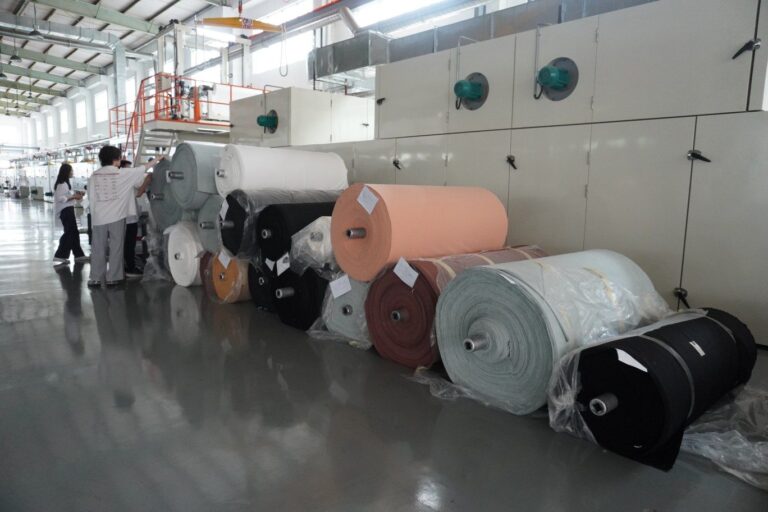
A finished roll carries the whole process history with it.
The Paper Trail Sustainable Textile Manufacturing Requires
Certificates make process claims checkable. OEKO-TEX STeP audits the entire production facility across six modules, from chemical management to social responsibility, and issues the certificate for three years. GOTS covers organic inputs with a 70% certified-fiber floor. Product-level labels then sit on top of process certificates, not instead of them.
The hierarchy matters. A hangtag describes a product. A STeP certificate describes the building that made it. Sustainable textile manufacturing claims hold up when both layers exist and a third party can verify each one. Our eco-friendly silicone leather page lists what we document today, including SGS batch reports.

Novel materials make headlines. Verified processes make shipments.
The numbers give the hierarchy teeth. A solvent-free line cuts VOC output by 98% before any filter runs. A recycled PET base removes virgin polymer demand upstream. Batch-level SGS reports then tie each shipped roll to the process that made it. Three documents, three stages, one verifiable chain.
A Process Claim, Not a Product Claim
Sustainable textile manufacturing is proven at the coater, in the water loop, and in the audit file, long before it reaches a label. Choose the process first, and the product claim takes care of itself.
Request Solvent-Free Samples with SGS Reports
About TOPSUN
TOPSUN operates a solvent-free silicone coating line with no DMF, NMP, or plasticizers to manage, documented batch by batch. Third-party SGS reports and factory audits back every shipment that leaves the warehouse.
Frequently Asked Questions
Is silicone coating actually solvent-free?
Yes. Silicone coating cures from a solvent-free system, so the DMF, NMP, and DMAC carriers used in solvent-based PU never enter the process. Waterborne PU achieves a similar result by replacing solvent with water as the carrier.
Which certificate should I ask for first?
Ask for the process certificate before the product label. OEKO-TEX STeP documents the facility, while batch-level SGS reports document what actually shipped. Together they close most of the credibility gap.
References
1. https://polycoresolutions.com/pages/waterborne-… – Waterborne PU Coatings: DMF, NMP, and DMAC classified as CMR substances; waterborne systems cut VOC emissions by 98% vs solvent-based.
2. https://wyss.harvard.edu/technology/nixe-bioins… – Harvard Wyss Institute, Nixe Coating: processing 1 kg of fiber requires 100-150 liters of water; water-resistant textile coatings account for ~50% of global PFAS use.
3. https://www.oeko-tex.com/en/our-standards/oeko-… – OEKO-TEX STeP: certification for the entire textile and leather production across six modules, issued for three years.