As a technical sourcing engineer who’s audited 80+ leather factories across China, Vietnam, and Turkey over the past decade, I can tell you that half the “OEM leather suppliers” on B2B directories aren’t manufacturers at all — they’re trading companies with a polished website and a borrowed factory photo. The difference costs you control over quality, lead time, and IP protection. After building supplier evaluation frameworks for three Fortune 500 furniture brands, I’ve distilled the verification process into six steps that separate real factories from middlemen before you sign a contract.
What “OEM Leather Supplier” Actually Means — and What It Doesn’t
OEM stands for Original Equipment Manufacturer. In leather sourcing, OEM means you — the brand — provide the designs, specifications, and technical requirements, and the factory produces material precisely to your brief. You own the formulation, the tooling, and the intellectual property. The supplier executes your vision. ODM (Original Design Manufacturer) is different: the factory offers its own formulations and designs that you select and brand. Private label sits further down the spectrum — you’re essentially reselling the supplier’s standard product under your brand name.
The distinction matters because each model carries different risks. OEM gives you maximum control but requires the supplier to have genuine engineering capability — not just production capacity. A trading company can source material, but it cannot reformulate a coating, adjust a embossing pattern, or troubleshoot a color-fastness failure on the production line. When B2B buyers complain about “supplier communication problems,” the root cause is usually that they hired a middleman for a job that required a manufacturer.

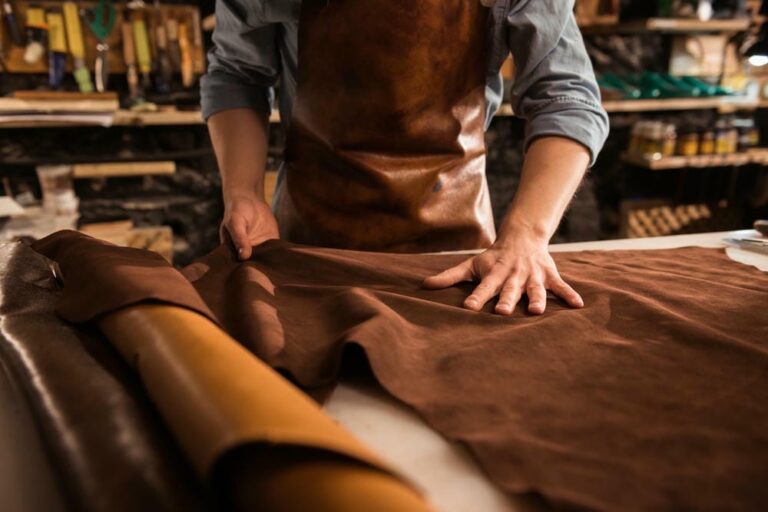
A real OEM leather supplier’s production floor — base fabric rolls staged for the coating line. Trading companies show you this photo; manufacturers let you walk the line.
The 6-Step OEM Leather Supplier Verification Framework
I’ve built this framework from 80+ factory audits across Asia. Each step addresses a specific failure mode I’ve encountered in real sourcing programs — from trading companies masquerading as manufacturers to certification fraud to sample-to-production bait-and-switch.
| Step | What to Verify | Red Flag | Real Manufacturer Signal |
|---|---|---|---|
| 1. Business License | Registered business scope includes manufacturing (生产/制造), not just trading (贸易) | Scope lists only “trading” or “wholesale” | Scope includes manufacturing + registered production address |
| 2. Factory Tour | Live video walkthrough showing coating lines, testing lab, and warehouse | Only offers showroom photos; refuses live video | Unscheduled video call accepted; operators visible on line |
| 3. Certification Stack | Current REACH, OEKO-TEX, ISO 9001 with scope matching your product category | Expired certs, scope mismatch, or “certificate in process” | Valid certs with traceable test reports from SGS or Intertek |
| 4. Sample-to-Production | Production batch matches approved sample within agreed tolerances | Sample quality dramatically exceeds production quality | Batch-level traceability with AQL inspection records |
| 5. Engineering Capability | In-house technical team that can reformulate coatings and customize textures | “We can do anything” with no technical documentation | Engineers who discuss polymer chemistry, not just pricing |
| 6. IP Protection | NNN agreement, tooling ownership clause, and export restriction on your custom formulations | Pushback on signing IP agreements | Standard NNN template ready; willing to register your tooling |

In-house testing laboratory — a real OEM leather supplier invests in equipment because quality control is their responsibility, not a third party’s afterthought.
Step 1-2: Business License and Factory Tour — Separating Factory from Fiction
The business license is the cheapest verification you’ll ever do, yet 40% of buyers skip it. In China, every registered company has a business license listing its scope of business. If the scope says (trading) or (wholesale) but not (production) or (manufacturing), you’re dealing with a middleman. In Vietnam, request the Enterprise Registration Certificate and verify the production address against the registered address — trading companies often list a warehouse address, not a factory.
The factory tour is where most trading companies fail. I don’t mean a pre-scheduled factory visit with a catered lunch — I mean an unscheduled video call during production hours asking to see the coating line running, the testing lab in use, and the warehouse with your would-be order’s raw materials. A real manufacturer answers within minutes. A trading company needs 24-48 hours to coordinate with the actual factory they’ll claim as their own.
The 10-minute test: Call the supplier’s listed phone number during production hours and ask to see a live video of the coating line. If they can’t show you operators running machinery within 10 minutes, they don’t own the machinery.
Step 3-4: Certification Stack and Sample-to-Production Consistency
A certificate tells you very little without two things: the issue date and the scope. I’ve reviewed supplier presentations featuring certificates that expired three years ago or covered a different product category entirely. For OEM leather suppliers targeting Western markets, the baseline certification stack includes REACH compliance (EU chemical safety), OEKO-TEX Standard 100 (harmful substance testing), and ISO 9001 (quality management). For automotive applications, add IATF 16949. For social compliance, BSCI or SMETA audits cover labor, health, safety, and environmental standards.
The bigger risk is sample-to-production consistency. Some factories maintain a dedicated sample line that produces flawless swatches — and a separate production line that runs faster, hotter, and with less quality control. Request the AQL (Acceptable Quality Limit) inspection records from the supplier’s last three production batches, not just the sample approval. Ask for batch-level traceability: can they trace a roll of material back to the specific base fabric lot, coating batch, and operator? If the answer is “we don’t track that,” you’re buying from a factory that can’t diagnose its own defects — which means neither can you.

Production-scale base fabric unwinding — evidence of manufacturing capacity that a trading company’s office photo cannot replicate.
Durability comparison overview — a real OEM supplier provides technical evidence, not just product photos. Request this level of documentation from any supplier you’re evaluating.
Step 5-6: Engineering Capability and IP Protection
The final two steps separate good factories from great partners. Engineering capability means the supplier has in-house technical staff who can reformulate a coating for improved UV resistance, adjust an embossing roller for a custom texture, or troubleshoot a color-fastness issue on the production floor. When you ask a technical question, a real manufacturer’s engineering team responds with polymer chemistry, test data, and process adjustments — not a salesperson saying “we can do anything you need.” If the supplier cannot produce a single engineer for a technical discussion within 48 hours, they don’t have one.
IP protection is the step most buyers skip and most regret skipping. An NNN agreement (Non-Use, Non-Disclosure, Non-Circumvention) prevents the supplier from selling your custom formulation to competitors, using your tooling for other clients, or bypassing you to reach your customers. Verify that the supplier has a standard NNN template and is willing to register custom tooling and embossing rollers under your company name. The cost of drafting this agreement is trivial compared to discovering your proprietary texture on a competitor’s product six months after launch.
About TOPSUN: OEM Leather Supplier with In-House Engineering

Finished silicone leather sample — the quality standard that must match from sample approval through production batches.
TOPSUN operates as a direct OEM leather supplier from its own 60,000 m² manufacturing facility in Dongguan — with 10+ automated production lines, 500,000m monthly capacity, and in-house engineering support for brands that need custom silicone leather formulations, not just resold material. Our factory passes every step of the verification framework above: manufacturing-licensed business, live factory tours on request, current REACH and OEKO-TEX certifications with SGS and Intertek test reports, batch-level traceability, 10+ in-house engineers, and standard NNN agreements for custom formulations.
With three production bases (Dongguan, Yichang, Xiangyang), a 500-meter MOQ, 7-15 day lead times, and free A4 swatches shipped worldwide via DHL/FedEx, we serve 100+ brands across automotive, furniture, medical, and consumer electronics markets. Custom embossing rollers are produced in 7-10 days, and Pantone/RAL color matching achieves Delta E ≤ 1.0 batch-to-batch consistency.
OEM Leather Supplier FAQ
How can I tell if an OEM leather supplier is a real factory or a trading company?
Check the business license first — the registered scope must include manufacturing (production or manufacturing in Chinese; or the equivalent production classification in Vietnam, Turkey, etc.). Then request an unscheduled video call during production hours to see the coating line running, testing lab in use, and raw materials in the warehouse. A real manufacturer can show you live operators on machinery within minutes; a trading company needs 24-48 hours to coordinate with the actual factory. Also ask for batch-level traceability records and AQL inspection data from recent production runs — trading companies typically cannot produce these because they don’t control the quality process.
What certifications should an OEM leather supplier have for export markets?
For EU markets, require REACH compliance and OEKO-TEX Standard 100 certification. For North America, require CA Prop 65 compliance and ANSI/BIFMA performance standards for furniture applications. For automotive, add IATF 16949 and FMVSS 302 flame retardancy. For social compliance auditing, BSCI or SMETA (SEDEX) covers labor rights, health and safety, environment, and business ethics. Always verify the certificate’s issue date, expiry, and scope — a certificate that covers “synthetic leather” doesn’t verify “silicone leather” if the product category differs. Request the underlying test reports from SGS or Intertek, not just the certificate itself.
Verify Before You Sign
The cost of supplier verification is measured in hours; the cost of supplier failure is measured in months of delay, percentage points of defect rate, and lost customer trust. Run the 6-step framework before your next purchase order — and if your current supplier can’t pass Step 2, it’s time to find one who can.
Contact: info@topsunsiliconeleather.com | WhatsApp: +44 744 461 7933 | Free A4 swatches shipped worldwide via DHL/FedEx