USD 62.42 billion. That is what the global automotive interior material market is projected to reach in 2026, climbing to USD 88.27 billion by 2032 at a 5.91% CAGR. Behind that number sits a quieter procurement problem. Cabin programs now demand premium feel, low emissions, and 10-year durability in the same spec sheet. The material you lock in at design freeze decides whether your program delivers all three, or renegotiates trim suppliers halfway through.
| Property | Genuine Leather | PU Leather | PVC Leather | Silicone Leather |
|---|---|---|---|---|
| Typical service life | 10-15 yrs, with care | 3-5 yrs | 3-5 yrs | 10-15 yrs |
| Hydrolysis behavior | Dries and cracks if untreated | Fails in humid heat | Plasticizer loss | 14 wks at 85°C/85% RH, no delamination |
| Martindale abrasion | Varies by hide | 30K-80K typical | 30K-100K | 200,000+ contract grade |
| VOC profile | Low | Residual solvents | Plasticizers plus chlorine | Non-detect VOC, solvent-free |
| Cold / heat range | Cracks in deep cold | Stiffens below -10°C | Softens near 60°C | Flexible -40°C to 200°C |
| Flammability route | Treatable | Additive FR fades | Halogenated FR | Inherent FR, EN 13773 Class 4 |
The Automotive Interior Material Market in Numbers
Two forces push those numbers. Electrification keeps lifting the EV share of interior programs, and EV buyers audit cabin materials harder than combustion-car buyers ever did. When there is no engine note to hide behind, the cabin becomes the product. Safety regulation and circular-economy targets push the same way: lower emissions, documented compliance, recyclable content.
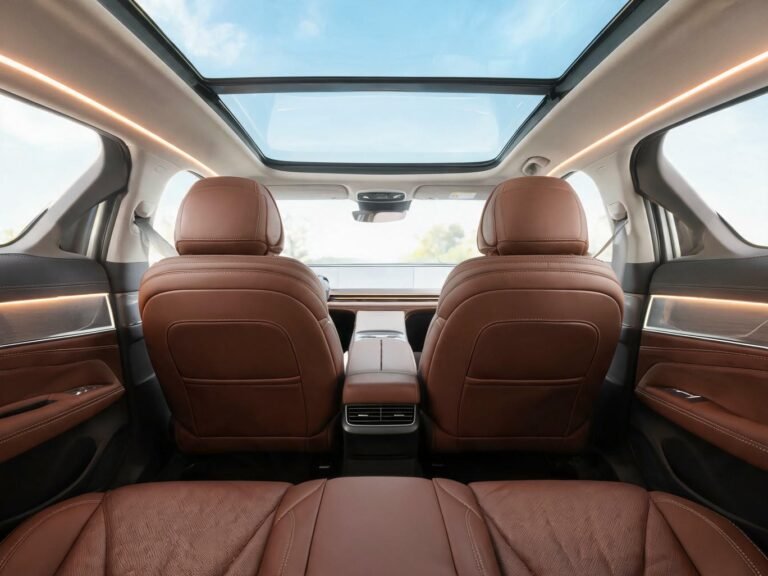
Seats, dashboards, door panels, headliners, and consoles all draw from the same pool of automotive interior material options, and every surface carries its own wear profile and certification burden. That is why experienced sourcing teams stop asking which material looks best. They ask which material survives the program’s full test plan. You can see how these surfaces break down by duty cycle in our automotive interior applications overview.
Context helps when you brief management. The wider automotive interior market, components included, is projected at USD 186.80 billion in 2026 and USD 217.11 billion by 2033. Materials are a fraction of that spend, but they decide how the rest of it is perceived. Trim quality drives the perceived value of every surface it covers.
The market will keep growing. The suppliers who document their specs will win the RFQs.

Martindale abrasion sampling on production batches keeps spec claims honest.
Material Options Compared for Car Interior Programs
Genuine leather still anchors luxury trims, and nothing replicates its grain. But hide-to-hide variation complicates color matching at volume, and it needs regular conditioning to resist cracking in dry climates.
PU leather dominates mid-market programs because it is cheap and consistent. Its weakness is hydrolysis. Polyester polyurethane breaks down in humid heat, which is why PU seats in tropical fleets often delaminate within three to five years. PVC carries similar durability limits, plus chlorine and plasticizer emissions that complicate cabin VOC compliance.
Silicone leather takes a different route. Its polymer backbone is silicon-oxygen rather than carbon, so it does not hydrolyze the way PU does. The trade-off used to be price. Today the gap narrows once you model a full program life, and a side-by-side silicone vs PU leather breakdown shows where each option earns its place.
None of this settles the decision on its own. Specs do.

Tensile and tear testing before any roll leaves the factory.
5 Specs Tier-1 Buyers Verify in an Automotive Interior Material
Brochures list properties. Purchase agreements list test methods. These are the five verifications we watch Tier-1 quality teams run before an automotive interior material earns program approval.
- FMVSS 302 flammability. The US federal burn-rate test caps horizontal burning at 100 mm/min. Ask for the actual report, not a certificate badge.
- VOC per ISO 16000-6. Cabin odor complaints turn into warranty costs fast. Non-detect VOC results and a 100% solvent-free coating are the claims worth seeing in writing.
- Abrasion per ISO 12947. Seat bolsters and door cards see different loads. In our Martindale sampling on every production batch, the High Performance line clears 200,000 cycles for contract seating.
- Hydrolysis resistance. We keep climate chambers running at 85°C and 85% relative humidity for up to 14 weeks with no delamination, strength loss, or surface degradation. Ask any supplier for that exact protocol.
- Color control. Grade 4-5 color fastness plus spectrophotometer Delta E checks on every roll keep batch-to-batch shade inside OEM tolerance.
One warning from our factory floor. Skip step four and the failure shows up two winters later as sticky, peeling bolsters on vehicles parked outdoors. By then the material is long installed.
The certification set behind every automotive-grade roll we ship.

Flame retardance verified on finished material, not just lab samples.
How EV Programs Are Rewriting the Interior Spec Sheet
EV programs change the checklist more than the menu. Lightweighting favors coated textiles over thick hides and foam laminates. Sensor-heavy cabins under glass roofs raise UV and thermal loads. And with range on every buyer’s mind, HVAC efficiency now punishes materials that soak up heat.
Emissions matter more, too. A sealed EV cabin amplifies any odor or fogging source, so non-detect VOC results have moved from nice-to-have to gate item. Cool-touch surfaces that stay usable in direct sun help as well. For programs running humid-climate fleets, we point engineers to our hydrolysis-resistant silicone leather, developed for exactly that duty cycle.
Heat and sunlight complete the picture. Cabin surfaces behind glass can exceed 90°C in parked vehicles, and UV-stable coatings rated beyond 1,500 hours of exposure hold their color where lesser materials chalk and fade. Cold matters at the other end. A material that stays flexible at -40°C never surprises you with winter cracking.
The pattern is clear. EV interiors reward materials whose performance is inherent, not added on.

EV cabins concentrate scrutiny on every surface the buyer touches.
The Warranty Math Most Quotations Ignore
Sticker price is not program cost. PU upholstery often quotes 20-30% below silicone leather per meter, yet the same climate-chamber logic that shows silicone surviving 14 weeks at 85°C and 85% relative humidity puts PU-class coatings on a 3-5 year hydrolysis clock. Fleet operators feel that gap as a retrim cycle, and retrim cycles are never just materials.
One ride-hailing fleet operator we worked with learned this mid-contract. Their PU seat covers in a coastal city fleet began delaminating around month 30, and every retrim meant vehicles pulled off the road for days while installers caught up. They moved their next 400-vehicle order to silicone leather. Two years in, those covers show surface wear from constant driver turnover but zero hydrolysis failures. The per-meter premium paid for itself in avoided downtime alone.
Run the arithmetic across a 10-year vehicle life. A single retrim cycle typically erases the per-meter saving on PU, then keeps charging through labor, downtime, and warranty administration. Materials rated for the full service life convert that open-ended risk into a fixed cost at design freeze, which is exactly what a procurement committee wants to sign.
That is why more RFQs now ask for lifecycle cost data alongside price lists. Bring test reports to the table and the conversation shifts from discounts to durability.
Sourcing teams can institutionalize this by scoring suppliers on three axes: certified lifespan data, warranty terms, and retrim support. Suppliers who resist that framework are pricing for the sale. Suppliers who welcome it are pricing for the program.
The Bottom Line Before You Sign
The automotive interior material market will reward suppliers who can prove performance, not just promise it. Before your next program award, run this checklist:
- Demand the FMVSS 302 report, not a logo.
- Get ISO 16000-6 VOC numbers in writing.
- Set Martindale thresholds per surface under ISO 12947.
- Require the 85°C / 85% RH 14-week hydrolysis protocol.
- Fix color tolerance with Grade 4-5 fastness and Delta E control.
Buyers who verify these five specs early avoid the mid-program material swaps that bleed margin and delay launches. The market has room for many materials. It has little patience for undocumented claims.
Request Automotive-Grade Samples
About TOPSUN
TOPSUN manufactures silicone-coated interior materials for car seats, dashboards, and door panels across EV and combustion programs.
FMVSS 302-tested and non-detect VOC, Martindale 200,000+ contract grade, 500,000 m monthly capacity, and 7-15 day delivery to 30+ countries.
Frequently Asked Questions
Does silicone leather pass FMVSS 302 without flame-retardant additives?
Yes. The silicone polymer is inherently flame resistant, and our Super Flame Retardant line reaches EN 13773 Class 4, the highest classification for contract textiles. FMVSS 302 reports ship with every automotive order.
What Martindale rating should I require for car seat material?
For driver seats in high-use fleets, specify 100,000 cycles minimum under ISO 12947. Contract and commercial seating programs typically demand 200,000 or more. Match the threshold to the surface, because bolsters and door cards see different loads than center panels.
How can I verify VOC claims before committing to a supplier?
Ask for third-party ISO 16000-6 test reports dated within the last year, and confirm the coating is 100% solvent-free with zero plasticizers. We welcome SGS, BV, or TÜV inspection before production, and every order ships with SGS test reports.
References
1. https://www.researchandmarkets.com/report/autom… – Automotive interior material market projected at USD 62.42B in 2026, USD 88.27B by 2032, 5.91% CAGR (2026)
2. https://www.marketsandmarkets.com/Market-Report… – Automotive interior market of USD 186.80B in 2026 rising to USD 217.11B by 2033, 2.2% CAGR (2026)