As a textile structure engineer who has analyzed microfiber leather material under electron microscopy for automotive and footwear clients, I’ve seen the same pattern repeatedly: the non-woven fiber architecture is remarkable — a three-dimensional matrix of 0.001-denier filaments that genuinely mimics the collagen network of genuine leather. But the polyurethane resin binding that matrix together is the same chemistry that hydrolyzes in humid environments within 3-5 years. The structure is brilliant. The chemistry is the flaw. And most B2B spec sheets don’t distinguish between the two — they treat “microfiber leather” as a single material, when it’s actually two materials working in tandem, one excellent and one fundamentally limited.
Download Structural Comparison Report
What Microfiber Leather Material Actually Is (and Isn’t)
Microfiber leather material is often called the “third generation” of artificial leather — the successor to PVC (first generation) and conventional PU (second generation). The distinction matters: PVC and standard PU coat a flat textile backing with a polymer film. Microfiber leather builds a three-dimensional non-woven structure from ultra-fine fibers — typically polyester or polyamide at 0.001 to 0.01 denier per filament, thinner than silk — then impregnates that structure with PU resin to create a material that replicates the collagen fiber network found in genuine animal hide.

Cross-section comparison reveals the structural difference: microfiber leather’s 3D non-woven matrix (left) vs. conventional PU’s flat coating on textile backing (right). The architecture is superior — but both use the same binder chemistry.
The composition is roughly 70% high-tenacity polyester microfiber non-woven base and 30% polyurethane resin. The manufacturing process follows four stages: fiber opening and carding to create a uniform web, needle-punching or hydroentanglement to entangle fibers into a dense 3D matrix, PU impregnation in a coagulation bath where resin fills voids and creates microporous structure, and surface finishing — coating, embossing, and coloring to achieve the desired grain texture. The result is a material with genuine structural sophistication that outperforms both PVC and standard PU on nearly every physical metric.
The problem is that “microfiber leather” is not a single material. It’s a composite of two materials: a fiber architecture (excellent) and a binder chemistry (limited). B2B buyers who specify “microfiber leather” on a purchase order are contracting for both — and the binder’s limitations will determine the product’s service life, regardless of how sophisticated the fiber architecture is.
The 3 Structural Wins of Microfiber Architecture
Under structural analysis, microfiber leather’s non-woven architecture delivers three measurable advantages over both conventional synthetic leather and, in some metrics, genuine leather. These wins are real, verifiable, and documented in laboratory testing — but they are structural properties, not chemical ones.
Win 1: Tensile Strength and Flexibility
Comparative testing published in footwear materials research shows microfiber synthetic leather achieving tensile strength of 12.06 N/mm² and elongation at break of 114.6% — outperforming both natural leather and conventional PU leather on robustness and flexibility simultaneously. The 3D non-woven fiber network distributes stress across thousands of entangled filaments rather than concentrating it at a coating-substrate interface, which is where conventional PU leather fails under tension. For B2B applications in automotive seating and performance footwear, this means microfiber leather maintains structural integrity at flex points where standard PU cracks within 50,000 cycles.
Win 2: Breathability and Water Vapor Permeability
The microporous structure created by PU coagulation around a non-woven fiber matrix delivers water vapor permeability of 65-80 mg/(cm²·24h) — roughly double the 30-40 mg/(cm²·24h) of conventional wet-processed PU leather. This is because the 3D fiber network creates interconnected channels that allow moisture vapor to pass through, while the dense fiber matrix blocks liquid water. For furniture upholstery and automotive interiors, this means microfiber leather regulates humidity better than any other synthetic — reducing the clammy, sticky feel that plagues PVC and standard PU in warm environments.
Win 3: Abrasion Resistance
In Martindale abrasion testing, high-quality microfiber leather consistently outperforms both genuine leather and standard PU — often by a factor of 5× over conventional PU. The non-woven fiber matrix presents a uniform surface where individual filaments absorb and distribute abrasion energy, unlike genuine leather’s varying grain structure or standard PU’s single coating layer that wears through to expose the textile backing. For B2B buyers specifying high-traffic applications — cinema seating, public transport, hotel lobby furniture — this is microfiber leather’s strongest structural advantage.

Flexural testing — microfiber leather’s 3D architecture distributes stress across thousands of filaments, delaying the flex-point cracking that destroys conventional PU leather.
The 1 Critical Failure: PU Binder Hydrolysis
Here is where the diagnosis turns. Every structural advantage listed above — tensile strength, breathability, abrasion resistance — is a property of the fiber architecture. But the material that holds that architecture together, fills the voids, and creates the microporous structure is polyurethane resin. And PU resin hydrolyzes.
Hydrolysis is the chemical breakdown of PU polymer chains through reaction with water molecules — specifically, the cleavage of ester bonds in polyester-based PU resins. In environments with humidity above 60% and temperatures above 25°C, this reaction accelerates significantly. The PU binder loses tensile strength, becomes brittle, and begins to separate from the fiber matrix. The non-woven architecture remains intact — the fibers themselves don’t degrade — but the resin holding them together fails, causing the material to delaminate, crack, and lose its structural cohesion. The result looks like the fiber matrix “falling apart,” when in reality the binder has failed.
| Structural Property | How Microfiber Excels | Where PU Binder Fails | Impact on B2B Lifespan | Silicone Alternative |
|---|---|---|---|---|
| Tensile Strength | 12.06 N/mm² — 3D fiber network distributes stress | PU ester bonds hydrolyze → binder loses adhesion to fibers | Strength drops 30-50% after 3 years in humid environments | Si-O-Si bonds resist hydrolysis; tensile ≥ 10-15 N/mm maintained |
| Breathability | 65-80 mg/(cm²·24h) — microporous channels allow vapor transfer | Hydrolysis fills micropores with degradation products → permeability drops | Material becomes clammy and non-breathable by year 4 | Silicone’s open-cell structure maintains breathability without hydrolysis |
| Abrasion Resistance | 5× conventional PU in Martindale tests — uniform fiber surface | As binder degrades, fiber surface loosens → pilling and surface loss | Abrasion resistance drops 40% as PU binder loses cohesion | ≥ 200,000 Martindale cycles maintained throughout service life |
| Flex Resistance | 3D matrix flexes without cracking at stress points | Brittle PU binder cracks at flex points after hydrolysis onset | Flex-point cracking appears at year 3-5 in humid climates | ≥ 50,000-100,000 flex cycles; silicone retains elasticity at flex points |
Material comparison — see how silicone leather’s polymer chemistry eliminates the hydrolysis failure mode that limits microfiber leather’s PU binder.
Microfiber vs PU vs Genuine Leather: Where Each Fails
The B2B procurement question isn’t “which material is best” — it’s “which failure mode is acceptable for your application and service environment.” Each material has a specific structural strength and a specific chemical weakness:
Conventional PU leather fails at the coating-substrate interface. The flat polymer film separates from the textile backing under flex, UV, and humidity — typically within 2-3 years in commercial environments. Its weakness is structural: it’s a two-layer system where the layers aren’t chemically bonded.
Microfiber leather solves PU’s structural weakness with a 3D non-woven architecture that eliminates the coating-substrate interface. But it inherits PU’s chemical weakness: the polyester-based PU resin binder hydrolyzes in humid environments, causing the fiber matrix to lose cohesion after 3-5 years. Its weakness is chemical: the binder is the same hydrolysis-prone polymer.
Genuine leather has neither structural nor chemical weakness in the traditional sense — collagen is an extraordinary biomaterial. But it has biological variability: thickness, grain density, and tensile strength vary across every hide and even within a single hide. For B2B production at scale, this variability creates yield loss, quality inconsistency, and batch-to-batch specification drift. Its weakness is consistency: no two hides are identical.

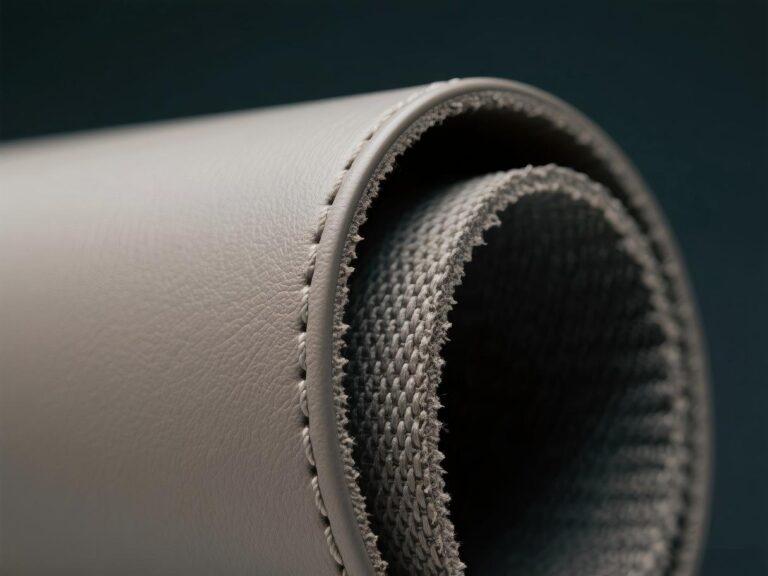
Folded texture closeup — the surface appearance of microfiber leather is nearly indistinguishable from genuine leather. The difference isn’t visible; it’s molecular.
How Silicone Leather Replaces the PU Binder Flaw
TOPSUN engineers silicone leather that applies the same principle as microfiber leather — a polymer-impregnated non-woven architecture — but replaces the PU binder with silicone polymer. The Si-O-Si (siloxane) backbone of silicone is fundamentally resistant to hydrolysis because it contains no ester bonds for water molecules to cleave. Where polyester-based PU resin breaks down through reaction with H₂O at the molecular level, silicone’s inorganic backbone is chemically inert in the presence of moisture, heat, and UV.

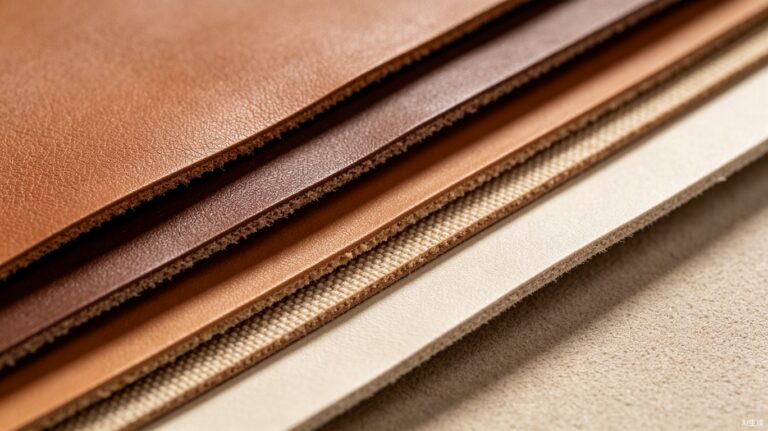
Silicone leather texture — the same structural approach as microfiber leather, but with a binder chemistry that doesn’t hydrolyze. The architecture wins; the chemistry survives.
The result is a material that retains microfiber leather’s structural advantages — the 3D non-woven architecture, the breathability, the abrasion resistance — while eliminating its single critical failure mode. TOPSUN’s silicone leather achieves Martindale abrasion resistance of ≥ 200,000 cycles, UV stability of 1,000+ hours with no fading or yellowing, and a service temperature range of -40°C to 250°C. Certified to ISO 10993-5 for biocompatibility, REACH chemical compliance, OEKO-TEX Standard 100, and GREENGUARD Gold, the material maintains its structural and chemical integrity across a 10+ year service life in environments where microfiber leather’s PU binder would have already begun hydrolyzing.
Frequently Asked Questions
Is microfiber leather better than PU leather?
Structurally, yes — microfiber leather’s 3D non-woven architecture outperforms conventional PU on tensile strength (12.06 vs. ~8 N/mm²), breathability (65-80 vs. 30-40 mg/cm²·24h), and abrasion resistance (5× longer in Martindale tests). Chemically, no — both use PU resin, which hydrolyzes in humid environments. The fiber architecture is superior; the binder chemistry is the same limitation.
How long does microfiber leather material last before the PU binder degrades?
In moderate-humidity environments (below 50% RH), microfiber leather can maintain structural integrity for 5-7 years. In high-humidity environments above 60% RH with temperatures above 25°C — typical of tropical, subtropical, and many commercial indoor environments — PU binder hydrolysis begins measurably within 3 years, with visible delamination and flex-point cracking by year 4-5. The fiber architecture itself does not degrade; the binder fails.
Can the PU binder in microfiber leather be replaced with a more stable polymer?
Yes — silicone polymer can impregnate the same non-woven fiber matrix, creating a material with microfiber leather’s structural advantages but without PU’s hydrolysis vulnerability. Silicone’s Si-O-Si backbone contains no ester bonds, making it chemically inert to water cleavage. This is the engineering principle behind TOPSUN’s silicone leather.