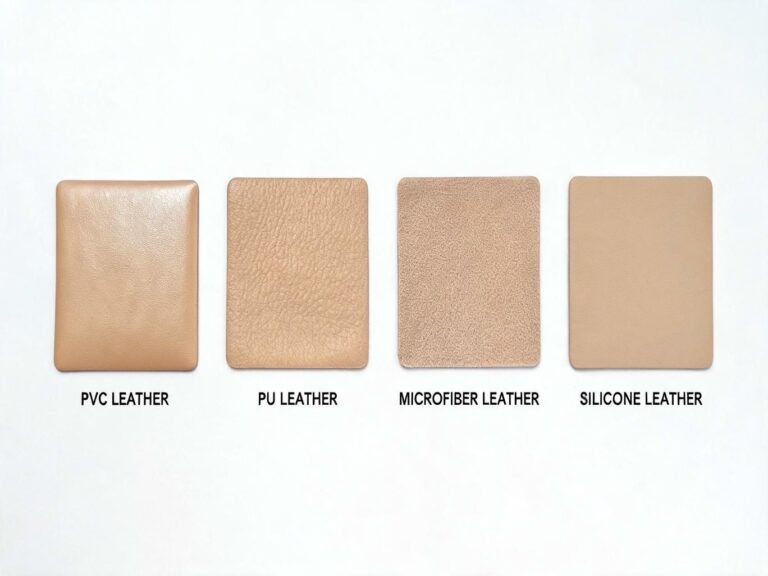
As a compliance auditor, I’ve rejected more fake leather shipments than I’ve approved. The pattern is always the same: a supplier ships samples that pass initial inspection — soft hand, rich color, clean surface — then 14 months into production, the warranty claims start. Cracking along stress lines. Peeling at seams. Surface tackiness from plasticizer migration. And the supplier’s response: “That’s normal wear for this material class.”
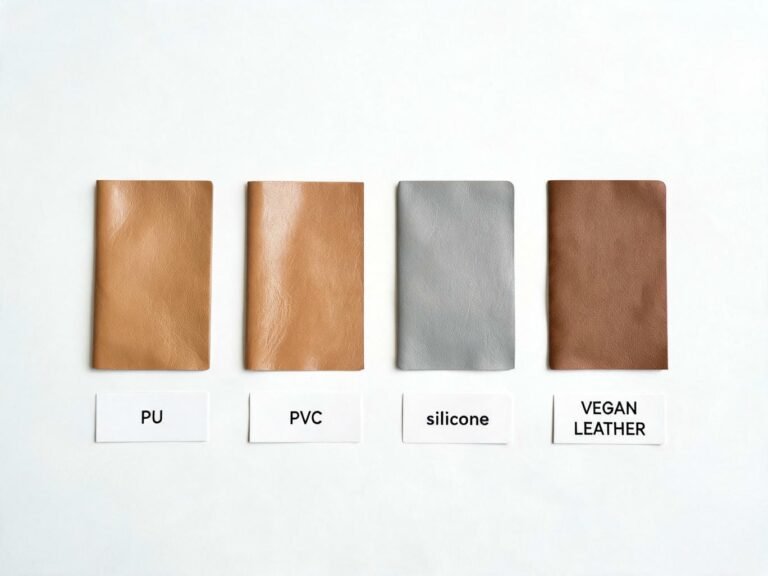
It’s not normal. It’s a predictable failure mode built into the chemistry of PVC vinyl and PU faux leather. The problem is that most B2B buyers can’t distinguish between the three materials that dominate the “fake leather” category — PVC vinyl, polyurethane (PU), and silicone — until it’s too late. By the time a warranty claim surfaces, you’re already locked into a production run, a supplier relationship, and a customer expectation that none of these materials can sustain.
The core issue: PVC vinyl and PU faux leather share a fatal flaw — both rely on organic polymer backbones and chemical plasticizers that evaporate, hydrolyze, and degrade over time. Silicone leather’s inorganic Si-O backbone doesn’t. The performance gap isn’t incremental — it’s 4–8× longer service life.
The 3 Materials Called “Fake Leather” — and How They Fail
PVC Vinyl (Polyvinyl Chloride)
Failure Mode: Plasticizer Evaporation & Surface Hardening 2–3 years
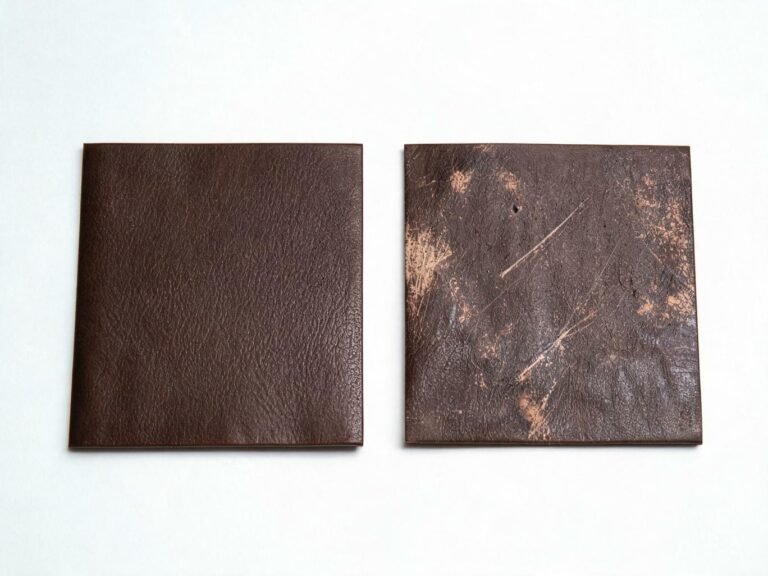
PVC leather is made by coating a fabric substrate with polyvinyl chloride mixed with liquid plasticizers (typically phthalates) that give the material its flexibility. The problem: plasticizers are not chemically bonded to the PVC matrix. They evaporate slowly — accelerated by heat, UV, and friction — leaving the PVC rigid and brittle. The surface cracks along stress lines where the material flexes repeatedly: seat edges, armrests, steering wheel grips. Once cracks form, they propagate rapidly because the now-brittle PVC has no elongation capacity.
Compliance red flags: Phthalate content (restricted under REACH Annex XVII), chlorine emissions during incineration, non-recyclable, plasticizer migration into skin-contact surfaces.

PVC vinyl leather closeup — the plasticizer-laden surface that hardens and cracks within 2–3 years.
PU Faux Leather (Polyurethane)
Failure Mode: Hydrolysis & Delamination 3–5 years
PU leather uses a polyurethane coating applied to a fabric backing. It’s softer and more breathable than PVC, which is why it dominates mid-range automotive and furniture applications. But PU’s ester bonds are chemically vulnerable to hydrolysis — water molecules break the polymer chain under heat and humidity. In tropical climates, high-humidity warehouses, or marine environments, PU delaminates in 2–3 years. In temperate climates, you get 4–5 years before the coating separates from the backing fabric.
Compliance red flags: DMF (dimethylformamide) solvent residue, VOC emissions (ISO 16000-6), poor UV stability (surface cracking after 200–400 hours of exposure).
Silicone Leather
No Predictable Failure Mode Within 10+ Years
Silicone leather uses an addition-cured silicone elastomer coated onto fabric. The Si-O (silicon-oxygen) backbone is the same chemical bond found in quartz and glass — it’s inert to water (no hydrolysis), stable under UV (no chain scission), and contains no plasticizers to evaporate. In our testing, TOPSUN silicone leather maintains flexibility, color, and surface integrity after 200,000+ Martindale abrasion cycles, 1,000+ hours of UV exposure, and 1,000+ hours of salt-spray resistance. The material doesn’t degrade; it outlasts the product it’s upholstering.
Head-to-Head: PVC vs PU vs Silicone Performance Data
| Property | PVC Vinyl | PU Faux Leather | Silicone Leather (TOPSUN) |
|---|---|---|---|
| Polymer backbone | C-C (organic) + plasticizers | C-C (organic, ester bonds) | Si-O (inorganic, same as quartz) |
| Martindale abrasion | 25,000–100,000 cycles | 50,000–80,000 cycles | 200,000+ cycles (SGS verified) |
| Service life | 2–3 years | 3–5 years | 10+ years |
| Temperature range | -10°C to 60°C | -20°C to 80°C | -40°C to 250°C |
| UV resistance | Poor — cracks in 1–2 years | Poor — cracks in 200–400 hrs | Excellent — 1,000+ hours no fading |
| Hydrolysis resistance | Moderate | Poor — ester bonds hydrolyze | Excellent — Si-O inert to water |
| VOC emissions | Contains plasticizers, chlorine | Contains DMF, solvents | Zero — solvent-free, addition-cured |
| Plasticizer content | 20–40% phthalates (REACH restricted) | None (but solvent residue) | None — plasticizer-free |
| Recyclable | No — chlorine contamination | Limited | Yes — 100% recyclable |
| Flame retardancy | Flammable, toxic smoke | Flammable | Self-extinguishing (EN 13773 Class 4) |
| REACH compliance | Risk — phthalate restrictions | Risk — DMF, solvent residues | Compliant by material design |

Material structure comparison — how silicone’s inorganic backbone outperforms organic PU and PVC chains.
The Hidden Cost of Cheap: 5-Year Total Cost Analysis
B2B buyers often choose PVC or PU because the per-meter price looks attractive. But material cost is only one line item. Here’s what the 5-year ledger actually looks like when you account for failure, replacement, and warranty costs:
| Cost Category (5-Year, per 1,000m) | PVC Vinyl | PU Faux Leather | Silicone Leather (TOPSUN) |
|---|---|---|---|
| Initial material cost | $2–4/m = $2,000–4,000 | $4–8/m = $4,000–8,000 | $8–15/m = $8,000–15,000 |
| Replacement cycles (5 yrs) | 2× replacement = +$4,000–8,000 | 1× replacement = +$4,000–8,000 | 0× replacement = $0 |
| Warranty claim rate | 15–25% (cracking, peeling) | 8–15% (hydrolysis, delamination) | <1% (no predictable failure mode) |
| Cleaning/maintenance | Requires protectants, conditioners | Requires protectants, conditioners | Water-only cleaning, no protectants |
| Compliance documentation | High — phthalate testing, REACH reporting | Moderate — DMF testing, VOC reporting | Low — compliant by design, SGS verified |
| 5-year total | $8,000–16,000+ | $10,000–18,000+ | $8,000–15,000 |
The counterintuitive truth: Silicone leather is often cheaper on a 5-year total cost basis — despite a higher per-meter price — because it eliminates replacement cycles, warranty claims, and compliance documentation overhead. The “expensive” option becomes the economical one when you calculate lifecycle cost, not unit cost.
When to Use Each Material: Application-Specific Guidance
I’m not going to tell you silicone leather is the answer to every application. It’s not. Here’s an honest breakdown of when each material makes sense — and when it doesn’t:
Choose PVC Vinyl when:
- Upfront cost is the only decision criterion and product lifespan is <2 years (promotional items, seasonal goods, disposable packaging).
- The application is indoor-only with no UV exposure, no flex stress, and no skin contact.
- You have no REACH, phthalate, or VOC compliance requirements.
Choose PU Faux Leather when:
- You need a softer hand-feel than PVC at a moderate price point (mid-range furniture, automotive economy trim).
- The product lifespan target is 3–5 years in temperate, low-humidity environments.
- You can manage DMF/VOC compliance through documentation and supplier audits.
Choose Silicone Leather when:
- Your product carries a warranty >3 years and warranty claims are expensive (automotive, commercial furniture, medical equipment).
- The application involves UV exposure, humidity, temperature extremes, or chemical cleaning (marine, outdoor, healthcare, automotive interiors).
- Compliance is non-negotiable: REACH, ISO 10993-5 biocompatibility, FDA food-contact, EN 13733 Class 4 flame retardancy.
- Your brand positions on sustainability: PVC-free, solvent-free, zero-VOC, 100% recyclable, vegan/cruelty-free.
Durability comparison — silicone leather vs. PU and PVC in abrasion, UV, and hydrolysis testing.

Martindale abrasion tester — the machine that separates 200,000-cycle silicone from 50,000-cycle PU.
About TOPSUN
TOPSUN manufactures silicone leather that eliminates the failure modes inherent in PVC vinyl and PU faux leather. Our 60,000+ m² facility in Dongguan, Yichang, and Xiangyang, China operates 10+ automated coating lines producing 500,000+ meters monthly for 100+ brands across automotive, furniture, medical, marine, 3C, and children’s product applications.
Our silicone leather uses a solvent-free, addition-cured silicone elastomer with an inorganic Si-O backbone — the same chemical structure as quartz — that resists hydrolysis, UV degradation, and plasticizer evaporation. Verified performance: Martindale abrasion ≥200,000 cycles (8× the PU standard), UV resistance 1,000+ hours, temperature range -40°C to 250°C, hydrolysis-proof, salt-spray resistant 1,000+ hours. Certifications: ISO 10993-5 biocompatibility, REACH, FDA 21 CFR 177.2600, EN 13733 Class 4, PAHs — all third-party verified by SGS-CSTC and Intertek. PVC-free, phthalate-free, DMF-free, zero-VOC, 100% recyclable.
We offer free A4 swatch samples shipped worldwide via DHL/FedEx so you can conduct your own abrasion, hydrolysis, and UV testing before committing to volume. Silicone vs. PU comparison | PVC and PU analysis | Full vs. semi-silicone guide
Frequently Asked Questions
Is silicone leather more expensive than PVC or PU?
On a per-meter basis, yes — silicone leather costs 2–4× more than PVC and 1.5–2× more than PU. But on a 5-year total cost basis, silicone is often cheaper because it eliminates replacement cycles, warranty claims, and compliance documentation. A furniture manufacturer who switches from PU to silicone leather typically breaks even at year 3–4 and saves 20–40% over the product’s full lifecycle. Request our cost comparison model for your specific application.
Can silicone leather pass the same certifications as PVC or PU?
Silicone leather doesn’t just pass the same certifications — it exceeds them. PVC requires phthalate compliance testing and often fails REACH Annex XVII restrictions. PU requires DMF residue testing and VOC emissions monitoring. Silicone leather is compliant by material design: no plasticizers to restrict, no solvents to test for, no VOCs to measure. TOPSUN’s certifications include ISO 10993-5, REACH, FDA 21 CFR 177.2600, EN 13733 Class 4, and PAHs — all verified by SGS and Intertek, not self-declared.
What happens to silicone leather at end of life — is it recyclable?
Yes. Unlike PVC (which contaminates recycling streams with chlorine) and PU (which has limited recyclability), silicone leather is 100% recyclable. The silicone elastomer can be ground and reprocessed into lower-grade silicone products, and the fabric substrate can be separated and recycled independently. This supports circular economy initiatives and LEED/EU Ecolabel compatible building certifications — increasingly required by EU procurement specifications.
Stop Accepting Predictable Failures
Get free A4 swatch samples of silicone leather and run your own abrasion, UV, and hydrolysis testing. Shipped worldwide via DHL/FedEx.
Request Free Samples Get a Custom Quote
Read our detailed silicone vs. PU technical comparison or see why silicone leather is eco-friendly.