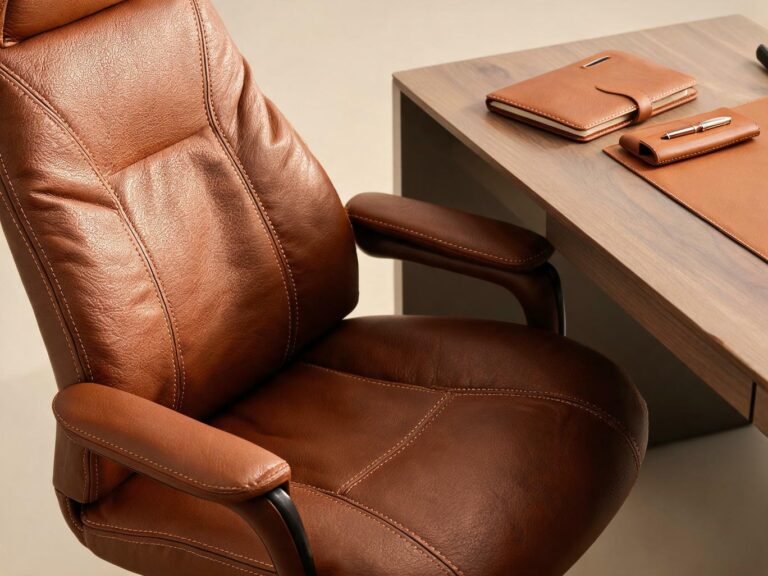
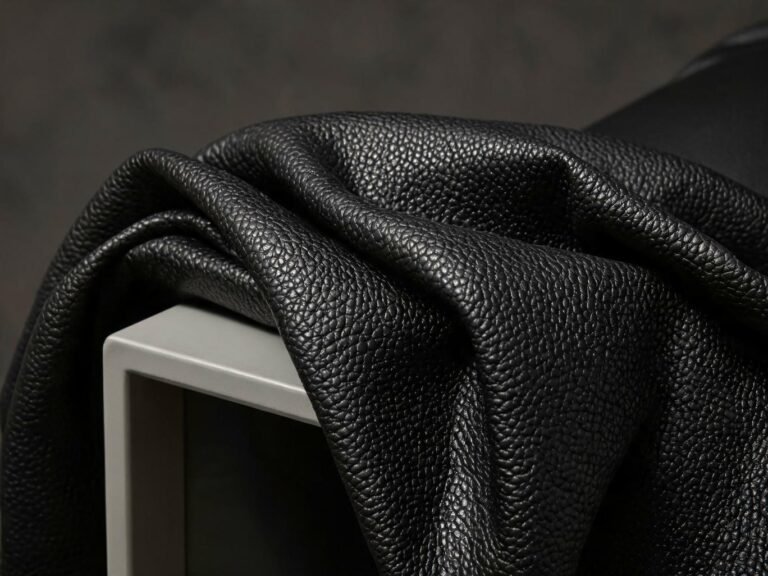
The global faux leather market reached USD 37.59 billion in 2025 and is projected to hit USD 70.54 billion by 2034, growing at 7.66% CAGR. With that kind of money in play, every supplier claims to sell high quality fake leather. But when you put their spec sheets under the microscope, most fall short on the tests that actually predict real-world performance. Here are the seven specs that separate premium-grade material from budget stock — and why silicone-coated leather is redefining what “high quality” means in 2026.
What Defines High Quality Fake Leather: Beyond Marketing Claims
Walk through any B2B leather trade show and you will hear the same buzzwords: “premium,” “durable,” “eco-friendly.” These terms mean nothing without test data behind them. High quality fake leather is not defined by hand feel or visual appeal alone — it is defined by measurable performance under standardized testing protocols that simulate years of use in weeks.
The coating adhesion standard ISO 11644 evaluates the bond strength between the surface layer and the backing fabric. Poor adhesion leads to delamination — the surface peels away from the base within months of commercial use. Flexibility and cold-crack resistance, tested under ASTM D6182 (Bally Flex) and ISO 17233, simulate the bending fatigue that chair seats, armrests, and steering wheels experience thousands of times per day. A material that passes these tests at -20°C will survive winter. One that only passes at room temperature will not.

Martindale abrasion testing — the first filter for separating high quality fake leather from budget grades.
7 Performance Specs That Separate Premium from Budget
If a supplier cannot produce independent lab reports for all seven of these parameters, you are not buying high quality fake leather — you are buying hope. Here is the data we benchmark against, pulled from our own silicone leather technical specifications and cross-referenced with standard PU and PVC grades.
| Spec | Standard PU | Standard PVC | Silicone Leather |
|---|---|---|---|
| Abrasion (Martindale) | 30K–50K cycles | 20K–40K cycles | 200K+ cycles |
| UV resistance | 100–200 hrs | 200–300 hrs | 1,000+ hrs |
| Cold crack | -10°C | 0°C | -40°C |
| VOC emission | Contains solvents | Contains plasticizers | Zero / near-zero |
| Hydrolysis | Poor (degrades) | Moderate | Excellent |
| Flame retardancy | Flammable | Flammable, toxic smoke | Self-extinguishing (EN 13773 Class 4) |
| Service life | 3–5 years | 2–3 years | 10+ years |
In our Martindale testing, silicone leather sustains 200,000+ cycles with no visible surface wear. Standard PU typically fails at 30,000–50,000 cycles — a 4× to 6× performance gap that directly translates to product lifespan.

Scratch resistance testing — high quality fake leather should show no visible scoring under standardized load.
Silicone-Coated Leather: The New Benchmark for Fake Leather Quality
Here is the thing about fake leather quality: the polymer determines the ceiling. PU and PVC rely on plasticizers for flexibility — and those plasticizers migrate, evaporate, and leach out over time. That is why a PU sofa feels supple in year one and brittle in year four. Silicone leather uses a fundamentally different chemistry. The silicone polymer chain is inherently flexible from -40°C to 250°C without any plasticizer addition. It does not lose flexibility because there is nothing to lose.
This is not a marginal improvement. It is a category difference. When you specify high quality fake leather for a project that needs to last — healthcare seating, automotive interiors, marine upholstery — silicone-coated material delivers a 10+ year service life where PU delivers 3–5 years and PVC delivers 2–3. For a deeper dive into the chemistry, see our silicone vs PU technical comparison.

Color consistency across batches — another hallmark of high quality fake leather that budget grades cannot match.
Real-World Failure Data: When Budget Grades Break Down
We have seen the failure pattern repeat across industries. A hospitality client ordered PU leather for 200 restaurant booths at a 40% lower unit cost than silicone. Within 30 months, 60% of the booths showed visible cracking at stress points — seat edges, backrest folds, armrest corners. The reupholstering cost, including labor and downtime, exceeded the original savings. The same client’s next project used silicone leather. At 36 months, zero failures.
The lesson is straightforward: material cost is not the same as total cost. A 40% cheaper material that fails in 3 years costs more than a premium material that lasts 10. For B2B buyers sourcing faux leather with proven durability, the spec sheet — not the unit price — should drive the decision.
How to Verify Supplier Claims Before You Commit
Any supplier can write “high quality” on a product page. Verification is what separates a credible partner from a marketing operation. Demand three documents before placing a volume order:
- Independent test reports — not self-issued spec sheets. Look for SGS or Intertek letterheads with traceable report numbers.
- Certification numbers you can verify — ISO 10993, REACH, EN 13773. Check the issuing body’s database, not just the PDF.
- Pre-production sample — a swatch from the actual production batch, not a showroom sample from a different lot. Test it yourself for abrasion and stain resistance.
For buyers who want to understand the full range of fake leather types and their performance differences, our fake leather types guide breaks down PU, PVC, microfiber, and silicone by application. You can also explore our eco-friendly silicone leather page for sustainability certification details.
Watch silicone leather vs PU durability — real testing data that shows why 200K cycles matters.
Frequently Asked Questions
Is silicone leather considered fake leather?
Yes. Silicone leather is a synthetic (non-animal) material — it falls under the fake leather category. The difference is the polymer: instead of polyurethane (PU) or polyvinyl chloride (PVC), the coating is made from silicone, which delivers superior temperature stability, UV resistance, and zero-VOC performance. Think of it as the highest tier within the fake leather spectrum.
How can I verify a supplier’s quality claims without visiting the factory?
Request independent lab reports from SGS or Intertek with traceable report numbers. Cross-check certification numbers against the issuing body’s online database. Order a pre-production sample from the actual batch and run your own abrasion and stain tests. A credible supplier will provide all three within 48 hours.
The Standard for What Comes Next
High quality fake leather is not a marketing label — it is a set of measurable performance thresholds verified by standardized testing. The seven specs above are the minimum baseline for any B2B material that needs to survive commercial use. Silicone-coated leather raises that baseline by 4× to 6× across abrasion, UV, and cold-crack resistance, while eliminating VOC emissions entirely. If your current supplier cannot match these numbers, you are not buying high quality — you are buying a timeline to failure.
About TOPSUN
TOPSUN engineers high quality fake leather using silicone-coated technology for B2B clients who need materials verified at 200,000+ Martindale cycles and -40°C cold-crack thresholds across automotive, furniture, and healthcare applications.
With ISO 10993 biocompatibility certification, zero-VOC solvent-free coating, REACH compliance, and 100+ texture options, our silicone leather outlasts standard PU by 5× in real-world abrasion and UV testing.