When procurement teams write “faux leather” into a material specification, they’re creating a compliance gap they don’t realize exists. The term appears on purchase orders, technical data sheets, and supplier catalogs across the furniture, automotive, and consumer goods industries — yet it has no standardized technical definition. The U.S. Federal Trade Commission’s 16 CFR Part 24 Guides for Select Leather and Imitation Leather Products requires disclosure when a material “appears to be leather” but isn’t, listing acceptable terms: “Imitation leather,” “Simulated leather,” “Vinyl,” “Vinyl coated fabric,” or “Plastic.” Notably absent from that list? “Faux leather.” The term is a marketing construct that covers at least five distinct polymer chemistries — PU, PVC, microfiber, silicone, and bio-based — each with radically different durability profiles, regulatory compliance pathways, and end-of-life outcomes. Specifying “faux leather” is like specifying “metal” when you need type 316 stainless steel.
Request Faux Leather Material Samples
What Is Faux Leather? The Regulatory Definition Gap
The closest legal definition of faux leather comes from the FTC’s guides, which classify any non-leather material that visually mimics leather as “imitation” or “simulated” leather. But the guides were last meaningfully updated decades ago, and they address labeling disclosure — not material performance. They don’t distinguish between a PVC-coated fabric that lasts 2 years and a silicone-coated fabric that lasts 10+. They don’t address REACH phthalate restrictions, Prop 65 chemical disclosures, or ISO 10993 biocompatibility. In practice, “faux leather” is a commercial umbrella term that tells a procurement team nothing about polymer chemistry, coating thickness, substrate construction, or regulatory compliance status.
This matters because the definition gap creates real sourcing consequences. A buyer who specifies “faux leather upholstery, 1.0mm, black” may receive PU-coated polyester from one supplier and PVC-coated nylon from another — materials that look identical on a swatch card but fail differently in service. The PU version delaminates under hydrolysis. The PVC version cracks under UV. Neither passes the same flammability standard. For a deeper look at how this confusion plays out in material comparisons, see our faux leather overview and our silicone vs PU technical comparison.
5 Material Types Hiding Behind “Faux Leather”
In our material classification work with B2B clients, we’ve identified five distinct polymer categories that suppliers label and sell as “faux leather.” Each has a different chemical backbone, different failure modes, and different regulatory exposure. Understanding these distinctions is the difference between a specification that performs and one that generates warranty claims.
| Material Type | Polymer Chemistry | Typical Lifespan | Key Failure Mode | Regulatory Risk |
|---|---|---|---|---|
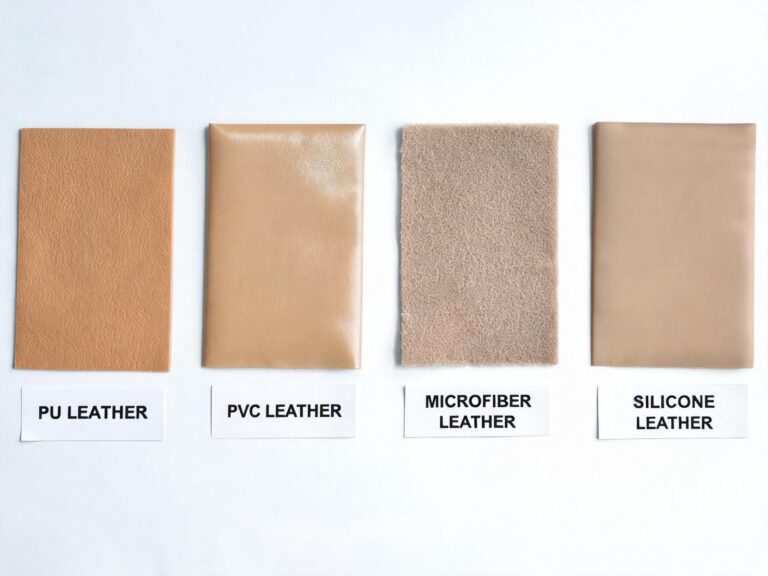
| PU Leather | Polyurethane coating on fabric backing | 3–5 years | Hydrolysis-driven delamination | DMF solvent residues; VOC emissions |
| PVC Leather | Polyvinyl chloride + plasticizers on fabric | 2–3 years | Plasticizer migration; UV cracking | REACH phthalate bans; lead restrictions |
| Microfiber Leather | Micro-denier fiber matrix + PU impregnation | 5–8 years | Coating oxidation at high temps | May contain PVC layer; phthalate risk |
| Silicone Leather | Polysiloxane polymer + fabric substrate | 10+ years | Minimal — no hydrolysis or UV degradation | Lowest risk — zero VOC, phthalate-free, PVC-free |
| Bio-based Leather | Plant-derived polymers (apple, grape, cactus) | 1–4 years (varies widely) | Biodegradation in service; coating instability | Unverified sustainability claims; performance data gaps |
The same purchase order reading “faux leather” could deliver any of these five materials. Only one — silicone — combines 10+ year service life with zero-VOC compliance and phthalate-free certification.

A material sample rack holding multiple faux leather categories — visually similar, chemically incompatible.
Why the Definition Matters for B2B Procurement
The definition gap translates directly into procurement risk. When a buyer specifies “faux leather” without naming the polymer chemistry, three problems follow. First, quality audits fail: incoming inspection can’t verify what isn’t defined. A QC inspector receiving a shipment of “faux leather” has no standardized reference point to confirm the material matches the approved sample. Second, compliance documentation becomes ambiguous: a supplier can provide a REACH compliance certificate for a PVC-free PU leather while the buyer assumed they were getting silicone. Third, warranty exposure increases: if the material fails at 3 years instead of the expected 10, the specification “faux leather” provides no contractual basis for recourse because no performance standard was tied to the term.
The procurement fix is straightforward: replace “faux leather” in specifications with the actual polymer chemistry. A properly written spec reads “silicone-coated polyester fabric, 1.0mm ±0.05mm, Martindale ≥200,000 cycles, REACH compliant, zero-VOC verified by SGS test report.” That specification is auditable, testable, and contractually enforceable. “Faux leather” is none of those things.
Silicone Leather: Redefining What Faux Leather Can Be
Silicone leather occupies a unique position within the faux leather taxonomy. It is technically a faux leather — it’s synthetic, contains no animal hide, and mimics the appearance and hand-feel of genuine leather. But its polymer backbone (polysiloxane) is chemically distinct from PU and PVC, and that difference eliminates the failure modes that define the category. Silicone leather doesn’t hydrolyze because the Si-O bond is stable against water attack. It doesn’t crack under UV because the polymer backbone doesn’t absorb UV radiation in the 290-400 nm range. It doesn’t require plasticizers, so there are no phthalates to migrate or restrict. It doesn’t emit VOCs because the coating process is solvent-free.
For B2B buyers, this means silicone leather passes compliance audits that PU and PVC faux leather cannot. It meets REACH without restriction, passes ISO 10993-5 biocompatibility for skin-contact applications, carries FDA 21 CFR 177.2600 food-contact compliance, and achieves EN 13773 Class 4 flame retardancy without halogenated additives. When procurement teams define faux leather by performance rather than by marketing terminology, silicone leather is the category that consistently exceeds the specification threshold. Learn more in our silicone leather introduction.

Material specification guide — the difference between “faux leather” as a marketing term and as an auditable polymer category.
Why zero-VOC compliance separates silicone leather from other faux leather categories.
About TOPSUN: TOPSUN manufactures silicone leather that redefines the definition of faux leather for B2B procurement — supplying automotive, furniture, medical, marine, and consumer electronics manufacturers with a polysiloxane-based material that achieves 200,000+ Martindale abrasion cycles, -40°C to 250°C thermal stability, and 1,000+ hour UV resistance without plasticizers, solvents, or VOC emissions. Our 60,000+ m² ISO-certified production facility in Dongguan delivers 500,000+ m monthly capacity with REACH, RoHS, ISO 10993-5, FDA 21 CFR 177.2600, EN 13773 Class 4, and FMVSS 302 compliance backed by SGS and Intertek test reports. Free A4 swatches shipped worldwide via DHL/FedEx.
Definition of Faux Leather: Frequently Asked Questions
Is faux leather the same as synthetic leather?
Yes and no. “Synthetic leather” and “faux leather” are used interchangeably in commercial contexts, but neither is a technical specification. Both terms describe any non-animal material that mimics leather’s appearance. The distinction that matters in B2B procurement is the polymer chemistry: PU, PVC, microfiber, silicone, and bio-based materials are all “faux leather” — but they carry different performance, compliance, and lifespan characteristics. Always specify the polymer type in purchase orders.
What is the legal definition of faux leather?
There is no single legal definition of “faux leather.” The FTC’s 16 CFR Part 24 guides require that non-leather materials appearing to be leather be disclosed as “imitation leather,” “simulated leather,” “vinyl,” or “plastic” — but the term “faux leather” itself is not regulated as a specific material category. EU regulations address restricted substances within materials (REACH, phthalates, lead) rather than defining “faux leather” as a class. Procurement teams should treat “faux leather” as a marketing term and specify the actual polymer chemistry.
Is silicone leather considered faux leather?
Technically, yes — silicone leather is a synthetic, non-animal material that mimics the appearance and hand-feel of genuine leather, placing it within the broad faux leather category. However, its polysiloxane polymer chemistry gives it fundamentally different performance characteristics: 10+ year service life (vs. 2-5 years for PU/PVC), zero VOC emissions, inherent flame retardancy without halogens, and ISO 10993-5 biocompatibility certification. Silicone leather is best understood as the highest-performance subcategory within faux leather.