Choosing between PU and PVC leather is like choosing between two flavors of planned obsolescence — one is softer but cracks in 3 years, the other is tougher but cracks in 5. B2B sourcing teams spend weeks comparing these two materials on price, feel, and durability, often missing the bigger question: why specify a material that needs replacing at all? The PU PVC debate has dominated contract furniture and automotive sourcing for two decades. But the durability data reveals that both materials lose to a third option that eliminates the compromise entirely.
Request Material Comparison Kit
PU vs PVC: 5 Structural Differences That Change Application Fit
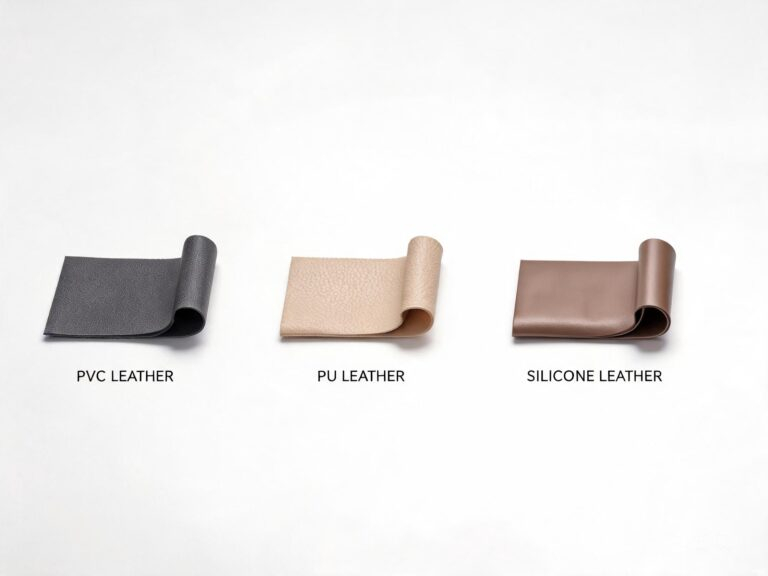
PU (polyurethane) and PVC (polyvinyl chloride) leather are both synthetic coated fabrics — but they differ fundamentally in how the coating layer bonds to the base fabric, and that determines everything downstream: feel, breathability, durability, and end-of-life.
- Coating chemistry: PU uses polyurethane, a polymer with open-cell structure that allows moisture vapor transmission. PVC uses polyvinyl chloride, a closed-cell polymer that blocks all moisture. This single difference drives the softness vs waterproofing trade-off.
- Breathability: PU leather transmits moisture vapor, making it more comfortable for skin-contact applications like clothing and executive seating. PVC is non-breathable — it traps body heat and moisture against skin, making it uncomfortable for prolonged contact but excellent for moisture barrier applications.
- Flexibility at temperature: PVC stiffens significantly below 10°C and can crack in cold environments. PU maintains flexibility across a wider range (-20°C to 80°C). Both, however, degrade well below the temperature range of silicone leather (-40°C to 250°C).
- Plasticizer content: PVC requires phthalate plasticizers to achieve flexibility — these can leach out over time, causing embrittlement and raising health concerns. PU uses no phthalates but may contain solvent residues from DMF-based production.
- Fire performance: PVC has inherently higher flame retardancy due to its chlorine content, but burns with toxic hydrogen chloride smoke. PU is flammable and requires chemical FR treatment. Neither matches silicone leather’s inherent self-extinguishing, low-smoke, halogen-free fire performance.

Chemical mixing station — PU and PVC coatings require solvent-based processing that silicone leather’s dry coating eliminates
The Durability Gap: Why Both PU and PVC Fail Within 5 Years
The PU PVC durability comparison is well-documented. PVC outperforms PU in abrasion resistance — it achieves higher Martindale cycle counts at equivalent price points, which is why it dominates heavy-contract applications like public transit seating and hospital upholstery. PU’s softer surface wears faster but feels more luxurious, making it the standard for executive furniture and fashion accessories.
But both materials share a common failure mode: hydrolysis. When moisture penetrates the coating-to-fabric bond layer, the adhesion breaks down. PU hydrolyzes faster — typically 3–5 years in humid environments. PVC resists hydrolysis better but embrittles as plasticizers migrate out over 2–3 years, leading to surface cracking. In our silicone vs PU comparison testing, we’ve documented PU surfaces cracking within 18 months in marine environments.
The practical implication: in any application involving moisture, cleaning chemicals, or UV exposure, both PU and PVC will require replacement within 5 years. The question is not which lasts longer, but whether a 3-year or 5-year failure timeline is acceptable for your product’s lifecycle — and whether the replacement cost is in your budget.
| Property | PU Leather | PVC Leather | Silicone Leather |
|---|---|---|---|
| Breathability | Good (moisture-vapor) | None (moisture barrier) | Good (breathable coating) |
| Martindale Cycles | 50K–80K | 30K–50K (heavy grades higher) | 200K+ |
| Hydrolysis Resistance | Poor (degrades) | Moderate | Excellent |
| UV Resistance | Poor (cracks 1–2 yr) | Poor (cracks 1–2 yr) | 1,000+ hours no fading |
| Service Life | 3–5 years | 2–3 years | 10+ years |
| VOC Emission | Moderate (DMF residues) | High (phthalates) | Zero |
| Recyclable | Limited | No | 100% recyclable |

PU and PVC leather application comparison — matching material properties to end-use requirements
Cost Comparison: Purchase Price vs 10-Year Total Cost
The PU PVC price comparison favors PVC on upfront cost — PVC leather typically runs $2–4/m², while PU leather ranges $4–8/m². But purchase price is the wrong metric for B2B buyers. The relevant number is total cost of ownership (TCO) over the product’s intended lifecycle, including material cost, replacement cycles, labor for reupholstering, and downtime.
Consider a 200-seat restaurant specifying upholstery material over a 10-year period:
- PVC at $3/m², 2.5-year lifespan: 4 replacement cycles × 200 seats × material + labor = approximately $48,000+ over 10 years (material alone, excluding labor and downtime).
- PU at $6/m², 4-year lifespan: 2.5 replacement cycles × 200 seats × material = approximately $40,000+ over 10 years.
- Silicone leather at higher upfront, 10+ year lifespan: 1 cycle × 200 seats × material = one-time cost with zero replacements over the same period.
The math flips when you extend beyond the initial purchase. PVC’s lower price evaporates when you account for 4 replacement cycles. PU’s better feel doesn’t justify the mid-life replacement. For more on this total cost economics, the same logic applies to maintenance subscriptions built around PU’s degradation timeline.

Tensile strength testing — quantifying the structural failure point of PU, PVC, and silicone leather materials
PVC leather contains phthalate plasticizers that can leach out over 2–3 years, causing the surface to embrittle and crack. PU leather degrades through hydrolysis within 3–5 years in humid environments. Both failure modes are inherent to their chemistry, not manufacturing defects.
When to Specify PU, PVC, or Silicone Leather
Not every application requires silicone leather’s 10-year lifespan — and that’s fine. The PU PVC decision should be application-driven, not price-driven. Use this framework to match material to product lifecycle:
- Specify PVC when: The product is disposable or short-lifecycle (promotional seating, transit vehicles with 5-year refurbishment cycles), cost is the primary driver, and fire retardancy is needed without chemical treatment. Accept plasticizer migration and limited recyclability.
- Specify PU when: Tactile quality matters more than maximum durability (executive furniture, fashion accessories, headboards), breathability is required for comfort, and the product lifecycle is 3–5 years. Accept hydrolysis risk and solvent-based production.
- Specify silicone leather when: The product lifecycle exceeds 5 years (commercial furniture, automotive interiors, marine upholstery, healthcare seating), zero VOC is required, fire code compliance is non-negotiable, and chemical cleaning is part of the maintenance protocol. Pay the higher upfront cost, eliminate replacement cycles.
For a detailed breakdown of faux leather types and their differences, the same application-matching framework applies. The key is specifying based on lifecycle data, not catalog photography.

Calender coating line — the production process where PU and PVC coatings are applied to base fabrics using solvent-based methods
Material comparison: see how silicone leather outperforms both PU and PVC in abrasion, hydrolysis, and UV resistance testing
Frequently Asked Questions
Which lasts longer, PU or PVC leather?
In controlled lab conditions, PVC typically outlasts PU by 1–2 years due to its higher abrasion resistance and better hydrolysis resistance. But in real-world use involving UV exposure, chemical cleaning, or temperature fluctuations, both materials fail within 3–5 years. PU hydrolyzes in humid environments; PVC embrittles as plasticizers migrate out. Silicone leather’s 10+ year service life — verified through SGS testing at 200,000+ Martindale cycles — eliminates the replacement cycle that makes both PU and PVC more expensive over a product’s lifecycle.
Is PVC leather safe for skin contact?
PVC leather raises two safety concerns: phthalate plasticizers, which can leach through skin contact and are restricted under REACH Annex XVII, and dioxin release if the material burns. For applications involving prolonged skin contact (clothing, seating), PU leather is generally preferred over PVC due to its phthalate-free chemistry. For the highest safety standard, silicone leather is ISO 10993-5 biocompatibility certified — the same standard used for medical device surfaces — with zero plasticizers and zero VOC emissions.
The Bottom Line for PU vs PVC Sourcing
The PU PVC comparison is not a choice between good and bad materials — it’s a choice between two materials with known failure timelines. PU offers better feel and breathability but hydrolyzes. PVC offers better durability and fire resistance but leaches plasticizers. Both need replacement within 3–5 years. For B2B specifiers designing products with lifecycles beyond that window, silicone leather removes the compromise entirely: it matches PVC’s fire performance, exceeds PU’s breathability, delivers 200,000+ Martindale cycles, and lasts 10+ years — all with zero VOC and 100% recyclability. The question isn’t PU or PVC. It’s whether your product can afford to specify a material that needs replacing at all.
About TOPSUN
TOPSUN manufactures silicone-coated leather materials that eliminate the PU vs PVC compromise for B2B specifiers. Our solvent-free dry coating process produces materials combining PVC-grade fire retardancy with PU-grade breathability — at a durability level neither synthetic leather can match.
200K+ Martindale cycles · -40°C to 250°C stability · Zero VOC · EN 13773 Class 4 · FMVSS 302 · 100% recyclable · SGS-verified