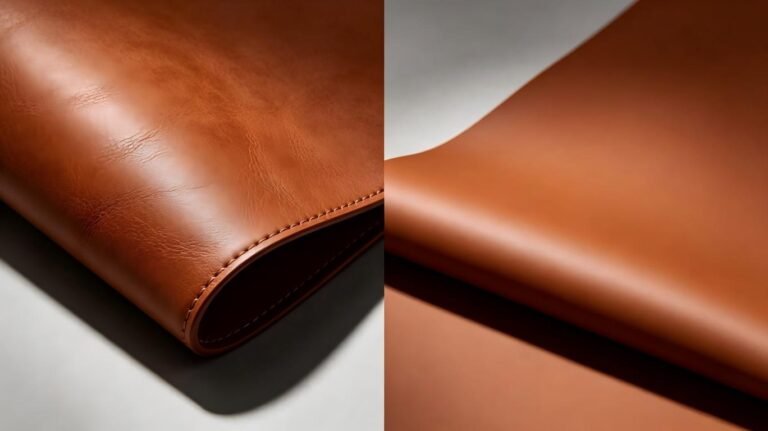
The difference between faux leather and leather is not just about animal welfare or price — it’s about how the material ages, fails, and ultimately costs you. Faux leather peels; real leather patinas. Faux leather breathes poorly; real leather breathes naturally. Faux leather ends up in landfill within 5 years; real leather lasts a decade with maintenance. But for B2B specifiers, the real question isn’t which one is “better.” It’s whether either one is the right material for a commercial product designed to last beyond 5 years. The third option — silicone leather — resolves the dilemma both create.
Request Identification Sample Kit
The Structural Difference: Why Faux Leather Peels and Real Leather Patinas
At the molecular level, the difference between faux leather and leather is fundamental. Real leather is a collagen fiber network — the hide of an animal, tanned to preserve its protein structure. The fibers are irregular, porous, and naturally breath. When leather ages, the fibers absorb oils and moisture from the environment and from conditioning treatments, softening and developing what the industry calls “patina” — a surface character that improves with use.
Faux leather is a plastic coating (PU or PVC) applied to a fabric backing. The coating is a thin polymer film that cannot absorb moisture, cannot soften, and cannot develop character. Instead, it degrades: UV exposure breaks polymer chains, plasticizers migrate out, and the coating loses adhesion to the fabric base. The visible result is peeling, cracking, and flaking — failure modes that are irreversible.
This structural difference has direct commercial implications. Real leather can be repaired — re-conditioned, re-dyed, re-stitched — extending its service life. Faux leather cannot be repaired once the coating delaminates. For a 200-seat hospitality venue, this means a real leather chair can be restored in-place, while a faux leather chair requires full reupholstering or replacement.

Quality inspection at the coating line — where faux leather’s plastic-to-fabric bond is checked for the adhesion that determines peel resistance
5 Identification Tests B2B Buyers Can Run at the Factory
When sourcing materials, you need to verify what you’re actually buying. Suppliers sometimes blend material types or use marketing terms that obscure the actual composition. Here are five field tests you can perform at the factory or on received samples — no lab equipment required:
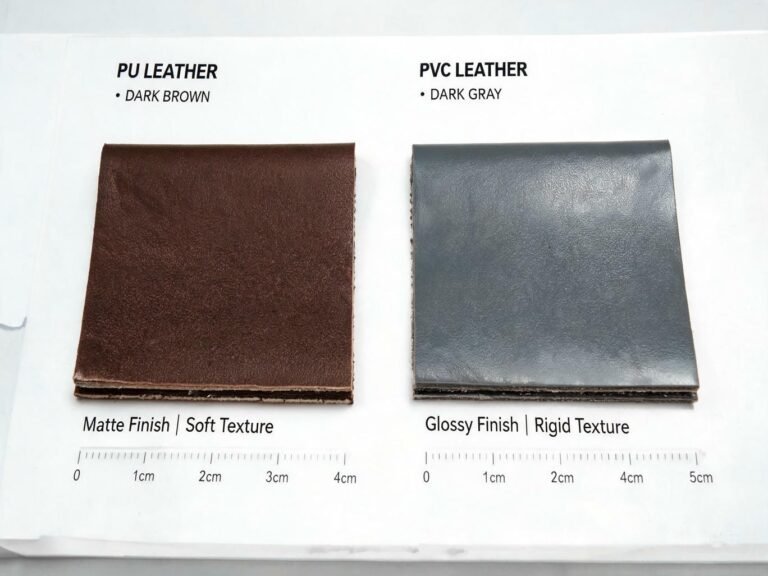
- The Edge Test: Look at the cut edge. Real leather has rough, fibrous edges — you can see the collagen fiber network. Faux leather has smooth edges or visible layers of fabric backing and coating. This is the fastest and most reliable identification method.
- The Texture Test: Press your finger into the surface. Real leather wrinkles like skin — the wrinkles disappear when you release. Faux leather depresses stiffly without wrinkling, and the surface doesn’t recover the same way.
- The Pore Test: Real leather has irregular pores — no two areas look identical. Faux leather has a repeating, uniform embossed pattern that looks machine-pressed because it is.
- The Smell Test: Real leather has a natural, earthy smell from tanning oils. Faux leather has a chemical or plastic odor — particularly strong with PVC, which off-gasses plasticizers.
- The Water Drop Test: A drop of water on real leather absorbs slowly into the pores. On faux leather, it sits on the surface as a bead — the plastic coating is non-porous. Silicone leather, notably, also beads water but for a different reason: its non-porous surface repels it rather than absorbing it.

Faux leather vs real leather comparison — structural differences that determine service life and repairability
| Attribute | Faux Leather (PU/PVC) | Real Leather | Silicone Leather |
|---|---|---|---|
| Composition | Plastic coating on fabric | Tanned collagen hide | Silicone coating on fabric |
| Lifespan | 2–5 years | 10+ years (with care) | 10+ years (maintenance-free) |
| Failure Mode | Peeling, cracking | Drying (preventable) | Minimal surface wear |
| Breathability | Low (plastic barrier) | High (porous fibers) | Good (breathable coating) |
| How It Ages | Degrades — peels, fades | Improves — softens, patinas | Stable — no change |
| Repairable | No (once coating fails) | Yes (re-dye, re-stitch) | Rarely needs repair |
| Vegan | Yes | No | Yes |
| Recyclable | Limited / No | Biodegradable (veg-tan) | 100% recyclable |
Faux leather’s failure mode — coating delamination and peeling — is irreversible. Once the plastic-to-fabric bond breaks, the material cannot be repaired. Real leather’s failure mode — drying — is preventable with conditioning. But silicone leather eliminates both failure modes entirely.
The Total Cost: Purchase, Maintenance, and Replacement
The difference between faux leather and leather extends well beyond the purchase price. Real leather costs 3–5× more upfront than faux leather, but its 10+ year lifespan with periodic conditioning can make it the cheaper option over time. Faux leather’s lower purchase price evaporates when you account for replacement cycles every 3–5 years — and the labor, downtime, and logistics costs that come with them.
But real leather carries hidden costs too: conditioning treatments, specialized cleaning products, and vulnerability to water damage. A single spill on an unconditioned real leather surface can cause permanent staining. Faux leather resists water but cracks from UV. Neither offers the combined resistance to water, UV, abrasion, and chemicals that commercial applications demand.
Silicone leather’s value proposition is simple: it costs more than faux leather upfront, but its 10+ year maintenance-free lifespan means zero replacement cycles, zero conditioning, and zero repair — verified through 200,000+ Martindale abrasion cycles and 1,000+ hour UV resistance testing. For applications where the PU vs PVC comparison already shows both synthetics failing within 5 years, silicone leather is the only option that matches real leather’s lifespan without the maintenance burden.

Release film coating line — the process that creates faux leather’s plastic-to-fabric bond, which determines its peel resistance and failure timeline
The Third Option: Why Silicone Leather Resolves the Dilemma
The faux-vs-real debate is a false dichotomy for B2B specifiers. Faux leather offers vegan credentials but fails in 3–5 years. Real leather offers durability but requires animal sourcing and ongoing maintenance. Silicone leather resolves both problems simultaneously:
- Vegan and cruelty-free: No animal sourcing. Like faux leather but without the plastic coating that peels.
- Real-leather durability: 10+ year service life, 200,000+ Martindale cycles. Matches real leather’s lifespan without conditioning.
- Zero maintenance: No conditioning, no specialized cleaning. Tolerates bleach, alcohol, and hospital-grade disinfectants without degradation.
- Breathable surface: Unlike PVC faux leather, silicone leather’s coating allows moisture vapor transmission — matching real leather’s comfort advantage.
- End-of-life: 100% recyclable, unlike faux leather’s microplastic-shedding landfill fate. No tanning chemicals, unlike real leather.

Genuine leather texture — natural grain irregularity that synthetic materials attempt to replicate through embossing
Service life comparison: silicone leather vs PU vs genuine leather under identical wear conditions
Frequently Asked Questions
How can you tell if leather is faux or real?
The fastest identification method is the edge test: real leather has rough, fibrous edges from the collagen network; faux leather has smooth edges or visible fabric-backing layers. Secondary tests include the texture test (real leather wrinkles like skin when pressed), the pore test (real leather has irregular pores, faux has uniform embossed patterns), and the water drop test (real leather absorbs slowly, faux leather beads). For B2B sourcing, always request material composition documentation and verify with these field tests on received samples.
Which is better for commercial furniture, faux or real leather?
For commercial furniture with a 5+ year lifecycle, neither is ideal. Faux leather fails within 2–5 years through coating delamination and cannot be repaired. Real leather lasts 10+ years but requires conditioning maintenance, is vulnerable to water staining, and raises animal sourcing concerns. Silicone leather is the recommended alternative for commercial furniture: it delivers real-leather durability (200K+ Martindale cycles, 10+ year service life) with faux-leather vegan credentials, zero maintenance, and verified fire code compliance — eliminating the trade-off both materials impose.
The Bottom Line: Choose Based on Lifecycle Data, Not Marketing Labels
The difference between faux leather and leather comes down to structure, aging, and repairability — not just price or ethics. Faux leather is a plastic coating that peels irreversibly within 5 years. Real leather is a collagen network that develops character over a decade but requires maintenance and animal sourcing. For B2B specifiers, the decision should be driven by product lifecycle data: if your product needs to last beyond 5 years, withstand commercial wear, and require minimal maintenance, silicone leather is the material that resolves the faux-vs-real compromise. It delivers real leather’s lifespan with faux leather’s vegan credentials — and neither’s failure modes.
About TOPSUN
TOPSUN manufactures silicone-coated leather that delivers real-leather durability with faux-leather vegan credentials for B2B specifiers. Our materials undergo head-to-head testing against both genuine leather and synthetic alternatives to provide evidence-based material selection data for commercial applications.
200K+ Martindale cycles · 10+ year service life · Vegan and cruelty-free · Zero VOC · ISO 10993-5 biocompatibility certified · 100% recyclable