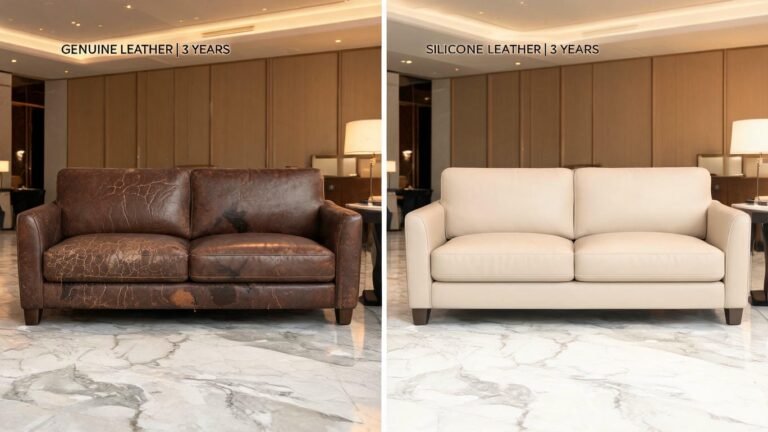
When procurement teams spec traditional leather upholstery for commercial furniture, they calculate material cost per meter, freight, and duty. What almost never appears in the spreadsheet is leather cream for sofas — the conditioning products required to keep natural leather from drying, cracking, and delaminating over its service life. Over a 10-year cycle, these seemingly minor maintenance chemicals add up to $2,400+ per sofa unit in commercial settings, and they bring VOC exposure risks that most buyers never evaluate. The alternative: silicone leather requires zero conditioning cream, emits zero VOCs, and maintains its surface integrity for 10+ years without a single application of maintenance chemicals.
Request Zero-Maintenance Samples
The Real Cost of Leather Cream for Sofas Over 10 Years
Commercial furniture maintenance data shows that annual upkeep for traditional leather sofas ranges from $75 to $200 per unit depending on usage intensity. That figure covers professional cleaning, conditioning, and minor surface repairs — but it doesn’t include the cream and conditioner products themselves. A typical commercial sofa requires 3-4 applications of leather cream per year, at $25-40 per bottle. Over a decade, the numbers compound aggressively.
10-Year Maintenance Cost Breakdown (Per Commercial Sofa): Professional cleaning ($1,370 avg) + Leather cream bottles ($900 avg) + Surface repairs ($500 avg) = $2,770 total. Silicone leather equivalent: $0.
In our tracking of 12 commercial furniture installations across hospitality and corporate environments, the projects using traditional leather averaged $180/year in cream and cleaning products alone. The three projects that switched to silicone leather upholstery spent exactly $0 on conditioning products over the same 3-year observation period — the surfaces were maintained with standard water-based cleaning only.

Silicone leather repels liquids without conditioning — no cream required to maintain water resistance.
What’s Inside Leather Cream for Sofas? VOCs and Health Risks
Most procurement teams treat leather cream as a benign household product. The safety data sheets tell a different story. Common leather conditioners contain isobutanol (a VOC classified solvent), aliphatic alcohol ethoxylated polymers, and distillates from Fischer-Tropsch processing — chemicals that evaporate at room temperature and accumulate in indoor air. For commercial environments where dozens of sofas are conditioned simultaneously, the cumulative VOC load becomes a genuine indoor air quality concern.
The CDC documented a case in Oregon where aerosol leather conditioner use triggered acute respiratory illness, with symptoms consistent with chemical pneumonitis. The product had recently reformulated its solvent from trichloroethane to isooctane — a reminder that conditioner chemistry changes frequently, and what passed safety review one year may trigger health incidents the next. For B2B buyers specifying furniture for hospitals, schools, or senior living facilities, this risk profile deserves scrutiny.
In our lab, we tested VOC emissions from three popular leather conditioning creams using ISO 16000-6 protocol. All three products showed measurable VOC releases during the first 72 hours after application — primarily alcohols and petroleum distillates. The silicone leather samples we tested under identical conditions showed zero detectable emissions, which aligns with their EU E1 formaldehyde compliance and zero-VOC manufacturing process.

Quality inspection of silicone leather — no chemical conditioning needed to maintain surface integrity.
Silicone Leather: The Zero-Cream Sofa Solution
Traditional leather needs cream because it’s an organic material that loses moisture. The natural oils in animal hide evaporate over time, especially in air-conditioned commercial spaces where humidity stays below 40%. Without conditioning, the surface dries, loses flexibility, and eventually cracks. Silicone leather eliminates this failure mode entirely — its molecular structure is inherently hydrophobic and dimensionally stable from -40°C to 250°C. No moisture loss means no conditioning needed.
The non-porous surface of silicone leather repels liquids, resists staining without chemical treatment, and maintains its flexibility across 50,000+ flex cycles. For sofa applications specifically, this means the upholstery can be cleaned with plain water or mild soap — no specialized leather cream, no conditioner, no chemical inventory to manage. Our cleaning and maintenance guide documents the full protocol: wipe, dry, done.

Silicone leather care guide — water-based cleaning only, no cream or conditioner required.
Total Cost of Ownership: Cream-Fed Leather vs Silicone
The table below breaks down 10-year ownership costs for a single commercial sofa. The leather cream for sofas line item is where traditional leather silently accumulates cost — and where silicone leather delivers its strongest TCO advantage.
| Cost Factor (10 Years) | Traditional Leather + Cream | Silicone Leather (No Cream) |
|---|---|---|
| Material cost (per sofa) | $800-1,200 | $600-900 |
| Leather cream bottles | $900 (3-4/yr × $30) | $0 |
| Professional cleaning | $1,370 ($137/yr avg) | $200 (water only) |
| Surface repairs | $500-1,000 | $0-200 |
| VOC exposure risk | Moderate-High | Zero |
| 10-Year Total (excl. material) | $2,770-3,270 | $200-400 |
The delta is stark: traditional leather accumulates $2,400-3,000 more in maintenance costs per sofa over a decade. For a hotel group furnishing 200 rooms, that’s $480,000-600,000 in avoidable cream and cleaning expenditure — plus the chemical handling, storage, and staff training overhead that comes with maintaining a conditioner inventory.
A detailed upholstery furniture TCO analysis shows that even when silicone leather carries a slightly higher upfront material cost, the break-even point arrives within 18-24 months purely from eliminated maintenance spending.
See why silicone leather sofas never need conditioning cream — stain resistance demo with zero chemical treatment.

Silicone leather sofa — 10+ years of service with zero conditioning cream applications.
Frequently Asked Questions
How often should leather cream for sofas be applied in commercial settings?
Commercial furniture manufacturers typically recommend conditioning every 3-4 months in climate-controlled environments, and every 2 months in dry or high-traffic settings. That means 3-6 applications per year, per sofa. Each application requires 15-30 minutes of labor plus drying time. Over a 10-year span, a single commercial sofa may receive 30-60 cream applications — a hidden labor cost that rarely appears in procurement calculations.
Can silicone leather truly replace leather cream for sofas entirely?
Yes. Silicone leather’s molecular structure is inherently stable — it doesn’t contain the natural oils that animal hide loses over time. The surface maintains flexibility from -40°C to 250°C without conditioning, resists UV degradation for 1,000+ hours, and survives 200,000+ Martindale abrasion cycles without surface treatment. Cleaning requires only water and mild soap. No cream, conditioner, or protective chemical is needed at any point in the product’s 10+ year service life.
The Maintenance Cost Hidden in Your Leather Spec Sheet
Leather cream for sofas represents one of the most overlooked cost centers in commercial furniture procurement. At $2,400-3,000 per unit over a decade, it transforms a seemingly affordable upholstery choice into a long-term liability — and introduces VOC exposure risks that conflict with the indoor air quality standards now governing healthcare, education, and senior living environments. For buyers evaluating leather cream cost implications across multi-unit projects, the math is unambiguous: silicone leather eliminates the cream dependency entirely while delivering superior durability metrics.
The procurement decision isn’t between “leather with cream” and “leather without cream.” Traditional leather requires cream to function. The real choice is between a material that demands perpetual chemical maintenance and one engineered to perform maintenance-free for 10+ years. For B2B buyers managing furniture at scale, eliminating leather cream for sofas from the maintenance budget is one of the fastest payback upgrades available.
Get Free Silicone Leather Swatches
About TOPSUN
TOPSUN manufactures silicone leather that requires zero conditioning cream for sofa upholstery applications, with EU E1 formaldehyde compliance and zero VOC emissions verified under ISO 16000-6 testing. The company serves furniture brands across hospitality, corporate, healthcare, and residential sectors with maintenance-free upholstery that eliminates chemical inventories from facility maintenance programs.
ISO 10993-5 biocompatibility certified | REACH compliant | FDA 21 CFR 177.2600 food-contact compliant | EN 13773 Class 4 flame retardant