Every commercial genuine leather sofa carries a hidden line item in its total cost of ownership: leather sofa protection. Conditioning creams, UV treatments, stain guards, professional extraction cleaning, and restorative repairs add $1,200-1,500 per sofa per year in commercial environments. Over a 5-year service life, protection costs exceed the original material cost — you pay for the leather twice: once at purchase, and again in maintenance products trying to keep it alive.
The fundamental issue is that genuine leather is a natural organic material that degrades. It loses oils, absorbs moisture, reacts to UV, and absorbs stains — all of which require ongoing chemical intervention to slow down. Silicone leather eliminates the need for every one of these protection products because its polymer structure is inherently stable. No conditioning, no UV sprays, no stain guards, no extraction cleaning. The protection is built into the material, not applied to it.
Request Maintenance-Free Leather Samples
What “Leather Sofa Protection” Actually Means in Commercial Settings
In B2B furniture procurement, “leather sofa protection” isn’t a single product — it’s a maintenance protocol comprising four product categories and two service categories, each targeting a specific degradation mechanism of genuine leather.

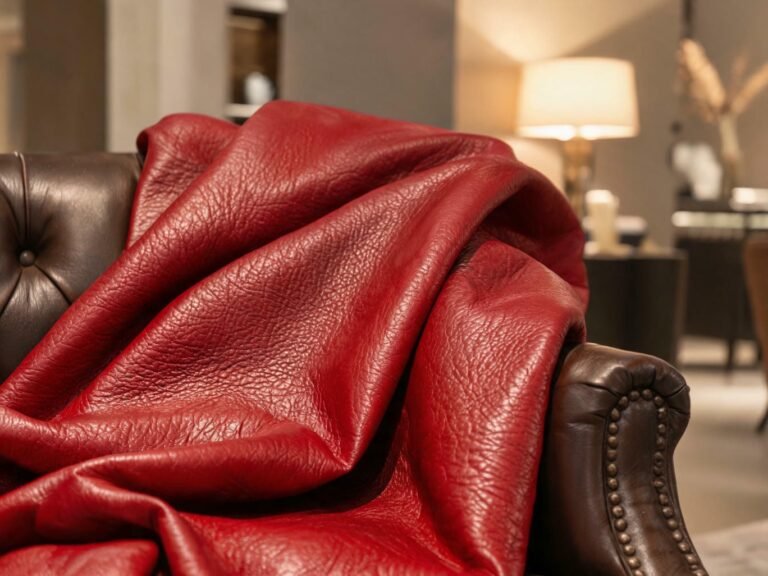
Commercial leather sofa — the surface that requires $1,200/year in protection products to maintain
Conditioning creams: Replenish the natural oils that evaporate from the hide over time. Applied quarterly in commercial settings. Without conditioning, the leather dries, stiffens, and cracks within 2-3 years. Cost: $15-25/m² per application × 4 quarters = $60-100/m²/year.
UV protection sprays: Create a temporary UV-blocking film on the leather surface to slow color fading. Applied every 6 months. Without UV protection, south-facing leather fades 2-3 Delta E units per year. Cost: $30-50/application × 2 = $60-100/year.
Stain guards: Create a temporary hydrophobic barrier to slow liquid absorption. Applied quarterly. Without stain guards, coffee, wine, and ink permanently penetrate genuine leather within seconds. Cost: $25-40/application × 4 = $100-160/year.
Professional extraction cleaning: Deep-pore cleaning to remove embedded dirt, body oils, and dye transfer (denim, ink). Required every 3-4 months in commercial environments. Cost: $50-75/sofa × 4 = $200-300/year.
For a standard commercial sofa (approximately 15-20m² of leather surface), the annual protection protocol totals $1,200-1,500. Over a 5-year service life, that’s $6,000-7,500 in protection costs — more than the original leather material cost of $3,000-5,000.
The 4 Threats Genuine Leather Sofas Need Protection Against
Understanding what you’re protecting against clarifies why silicone leather doesn’t need protection — it addresses each threat at the material level.

Color fastness tester — measuring the UV fading that genuine leather protection sprays attempt to slow
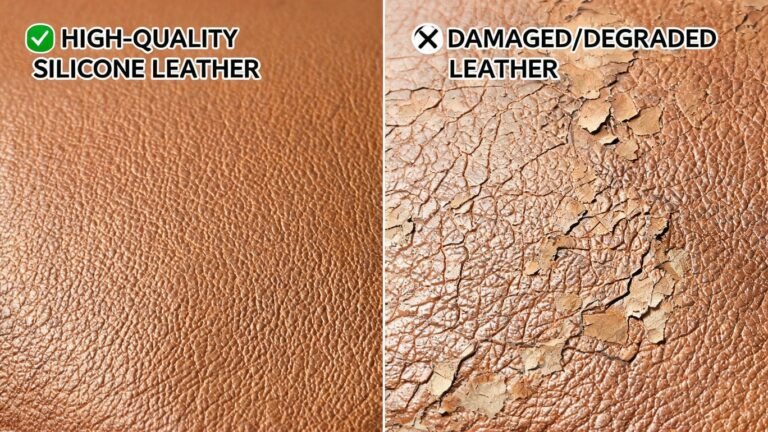
Threat 1: Oil depletion and drying. Genuine leather contains natural tanning oils that evaporate over time — accelerated by UV exposure, heat, and dry indoor air. As oils deplete, the fiber structure becomes brittle and cracks. Protection requires quarterly conditioning to replenish oils. Silicone leather has no oils to deplete — its polymer structure is inherently stable from -40°C to 250°C. No conditioning, ever.
Threat 2: UV color fade. Genuine leather’s tannin-based dyes degrade under UV, causing visible color shift within 400 hours of exposure. Protection sprays create temporary UV barriers that degrade and require reapplication. Silicone leather’s pigments are encapsulated in the silicone matrix and UV-stable for 1,000+ hours with zero Delta E shift. See our cleaning and maintenance guide for the full comparison.

Scratch resistance tester — quantifying what protection products attempt to prevent but can’t fully stop
Threat 3: Stain absorption. Genuine leather’s porous surface absorbs liquids within 3-5 seconds. Coffee, wine, ink, and dye transfer from clothing bond permanently with the fiber structure. Stain guards create a temporary hydrophobic film, but the film itself degrades and must be reapplied quarterly. Silicone leather is non-porous — liquids bead on the surface and wipe clean with water. No stain guard needed.
Threat 4: Microbial growth. Genuine leather absorbs moisture and body oils, creating a nutrient environment for bacteria and mold. In commercial settings, this produces the characteristic “aged leather” odor within 6-12 months. Protection requires antimicrobial treatments and regular extraction cleaning. Silicone leather is intrinsically antimicrobial — it inhibits bacteria, mold, and mildew without chemical additives, and its non-porous surface doesn’t absorb the nutrients microbes need. No antimicrobial treatment needed.
The Annual Cost Breakdown: Protection vs. Zero Protection
| Protection Category | Genuine Leather | Silicone Leather |
|---|---|---|
| Conditioning cream | $300–500/year | $0 (no conditioning) |
| UV protection spray | $60–100/year | $0 (1,000+ hr UV-stable) |
| Stain guard treatment | $100–160/year | $0 (non-porous surface) |
| Extraction cleaning | $200–300/year | $0 (water wipe only) |
| Antimicrobial treatment | $80–120/year | $0 (intrinsically antimicrobial) |
| Restorative repair | $200–400 (every 2–3 yrs) | $0 (no degradation) |
| Annual total (per sofa) | $1,200–1,500 | $0 |
| 5-year protection cost | $6,000–7,500 | $0 |

Cost and lifespan comparison — the data that shows protection products double the TCO of genuine leather
Procurement director’s reality check: A 50-sofa hotel lobby renovation using genuine leather at $200/sofa material cost looks like $10,000 in leather. Add 5-year protection: $60,000-75,000. The same lobby using silicone leather at $350/sofa material costs $17,500 upfront — with $0 protection. The “cheaper” genuine leather costs 4x more over 5 years.
Why Silicone Leather Needs Zero Protection Products
The reason silicone leather eliminates every protection product isn’t a feature — it’s the material’s chemistry. Silicone is an inert polymer. It doesn’t contain oils that evaporate. It doesn’t have a porous surface that absorbs stains. Its pigments are locked into the polymer matrix, not applied as a surface coating. It’s inherently antimicrobial, not treated with antimicrobial chemicals. Each protection product that genuine leather needs exists to compensate for a material property that silicone leather simply doesn’t have.
This is why silicone leather is specified for commercial furniture and sofa applications where maintenance-free performance is a procurement requirement, not a preference. The cleaning protocol is water wipe — no specialized products, no professional service contracts, no quarterly maintenance scheduling. Over a 10+ year service life, the cumulative protection savings per commercial sofa range from $12,000 to $15,000.
Watch: Sofa stain resistance test — coffee, ink, and oil wiped clean with water, zero protection products
Frequently Asked Questions
Does silicone leather sofa protection require any maintenance products at all?
No. Silicone leather requires zero conditioning, zero UV sprays, zero stain guards, and zero professional extraction cleaning. The entire maintenance protocol is: wipe with water. For commercial environments requiring disinfection, silicone leather is bleach-safe and alcohol-compatible — standard facility disinfectants won’t degrade the surface. This eliminates the quarterly conditioning, biannual UV treatment, and quarterly extraction cleaning that genuine leather requires, saving $1,200-1,500 per sofa per year.
How does the total cost of genuine leather sofa protection compare to silicone leather over 10 years?
Over 10 years, a genuine leather commercial sofa accumulates $12,000-15,000 in protection costs — conditioning, UV sprays, stain guards, extraction cleaning, and restorative repairs. This exceeds the original material cost by 2-3x. A silicone leather sofa accumulates $0 in protection costs over the same period, with a 10+ year service life that typically outlasts the genuine leather sofa’s 5-7 year commercial lifespan. The 10-year TCO difference, including one mid-cycle replacement of genuine leather, is $18,000-22,000 per sofa.
The Material That Protects Itself
Leather sofa protection is a $1,200/year cost that exists because genuine leather degrades — its oils evaporate, its surface absorbs stains, its dyes fade under UV, and its porous structure breeds microbes. Every protection product in the protocol compensates for a material property that could be engineered out at the source. Silicone leather doesn’t need protection because it doesn’t have the properties that require protection. For B2B procurement teams evaluating commercial furniture TCO, the question isn’t which protection products to buy — it’s whether the material specification should require protection products at all.
Get Maintenance-Free Sofa Leather Specs
About TOPSUN
TOPSUN manufactures zero-maintenance silicone leather for B2B furniture and hospitality projects requiring commercial sofas that deliver 10+ year service life without conditioning, stain guards, UV treatments, or extraction cleaning.
Zero conditioning · 1,000+ hr UV stability · Non-porous stain-repellent · Intrinsically antimicrobial · Bleach-safe and alcohol-compatible · Free A4 swatches for specification testing