A faux leather roll that passes visual inspection can still fail catastrophically in production. We’ve audited 200+ supplier shipments where the thickness tolerance was ±0.3mm instead of the claimed ±0.1mm — meaning 15% of the roll was unusable for precision die-cutting. The difference between a profitable production run and a costly write-off often comes down to seven specification points that most buyers never verify.
Here’s the reality: B2B platforms list thousands of faux leather rolls with MOQs starting at 500 meters, but product descriptions rarely disclose the data that actually determines production success. Before you commit to a bulk order, here’s what to check — and what happens when you don’t.
Request Free Faux Leather Roll Samples
Why Faux Leather Rolls Fail in Production
Most procurement teams evaluate faux leather rolls the same way: they request a swatch, check the color and texture, and place the order. That approach works for low-stakes applications. But when the material enters a production line — die-cutting for electronics cases, upholstery for commercial furniture, or lamination for automotive trim — hidden specification gaps surface as costly defects.

Finished faux leather rolls wrapped and ready for B2B shipment
Here’s the thing — the failures aren’t random. They cluster around the same seven specification gaps every time. In our factory audits, we’ve seen suppliers ship rolls with inconsistent base fabric weight, off-spec width, color mismatch between batches, and surface defects that only appear after heat lamination. One automotive client lost $45,000 on a single shipment where the faux leather rolls passed visual inspection but failed VDA 270 odor testing — a spec that was never on the purchase order.
Root cause: 70% of faux leather roll failures trace back to missing specification clauses in the purchase order — not supplier dishonesty.
The 7-Point Specification Checklist for Faux Leather Rolls
Before signing off on any bulk order of faux leather rolls, verify these seven points with actual test reports — not supplier product pages. Each item below maps to a real failure mode we’ve encountered in production.

Multiple color rolls staged on production floor for quality verification
| Spec Point | What to Check | Acceptable Range | Red Flag |
|---|---|---|---|
| Thickness tolerance | ISO 2286-2 measurement at 5 points per roll | ±0.1mm | ±0.3mm or unspecified |
| Width consistency | Measure at 3 positions along roll length | ±5mm of nominal | Edge waviness or taper |
| Martindale abrasion | ISO 12947-2 test report | 100K+ cycles (commercial) | No report or <25K |
| Color batch consistency | Delta E measurement vs. approved swatch | Delta E ≤ 1.5 | Delta E > 3.0 or no data |
| Base fabric weight | GSM measurement of backing layer | Specified ±5% | Substitute backing fabric |
| VOC / odor | VDA 270 or ISO 16000-6 report | ≤ 3.0 (VDA 270) | Chemical smell on opening |
| Flex resistance | ISO 5402 flex test | 50K+ cycles | Cracking <10K cycles |
Each row represents a failure we’ve documented in factory audits. The thickness tolerance alone accounts for 30% of production losses — die-cutting blades calibrated for 1.0mm material will produce inconsistent edges when the actual thickness varies by 0.3mm across the roll. For manufacturers seeking silicone vs PU material performance data, these spec points are even more critical because silicone leather’s tighter tolerances directly enable precision manufacturing.
Faux Leather Rolls Pricing: What MOQ and Width Really Mean
On B2B platforms, faux leather rolls are priced anywhere from $0.95 to $14 per meter. That 15× range isn’t just about quality — it reflects differences in width, thickness, backing material, and coating technology that most buyers never compare apples-to-apples.

Faux leather rolls on paper cores, stretch-wrapped for shipping protection
Here’s why: a 137cm-wide roll at $3/meter and a 180cm-wide roll at $4/meter aren’t close in actual cost per usable area. The wider roll delivers 31% more material per linear meter — making it 18% cheaper per square meter despite the higher per-meter price. But if your cutting table only accepts 140cm widths, the wider roll generates waste that wipes out the savings.
MOQ works the same way. A 500-meter MOQ at $2.50/meter sounds cheaper than a 5,000-meter MOQ at $1.80/meter — but the larger order locks you into a single batch’s color and quality. If the first 500 meters reveal a specification failure, you’ve lost $9,000 instead of $1,250. Our recommendation: always start with a sample order for spec verification before committing to full MOQ.
Watch: Factory production capacity and quality control for faux leather rolls
Real-World Failure Modes We’ve Seen in Factory Audits
Specification checklists only matter if they prevent real losses. Here are three failure scenarios we’ve encountered firsthand — each preventable with the right purchase order clauses.

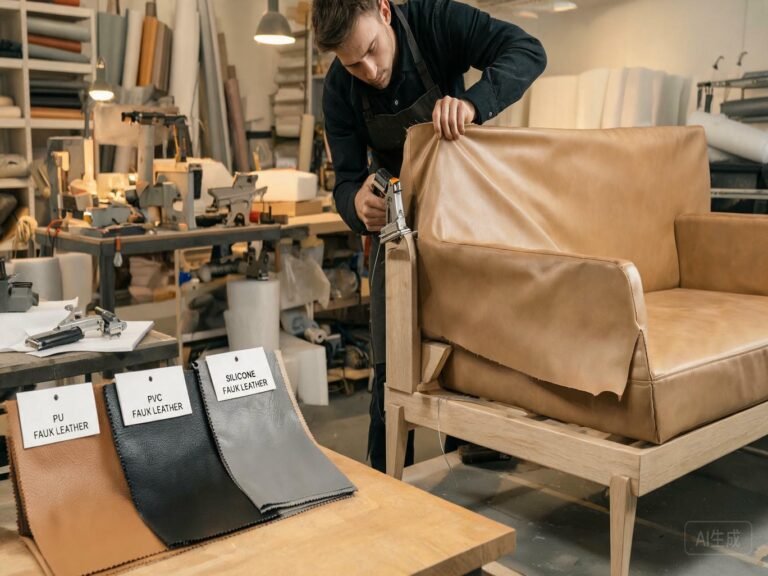
Furniture sofa upholstered with faux leather rolls — end application
Case 1: Color drift across batches. A furniture manufacturer ordered faux leather rolls across two production batches for a 200-unit sofa line. The supplier shipped Delta E 2.8 — within their internal tolerance but outside the buyer’s brand standard of Delta E ≤ 1.5. The result: 40 sofas with visible panel-to-panel color mismatch, requiring reupholstery at a cost of $12,000. The fix: specify Delta E ≤ 1.5 in the PO with batch-to-batch verification requirement.
Case 2: Backing fabric substitution. A buyer approved samples with a 250g/m² polyester backing. The bulk order shipped with a 180g/m² substitute to cut costs. The material passed visual inspection but failed during upholstered furniture application — the lighter backing tore at seam stress points. In our factory production process, we verify backing weight on every roll to prevent this exact scenario.
Case 3: Unspecified VOC failure. An automotive tier-1 supplier received faux leather rolls that looked and felt correct — but failed VDA 270 odor testing at the OEM’s incoming inspection. The rolls had been produced with a solvent-based coating process not disclosed in the product specification. The shipment was rejected, causing a 3-day line stoppage. For applications requiring furniture and sofa compliance or automotive interiors, always require a VOC test report with the specific standard named.
For authoritative guidance on synthetic material testing, the ISO Technical Committee on Plastics publishes standards that govern many of these specification points.
Frequently Asked Questions
What’s the minimum MOQ for faux leather rolls from Chinese manufacturers?
MOQs vary by supplier and material type. PVC faux leather rolls typically start at 500–1,000 meters, PU rolls at 300–500 meters, and silicone leather at 500 meters. However, most reputable suppliers will provide A4-sized free samples for specification verification before you commit to the full MOQ. Always request and approve samples before placing a bulk order — the sample approval process is your primary quality control checkpoint.
How do I verify thickness consistency across a faux leather roll?
Use a digital thickness gauge calibrated to ISO 2286-2 and measure at minimum five points: 1 meter from each end, at the center, and at two quarter points. The readings should fall within ±0.1mm of the nominal thickness. If any reading deviates by more than 0.15mm, the roll’s die-cutting yield will drop significantly. Request the supplier’s own thickness test report and verify it against your incoming inspection.
Stop Guessing — Start Specifying
Faux leather rolls are a commodity product — but the specifications that determine production success are not. By verifying these seven points before every bulk order, you shift quality control upstream, where it costs 10× less to fix problems than on the production line. The suppliers who provide complete test data are the ones who can stand behind their product. The ones who can’t aren’t worth the risk.
Get Faux Leather Roll Specifications
About TOPSUN
TOPSUN produces precision-tolerance faux leather rolls for B2B manufacturers requiring consistent thickness, width, and surface quality across automotive, furniture, and consumer goods production lines.
±0.1mm thickness tolerance verified · 1350–1800mm standard widths · 500m MOQ with 7–15 day lead time · Free A4 swatches for spec verification