We’ve received purchase orders for artificial leather sheet with nothing more than “PU leather, black, 1.0mm” written on them. That level of specification is why roughly 30% of B2B leather orders arrive with tolerance issues, wrong backing material, or substandard abrasion performance. The gap between what buyers specify and what manufacturers actually need to produce consistent quality is wider than most procurement teams realize.
This article breaks down seven specification parameters that separate a clean production run from a costly rejection cycle. Whether you’re sourcing for upholstery, automotive interiors, or consumer electronics, these are the specs that belong on every purchase order.
Request Artificial Leather Sheet Samples

Physical testing lab where artificial leather sheet specs are verified against international standards
Thickness and Width: Why Tolerance Matters in Artificial Leather Sheet
Thickness is the first spec every buyer includes — and the one most often specified incorrectly. The international standard ISO 2589 governs thickness measurement for coated fabrics, with typical tolerance at ±0.05mm. But here’s what catches buyers off guard: thickness varies across the roll width, not just between rolls. A sheet specified at 1.0mm can measure 0.95mm at the edges and 1.05mm at center.
For artificial leather sheet, thickness ranges typically span 0.4mm to 2.0mm depending on application. Upholstery requires 0.8-1.2mm for stitchability and durability. Automotive trim often needs 0.6-1.0mm for wrapping curves without wrinkling. 3C electronics demand ultra-thin 0.23-0.8mm for tight tolerances on device skins. Specifying the right thickness without the right tolerance is like ordering a suit in your size but ignoring the fit.
Width matters equally. Standard production widths range from 1,350mm to 1,800mm. If your cutting die assumes 1,400mm and the roll arrives at 1,350mm, you lose yield on every cut. Always specify both nominal width and minimum acceptable width on the PO.

Coating machine rollers — where thickness tolerance is won or lost before the sheet ever reaches QC
Abrasion Resistance: Martindale vs Taber vs ASTM D3884
Abrasion resistance is where most spec sheets go wrong — not because the number is inaccurate, but because the test method doesn’t match the application. Three test methods dominate the industry, and they measure fundamentally different things.
Martindale abrasion (ISO 12947-2) uses a multi-directional rubbing motion that simulates real-world wear. It’s the gold standard for upholstery and furniture applications. Taber abrasion (ASTM D3884) uses rotary wheels and is common in automotive specs. The two methods produce numbers that aren’t directly comparable — 10,000 Taber cycles ≠ 10,000 Martindale cycles.
In our lab, we test every batch of silicone leather sheet to 200,000+ Martindale cycles. That’s not a marketing number — it’s the minimum threshold we’ve established for materials claiming 10-year service life in commercial upholstery. PU leather typically tests at 20,000-50,000 cycles before surface breakdown. PVC can reach 10,000-30,000 cycles. The spec sheet should state test method, cycle count, and pass/fail criteria — not just “high abrasion resistance.”
Specification tip: Always require test method + cycle count + evaluation endpoint (e.g., “Martindale 100,000 cycles, no visible wear”). A bare cycle number without the test standard is unverifiable.
| Parameter | Test Standard | Typical Range | What to Verify on PO |
|---|---|---|---|
| Thickness | ISO 2589 | 0.23–2.0mm | Nominal + tolerance ±0.05mm |
| Width | Mill measurement | 1,350–1,800mm | Nominal + minimum acceptable |
| Abrasion | ISO 12947-2 | 20K–200K+ cycles | Method + cycles + endpoint |
| Tensile strength | ISO 3376 | ≥10–15 N/mm | Minimum value + warp/weft |
| Tear strength | ISO 34-1 | ≥15–20 N | Minimum value + direction |
| Color fastness | ISO 105-B06 | Grade 4–5 | Grade + exposure hours |
| VOC emission | ISO 16000-6 | Zero–low | Test report + chamber data |
Backing Material: The Hidden Variable in Artificial Leather Sheet Quality
Backing material is the spec that most procurement teams omit — and it’s the one that causes the most production headaches. The backing determines how the sheet behaves during cutting, sewing, lamination, and thermoforming. Get it wrong and you’ll know within the first 100 meters of production.
Common backing options include woven cotton, non-woven polyester, knitted elastic, and fleece. Each has different stretch characteristics, breathability, and bonding behavior. For automotive interiors that require thermoforming, a woven backing provides dimensional stability. For furniture that needs draping, a knitted backing flexes without distortion. For full silicone leather construction, the backing is typically a woven polyester or glass fiber fabric that maintains structural integrity across the -40°C to 250°C operating range.
One of our furniture clients switched from a knitted to a non-woven backing on their artificial leather sheet order without updating the spec. The result: seam puckering on every sofa in the production run, a full week of rework, and 2,000 meters of material scrapped. Backing material isn’t optional information — it’s a production-critical specification.

Swatch rack showing thickness, color, and backing combinations — every variable must be specified
Chemical Compliance: REACH, RoHS, and VOC Specs
Chemical compliance is non-negotiable for B2B shipments entering the EU and North American markets. Yet many buyers leave it as “must comply with REACH” without specifying which SVHC substances to test for and at what detection limits.
A proper chemical compliance spec for artificial leather sheet should include: REACH SVHC full list compliance with test report, RoHS heavy metal screening (lead, cadmium, mercury, chromium VI), formaldehyde emission per EN 717-1, and VOC emission per ISO 16000-6 or VDA 277 for automotive applications. For food-contact or medical applications, add FDA 21 CFR 177.2600 and ISO 10993-5 biocompatibility testing.
Here’s why this matters: customs authorities in the EU can reject shipments that lack proper chemical compliance documentation. We’ve seen shipments held for 3+ weeks because the test report didn’t match the invoice batch number. Always require that test reports reference the specific production batch.

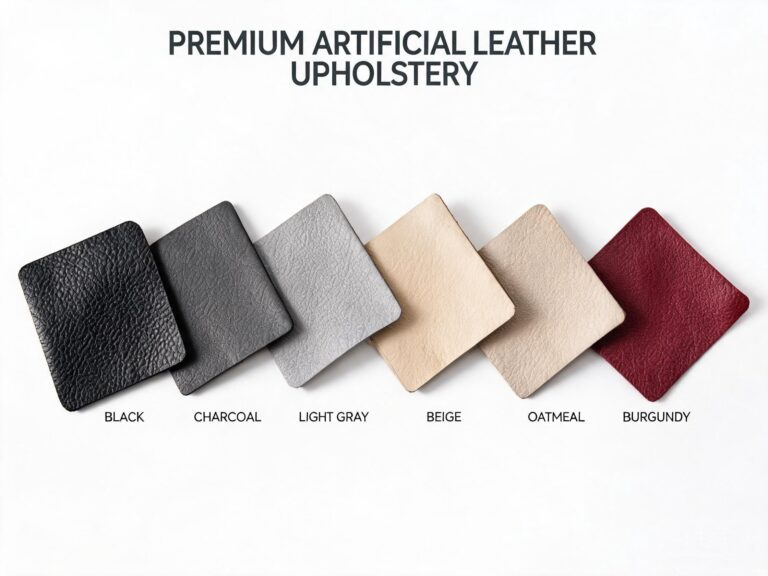
Color palette display — color fastness specs must include test standard, grade, and exposure duration
How to Specify Artificial Leather Sheet on a Purchase Order
After years of reviewing purchase orders — both clean ones and problematic ones — here’s the specification template we recommend B2B buyers use for artificial leather sheet procurement:
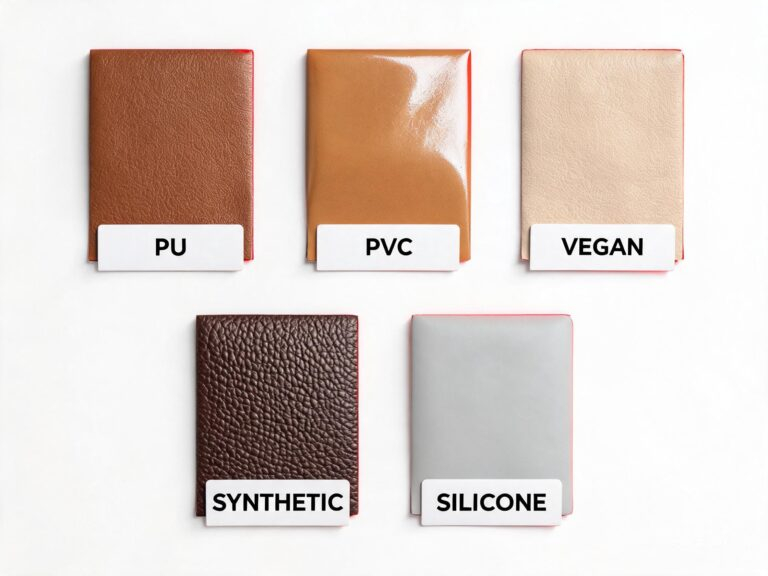
• Material type: Silicone / PU / PVC (specify full or semi if applicable)
• Thickness: Nominal value + tolerance (e.g., 1.0mm ±0.05mm per ISO 2589)
• Width: Nominal + minimum acceptable (e.g., 1,400mm, min 1,380mm)
• Backing material: Woven / non-woven / knitted + fiber type
• Color: Pantone/RAL reference + Delta E ≤ 1.0 acceptance
• Abrasion: Test method + cycle count + endpoint (e.g., Martindale 100,000 cycles, no visible wear)
• Chemical compliance: REACH SVHC + RoHS + VOC test standard + batch-referenced report
For more on how MOQ and pricing interact with these specs, see our faux leather sheet performance analysis and our guide on leather MOQ and pricing structures. The difference between a well-specified order and a vague one isn’t just quality — it’s weeks of production time and thousands of dollars in potential rework.
Substrate selection guide — how backing material choice affects every downstream production step
From Spec Sheet to Production Floor
An artificial leather sheet is only as reliable as the specification behind it. When procurement teams specify thickness with tolerance, abrasion with test method, backing with fiber type, and chemical compliance with batch-referenced reports, the production floor knows exactly what to make — and QC knows exactly what to verify. That’s the difference between a spec sheet and a wish list.
Compare Silicone vs PU Leather Specs
About TOPSUN
TOPSUN produces precision-engineered artificial leather sheets for B2B manufacturers requiring tight tolerance, certified performance, and consistent roll-to-roll quality across automotive, furniture, and 3C electronics applications.
Thickness 0.23–2.0mm with ±0.05mm tolerance · Width 1,350–1,800mm · Martindale 200,000+ cycles · ISO 10993 + REACH + FDA certified · 500,000+ m monthly capacity · Free A4 swatches shipped worldwide