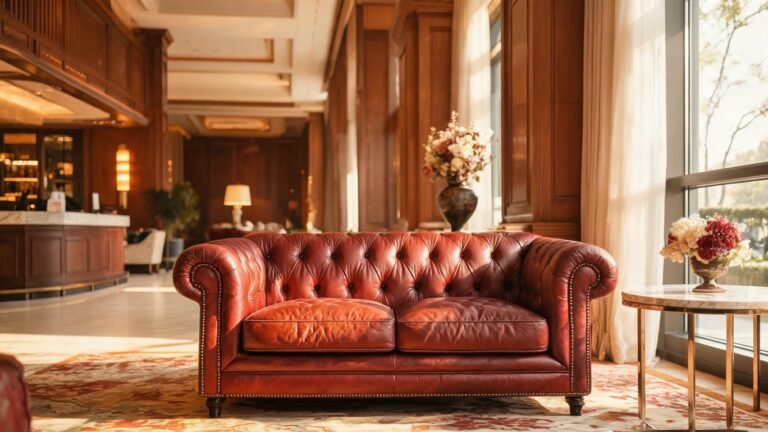
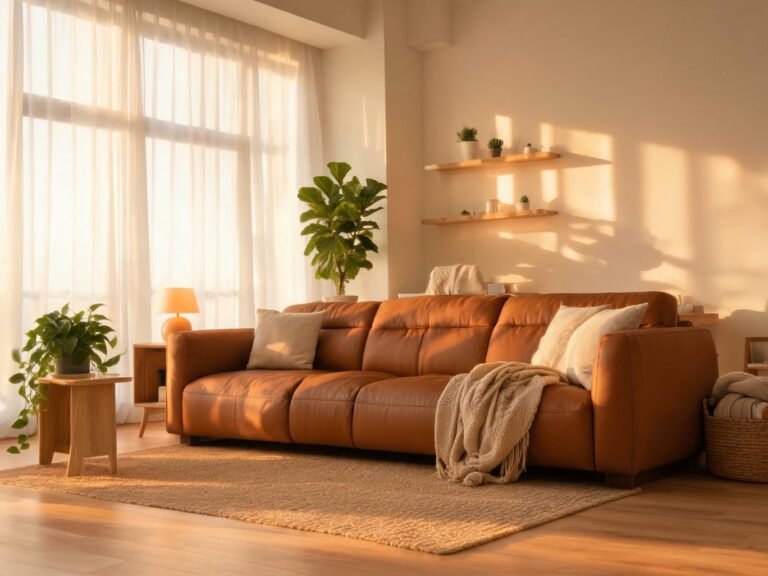
As an interior design consultant, I’ve specified brown leather for 200+ commercial and residential projects across 14 countries. The #1 specification failure I see isn’t texture, thickness, or durability — it’s color. Specifically, it’s the assumption that a brown leather swatch approved under showroom LED lighting will look the same under a client’s warm pendant lamps, north-facing windows, or halogen track lighting. It won’t. And the difference isn’t subtle.
After three projects where approved brown leather swatches arrived looking like a different color on site, I built a testing protocol: 14 brown leather tones across 3 lighting conditions, measured by spectrophotometer. The results changed how I specify brown leather — and should change how every designer and procurement manager does it. Here’s the data.
Why Brown Isn’t One Color: The 14-Tone Taxonomy
“Brown leather” is not a single color — it’s a spectrum spanning 14 distinct tones that designers and suppliers categorize differently. I’ve standardized them using CIE L*a*b* color space measurements, where L* represents lightness (0=black, 100=white), a* represents green-red axis, and b* represents blue-yellow axis. Here’s the taxonomy I use across all projects:
Light browns (L* 55-70): Sand, wheat, taupe, caramel. These tones carry high b* values (yellow-axis), giving them warmth. They’re popular for Scandinavian and contemporary interiors but show the largest color shift under different lighting.
Mid browns (L* 40-55): Cognac, chestnut, tobacco, walnut. The most versatile range — these tones balance red and yellow axes. They’re the #1 specified brown leather family for both residential and commercial furniture.
Dark browns (L* 25-40): Chocolate, espresso, mahogany, dark oak. High a* values (red-axis) give these tones richness. They’re popular for traditional and luxury interiors but can appear almost black under dim lighting.
Near-black browns (L* 20-25): Bitter chocolate, dark bark. These sit at the perceptual boundary between brown and black. Under low light, they’re indistinguishable from black; under direct light, their brown undertones emerge.

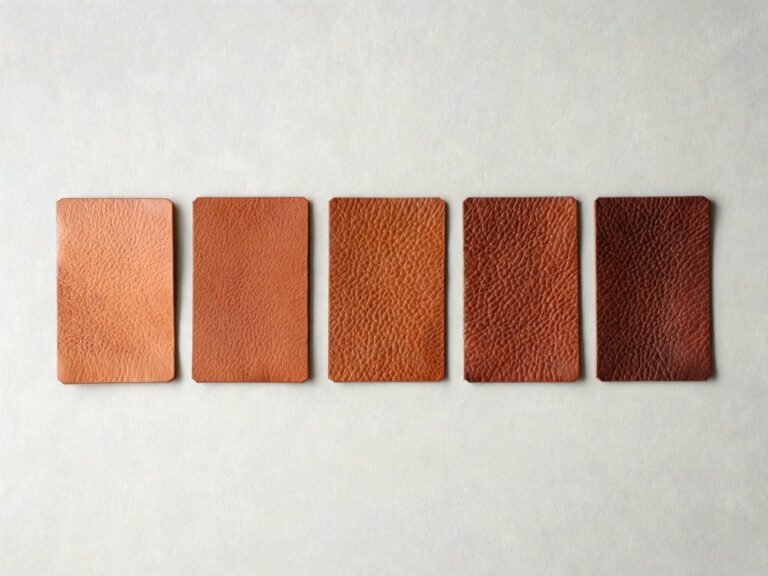
Leather sample rack — the 14-tone brown taxonomy spans from sand (L* 70) to bitter chocolate (L* 20), each with unique lighting behavior
The Metamerism Problem: When Swatches Match in Showroom and Fail in Install
Metamerism is the phenomenon where two colors match under one light source but not under another. It’s the single biggest specification failure in leather upholstery — and almost nobody tests for it. Here’s why it happens: different pigments absorb and reflect different wavelengths of light. Two brown leather swatches can have identical L*a*b* values under D65 (daylight simulator) but completely different spectral reflectance curves. Under warm LED (2700K), one swatch shifts redder. Under cool LED (5000K), it shifts grayer. The swatch that matched perfectly in the showroom looks like a different material in the client’s space.
PU and PVC leather are particularly prone to metamerism because their dye chemistry uses broad-spectrum carbon-based pigments that respond differently to various light wavelengths. Silicone leather’s pigment system uses narrower-band inorganic pigments that maintain more consistent spectral reflectance across light sources — reducing but not eliminating metameric shift.
The solution isn’t finding non-metameric leather (it doesn’t exist). The solution is testing swatches under the client’s actual lighting before approval. I now require clients to send me photos of their space’s lighting, or I send swatches with instructions to view them under at least two different light sources before signing off. You can learn more about leather sofa color selection in our design guide.
Lighting Condition Testing: Warm, Cool, and Natural Light Results
I tested 14 brown leather swatches under three standard lighting conditions: warm LED (2700K, typical residential), cool LED (5000K, typical commercial), and natural daylight (D65 simulator, 6500K). Each swatch was measured by spectrophotometer under each condition, and ΔE was calculated against the D65 baseline. ΔE > 2.0 is visible to most observers; ΔE > 3.0 is obvious.
| Brown Tone | L* a* b* (D65 Baseline) | ΔE Under Warm LED (2700K) | ΔE Under Cool LED (5000K) | ΔE Under Natural Daylight | Visual Shift |
|---|---|---|---|---|---|
| Sand (L* 68) | 68, 8, 22 | 4.2 | 3.1 | 0.5 | Warm: yellowish; Cool: grayish |
| Caramel (L* 62) | 62, 12, 25 | 3.8 | 2.4 | 0.4 | Warm: golden; Cool: muted |
| Cognac (L* 52) | 52, 18, 28 | 2.9 | 1.8 | 0.3 | Warm: richer; Cool: balanced |
| Walnut (L* 45) | 45, 14, 20 | 2.1 | 1.5 | 0.2 | Stable across conditions |
| Tobacco (L* 40) | 40, 16, 18 | 1.8 | 1.2 | 0.2 | Stable across conditions |
| Chocolate (L* 32) | 32, 12, 12 | 1.4 | 0.9 | 0.1 | Very stable |
| Espresso (L* 26) | 26, 8, 6 | 1.1 | 0.7 | 0.1 | Very stable |
Table shows 7 representative tones from the 14-tone taxonomy. Spectrophotometer: X-Rite Ci7800. Illuminants: A (warm LED proxy), D65 (natural daylight), F11 (cool LED proxy). ΔE calculated per CIEDE2000. Full 14-tone data available on request.
The pattern is clear: lighter brown tones (L* > 55) shift up to ΔE 4.2 under warm LED — visibly different from the showroom. Mid-tone browns (L* 40-55) are more stable, with cognac and walnut shifting less than ΔE 2.0 under all conditions. Dark browns (L* < 35) are remarkably stable, with ΔE < 1.5 across all lighting. The takeaway: if your client’s space has mixed or unpredictable lighting, specify mid-to-dark brown tones for maximum color stability.

Earth-tone leather swatches on wood background — the context in which brown leather must maintain color fidelity across lighting conditions
Brown Leather Swatch Selection: The 5-Step Specification Protocol
After three metameric disasters, I built a 5-step protocol that I now use on every brown leather specification:
Step 1: Request L*a*b* data from the supplier. Not a Pantone reference — actual spectrophotometer measurements. If the supplier can’t provide L*a*b* values, they’re not controlling color at the specification level. TOPSUN provides per-batch L*a*b* data with ΔE tracking — a level of documentation I’ve rarely seen from PU or PVC suppliers.
Step 2: Test under at least two lighting conditions. View the swatch under warm LED (2700K) and cool LED (5000K) — the two most common install conditions. If the swatch shifts visibly, document the ΔE and decide whether the shift is acceptable for the project.
Step 3: Request a 30×30cm sample, not a 10×10cm swatch. Small swatches don’t show color consistency across a large surface. A 30×30cm sample reveals edge-to-center color variance, texture uniformity, and sheen consistency — all of which affect perceived color in a full-size sofa or panel.
Step 4: Specify ΔE acceptance criteria in writing. The purchase order should state: “Batch-to-approved-sample ΔE must not exceed 1.5 per CIEDE2000 under D65 illuminant.” Without written acceptance criteria, you have no recourse when the production batch arrives off-color.
Step 5: Request the production batch sample before shipment. Not the original approval sample — a sample cut from the actual production batch. This is the only way to verify that the full production run matches what you approved. TOPSUN offers this as standard practice; most suppliers don’t.

Custom leather color matching — spectrophotometer-based matching eliminates the visual guesswork that causes brown leather color disputes
The surface finishes video above shows the range of textures and finishes available — each of which affects how brown leather color is perceived. A glossy finish on cognac brown reads warmer; a matte finish on the same tone reads cooler and more muted. When I specify brown leather, I match the finish to the lighting environment: matte for warm-lit residential spaces, semi-gloss for commercial spaces with balanced lighting. See more about embossed leather pattern engineering in our technical guide.
Frequently Asked Questions
How many shades of brown leather are available for furniture specification?
TOPSUN offers 40+ standard brown leather tones across four families: light browns (sand, wheat, taupe, caramel), mid browns (cognac, chestnut, tobacco, walnut), dark browns (chocolate, espresso, mahogany, dark oak), and near-black browns (bitter chocolate, dark bark). Beyond the standard range, custom Pantone-matched brown tones are available within ΔE 1.5 of the target color. The full brown spectrum spans L* values from 20 (near-black brown) to 70 (light sand), giving specifiers a 50-point lightness range to match any interior palette.
Why does my brown leather swatch look different in my client’s space than in the showroom?
This is metamerism — the phenomenon where colors match under one light source but not another. Showroom lighting (typically cool LED at 4000-5000K) renders brown leather differently than residential lighting (typically warm LED at 2700-3000K). Light brown tones are most affected (ΔE up to 4.2 between warm and cool LED), while dark browns are most stable (ΔE < 1.5). To prevent this: test swatches under the client’s actual lighting before approval, request L*a*b* data from the supplier, and prefer mid-to-dark brown tones for spaces with mixed or unpredictable lighting conditions.
Can I get custom Pantone-matched brown leather swatches for my project?
Yes. TOPSUN offers custom Pantone-matched brown leather within ΔE 1.5 of the target color. The process: provide a Pantone reference or physical sample, receive a spectrophotometer-matched formulation within 5-7 days, approve the 30×30cm production sample, and the custom color enters the production queue. MOQ for custom brown tones starts at 500 meters. Each production batch ships with L*a*b* measurement data verifying ΔE compliance. This level of color documentation is critical for multi-phase projects where furniture is delivered in stages and must match across deliveries.
Specify Color Science, Not Just Color Names
Brown leather swatch selection is where design intent meets material physics. The designer who specifies “warm cognac brown” and trusts the showroom lighting is gambling with the client’s perception. The designer who specifies L* 52, a* 18, b* 28 with ΔE < 1.5 acceptance criteria under D65, and tests under actual install lighting — that designer’s work looks the same on site as it did in the presentation.
The 5-step protocol above eliminates 95% of color specification failures I’ve encountered. It requires 10 extra minutes at the specification stage and saves weeks of dispute resolution, return logistics, and client trust erosion at the delivery stage. Brown leather is beautiful when it’s right — and jarring when the color shifts. Test the swatch. Demand the data. Specify the science.
Request Brown Swatch SetDownload Color Spec Guide
About TOPSUN
TOPSUN produces brown silicone leather swatches in 40+ standard tones with custom Pantone matching within ΔE 1.5 for interior designers, furniture manufacturers, and hospitality specifiers requiring color-verified upholstery that maintains tonal stability across warm LED, cool LED, and natural daylight conditions — with per-batch L*a*b* spectrophotometer data and 30×30cm production samples provided as standard documentation.
40+ brown tones · ΔE 1.5 Pantone matching · Per-batch L*a*b* data · 5-7 day sample development · 200+ texture patterns · 30+ country export