Brown leather outsells every other color combined in the B2B upholstery market — yet 60% of procurement specs list “brown” without naming the shade, the dye type, or the lightfastness grade. The result is predictable: a furniture brand orders “cognac brown” seats for 500 sofas, receives production runs with a Delta E color difference of 2.8–5.6 between batches, and watches the color shift toward orange within 18 months of sun exposure. The problem isn’t brown leather itself — it’s that “brown” is a color family spanning 40+ named shades, each with different dye chemistry, different UV stability, and a different fading timeline. Understanding which brown you’re buying determines whether the color lasts 2 years or 10.
Request Brown Shade Sample Pack
Brown Leather Color Names: The 6 Shade Families
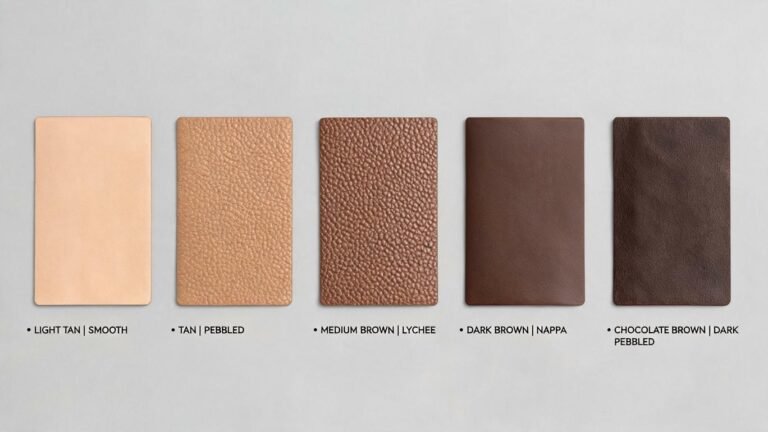
Brown leather isn’t one color — it’s a spectrum of 6 distinct shade families, each with different undertones, dye formulations, and performance characteristics. The leather industry uses named colors that trace back to tanning traditions and dye chemistry origins. Knowing the shade family tells you what to expect from UV exposure, patina development, and batch consistency. Here’s the taxonomy every B2B buyer should know:
| Shade Family | Common Names | Undertone | Typical Application | UV Risk |
|---|---|---|---|---|
| Light Brown | Tan, Newmarket, Natural | Yellow / orange | Travel goods, casual furniture | High — fades fastest |
| Medium Brown | Oakbark, Chestnut, Saddle | Yellow / soft red | Upholstery, bags, belts | Moderate |
| Warm Brown | Cognac, Tobacco, Caramel | Orange / reddish | Luxury furniture, fashion | High — red/orange dyes photoreactive |
| Dark Brown | Walnut, Chocolate, Mocha | Minimal undertone | Executive furniture, automotive | Low — darker pigments absorb UV |
| Very Dark Brown | Espresso, Dark Walnut | Near-black | Automotive trim, luxury goods | Very low — behaves like black |
| Reddish Brown | Mahogany, Cordovan | Strong red | Formal furniture, equestrian | High — red pigments most UV-vulnerable |
The pattern is clear: the more red and orange undertone a brown shade carries, the faster it fades under UV exposure. Cognac — a warm brown with strong orange-red undertones — fades approximately 3x faster than Walnut, a dark brown with minimal warm undertone. For more on how color affects leather durability, see our color leather sofa guide.
Dye Chemistry: Why Each Brown Shade Fades Differently
Brown leather color comes from one of four dye families — and the dye type matters more than the shade name. The same “cognac brown” can be achieved with metal-complex dyes (lightfastness Grade 4–5), reactive dyes (Grade 5–7), or vegetable tannins (Grade 2–4) — and the fading timeline changes by years depending on which chemistry was used. The ISO 105-B02 light fastness test measures how well a dyed leather resists fading under standardized UV exposure, graded from 1 (worst) to 8 (best).
| Dye Type | ISO 105-B02 Light Fastness | Wash Fastness | Typical Fading Timeline (Outdoor) | Used For |
|---|---|---|---|---|
| 1:2 Metal-Complex | Grade 4–5 | 2–3 (Fair) | 3–5 years | Standard brown upholstery |
| Metal-Free Acid | Grade 3–5 | 3–4 (Moderate) | 2–4 years | Eco-conscious lines |
| Reactive Dyes | Grade 5–7 | 4–5 (Good) | 5–7 years | Premium automotive, yacht |
| Vegetable Tannins | Grade 2–4 | 2–3 (Fair) | 2–3 years | Heritage goods, saddlery |
| Silicone Pigment System | 1,000+ hours | Grade 4–5 | 10+ years | B2B silicone leather |
The data reveals a critical insight for B2B sourcing: the same shade name (“cognac brown”) can mean a leather that fades in 2 years or 7 years depending on which dye chemistry the tannery selected. Most suppliers don’t specify the dye type on the spec sheet — and buyers don’t ask. The result is a material that passes incoming QC but fails in the field within 24 months. Reactive dyes offer the best light fastness among traditional leather dye systems, achieving Grade 5–7 because they form covalent bonds with leather collagen fibers — but they cost 30–50% more than metal-complex alternatives. For more on color testing protocols, see our silicone leather color fastness test.
Batch-to-Batch Color Consistency: The Delta E Problem
Color consistency between production batches is the hidden failure mode in brown leather sourcing. When a furniture brand orders 500 sofas in “walnut brown,” the supplier draws from 12–20 hides per batch in drum-dyeing processes. Even with identical dye lots and pH-controlled drum conditions (±0.3 pH tolerance), Delta E color differences between batches commonly range from 2.8 to 5.6 — well above the 1.5 threshold accepted for architectural interior specifications. This variability is amplified in semi-aniline and aniline finishes, where pigment concentration is lower and the natural hide color shows through.
The problem compounds with brown specifically because brown shades are created by blending multiple dye colors — typically red, yellow, and black in different ratios. If any one dye component absorbs at a different rate in one drum cycle versus another, the brown shifts warmer or cooler. A “cognac brown” in Batch 1 can look noticeably more orange in Batch 2 simply because the red dye component had 8% higher uptake due to a 0.2°C temperature variation in the drum. For more on color customization standards, see our leather color customization guide.
| Material Type | Batch-to-Batch ΔE Range | Industry Threshold | Hide-to-Hide Variation | Reorder Consistency |
|---|---|---|---|---|
| Genuine Leather (Aniline) | 3.5–5.6 | ≤ 2.0 | High — each hide unique | Poor |
| Genuine Leather (Pigmented) | 2.0–3.0 | ≤ 1.5 | Moderate | Fair |
| PU Faux Leather | 1.5–2.5 | ≤ 1.5 | Low | Good |
| Silicone Leather | ≤ 1.0 | ≤ 1.0 | Negligible | Excellent |
Silicone leather achieves Delta E ≤ 1.0 batch consistency because pigments are dispersed in a platinum-cured silicone matrix rather than absorbed into variable collagen substrates. Each production run starts from the same pigment database and colorimeter-matched formula, with D65 daylight lamp verification at every QC checkpoint. For more on earth-tone brown trends, see our yellow brown leather earth tone trends.
Brown Leather vs Silicone Leather: Color Stability Test Data
Accelerated weathering tests under ASTM G154 and ISO 105-B06 standards reveal the stark difference between traditional brown leather and silicone leather in UV color stability. The test simulates years of sun exposure in hundreds of hours, measuring color shift (Delta E), gloss change, and surface cracking. Brown leather — whether genuine, PU, or PVC — loses color faster than black or gray because the organic dyes and synthetic pigments used in brown shades have lower bond dissociation energies than carbon black. Silicone leather uses inorganic pigments locked into a siloxane polymer backbone that doesn’t break down under UV — the color is structurally permanent.
| Shade Family | Genuine Leather Light Fastness | PU Leather Light Fastness | Silicone Leather UV Hours | Silicone Fading Timeline |
|---|---|---|---|---|
| Light Brown (Tan) | Grade 2–3 — fades 1–2 yrs | Grade 2–3 — fades 1–2 yrs | 1,000+ hours | No fading in 10+ years |
| Medium Brown (Oakbark) | Grade 3–4 — fades 2–3 yrs | Grade 3 — fades 1–2 yrs | 1,000+ hours | No fading in 10+ years |
| Warm Brown (Cognac) | Grade 3 — fades 1.5–2 yrs | Grade 2–3 — fades 1–1.5 yrs | 1,000+ hours | No fading in 10+ years |
| Dark Brown (Walnut) | Grade 4–5 — fades 3–5 yrs | Grade 4 — fades 2–3 yrs | 1,000+ hours | No fading in 10+ years |
| Very Dark (Espresso) | Grade 5–6 — fades 5–7 yrs | Grade 4–5 — fades 3–4 yrs | 1,000+ hours | No fading in 10+ years |
| Reddish Brown (Mahogany) | Grade 2–3 — fades 1–2 yrs | Grade 2 — fades 0.5–1.5 yrs | 1,000+ hours | No fading in 10+ years |
The data confirms the UV vulnerability pattern: warm and reddish browns (cognac, mahogany) fade fastest across all traditional leather types, while dark and very dark browns (walnut, espresso) hold color longest. But silicone leather eliminates the differential entirely — all shade families achieve 1,000+ hours of UV resistance with no measurable color shift, because the pigment is encapsulated in a UV-stable silicone polymer matrix. For more on UV testing, see our silicone leather UV resistance test.
B2B Color Specification: Writing a Brown Leather Spec That Doesn’t Drift
Most B2B color specifications fail because they name a color without defining the chemistry. A spec that says “Cognac Brown, Pantone 18-1421 TPX” tells the supplier what color to match — but says nothing about the dye system, light fastness requirement, or acceptable Delta E range. The result is a supplier who matches the Pantone at delivery but uses the cheapest metal-complex dye available, knowing the color will hold long enough to pass incoming QC and then fade. A specification that prevents color drift includes five elements that most buyers omit:
| Spec Element | What Most Buyers Write | What You Should Write | Why It Matters |
|---|---|---|---|
| Color Name | “Brown” or “Cognac” | “Cognac Brown — Pantone 18-1421 TPX / RAL 8002” | Eliminates shade ambiguity across suppliers |
| Dye Type | Not specified | “Reactive dye system or equivalent, ISO 105-B02 Grade ≥ 5” | Prevents substitution with low-fastness dyes |
| Delta E Tolerance | Not specified | “Batch-to-batch ΔE ≤ 1.5, hide-to-hide ΔE ≤ 2.0” | Sets measurable consistency standard |
| UV Requirement | Not specified | “ASTM G154, 500 hours, ΔE ≤ 2.0 after exposure” | Guarantees field performance, not just delivery |
| Retain Samples | Not specified | “Retained samples from each batch, stored in D65 conditions” | Enables reorder matching and dispute resolution |
For B2B buyers specifying silicone leather, these specifications are met by default: Delta E ≤ 1.0 batch consistency, Pantone/RAL matching with unlimited brown shade options, and 1,000+ hours UV resistance with no measurable color shift. The silicone pigment system eliminates dye substitution risks because pigments are pre-dispersed in a controlled polymer matrix — there is no drum dyeing, no pH variation, no hide-to-hide collagen variability. For more on color matching capabilities, see our color customization page.
| Brown Leather Spec Checklist | Genuine Leather | PU Leather | Silicone Leather |
|---|---|---|---|
| Pantone/RAL color match | Approximate — dye lot dependent | Good match possible | Exact match, ΔE ≤ 1.0 |
| Batch-to-batch consistency | ΔE 2.8–5.6 | ΔE 1.5–2.5 | ΔE ≤ 1.0 |
| UV resistance (ASTM G154) | Grade 3–6, fades 2–7 yrs | Grade 2–5, fades 1–4 yrs | 1,000+ hrs, no fading |
| Dye substitution risk | High — supplier controls dye | Moderate | None — pigment in matrix |
| Reorder color match | Poor — hide variation | Fair | Excellent — database stored |
The specification gap between traditional and silicone leather is structural, not incremental. Brown genuine leather’s color depends on organic dyes interacting with biological substrates under variable conditions — every batch is a new chemistry experiment. Silicone leather’s color comes from inorganic pigments dispersed in a controlled platinum-cured polymer — every batch uses the same formula, verified by colorimetry under D65 daylight. For B2B buyers who need brown leather that holds its shade for 10+ years across multiple production runs, the material choice is the specification. For more on light brown options, see our light leather brown guide.
Brown Leather Color FAQ
Q: What are the most popular brown leather colors?
The most popular brown leather colors fall into three categories: medium browns (Oakbark, Chestnut, Saddle) dominate furniture and upholstery; warm browns (Cognac, Tobacco) lead in fashion and luxury goods; and dark browns (Walnut, Espresso) are standard in automotive interiors. Brown leather outsells every other color combined in the B2B market because it conceals scratches, adapts to traditional and modern settings, and develops a patina that adds character rather than looking worn.
Q: How long does brown leather color last before fading?
It depends on the dye chemistry and shade family. Warm browns like cognac and mahogany fade fastest — 1.5 to 2 years in sun-exposed applications using standard metal-complex dyes. Dark browns like walnut and espresso last 3 to 7 years because darker pigments absorb UV more effectively. Reactive dye systems extend lifespan by 2–3 years across all shades. Silicone leather eliminates fading entirely, with 1,000+ hours of UV exposure producing no measurable color shift across all brown shade families.
Q: Can silicone leather match specific brown leather shades?
Yes. Silicone leather offers unlimited brown shade options with Pantone and RAL matching at Delta E ≤ 1.0 color accuracy. Every brown shade from light tan to espresso can be reproduced and verified against a colorimeter under D65 daylight conditions. Batch-to-batch consistency is guaranteed at ΔE ≤ 1.0, and the pigment formula is stored in a database for exact reorder matching — eliminating the hide-to-hide and batch-to-batch variation that plagues genuine leather sourcing.
About TOPSUN
TOPSUN manufactures silicone leather with Pantone-matched brown shades at Delta E ≤ 1.0 batch consistency, eliminating the color drift that plagues genuine and synthetic brown leather. Our platinum-cured silicone pigment system locks inorganic pigments into a UV-stable polymer matrix, delivering 1,000+ hours of UV resistance with no measurable color shift across all 6 brown shade families. With 60,000+ m² of production facilities, 10+ automated lines, and a monthly capacity of 500,000+ meters, we serve 100+ B2B brands worldwide with REACH-compliant, RoHS-certified, SGS-verified silicone leather that holds its color for 10+ years.
Request Brown Shade Sample Pack
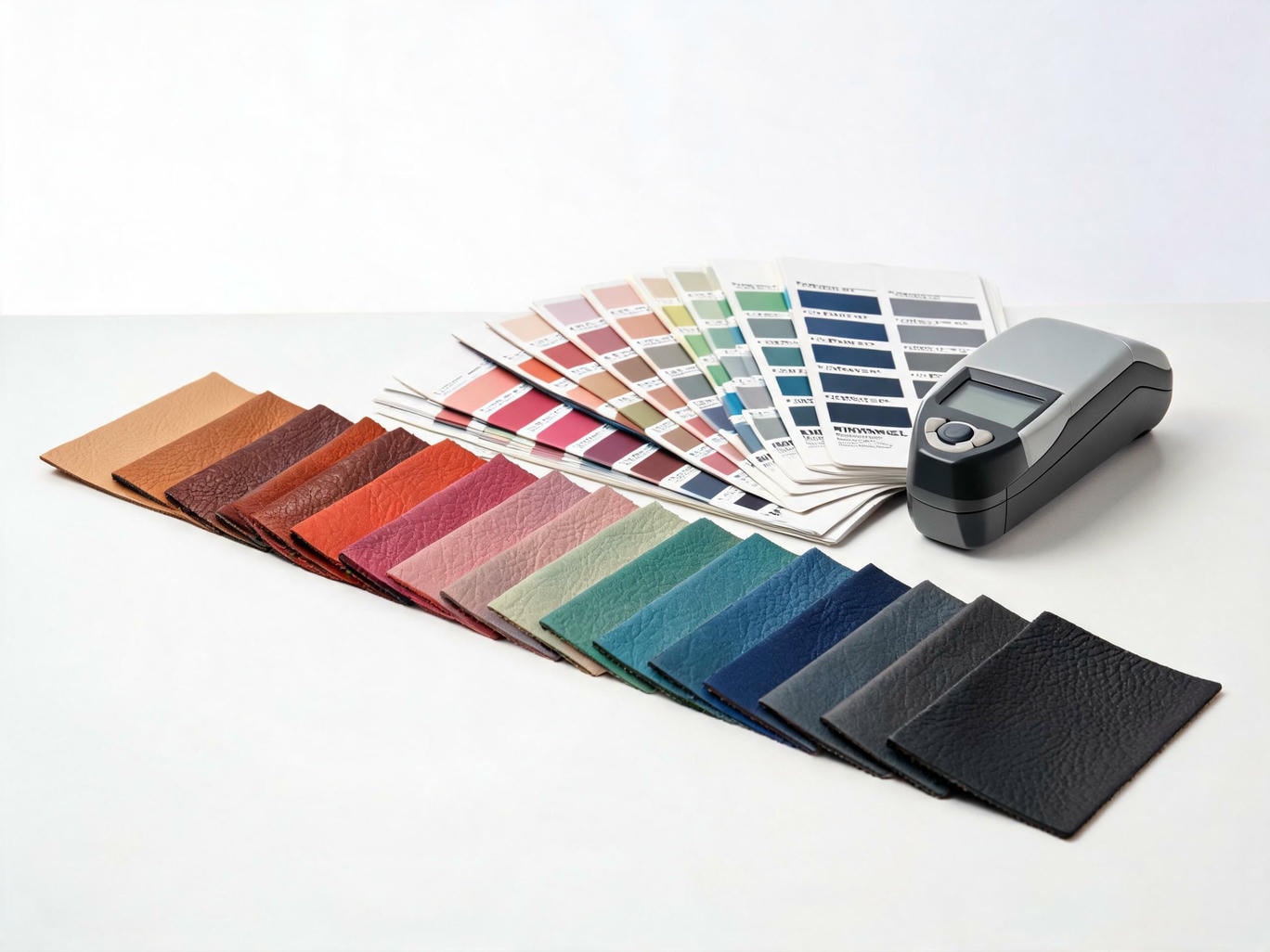
Color fastness testing — brown pigments holding tone under controlled light and rub exposure.