Polyurethane fabric leather — better known as PU leather — is the most widely used synthetic leather material on the planet. Walk into any furniture store, pick up any accessory, or sit in any mid-range car, and there’s a good chance you’re touching PU. It’s cheap, versatile, and can be made to look almost identical to genuine leather.
But if you’re a procurement manager or sourcing professional, you’ve probably also seen the dark side of PU leather: peeling armrests on 2-year-old office chairs, cracked dashboards in cars from sunny climates, customer complaints about “fake leather” that didn’t last, and increasingly strict regulations about the chemicals used in its production.
This guide is an unvarnished look at PU fabric leather — how it’s made, where it performs well, where it fails, what regulations you need to worry about, and what alternatives are worth considering for different applications.
Read: PU Leather’s Hidden Problems
What Is Polyurethane Fabric Leather?
Polyurethane fabric leather is a composite material made by coating a fabric base with a layer of polyurethane resin. The fabric backing provides structure and tensile strength. The PU coating provides the leather-like surface — color, texture, grain pattern, and water resistance.

PU leather structure: surface coating + PU layer + adhesive + fabric backing
The basic structure of PU fabric leather, from top to bottom:
- Surface finish / topcoat — A thin protective layer that determines gloss, feel, and stain resistance
- PU skin layer — The main polyurethane layer with embossed leather grain
- Adhesive layer — Bonds the PU skin to the backing fabric
- Fabric backing — Woven, knitted, or nonwoven fabric (polyester, cotton, or blends) that provides mechanical strength
PU leather was first developed in the 1960s — DuPont’s Corfam was the first commercial synthetic leather, introduced as a shoe material. The technology has improved dramatically since then, with better PU formulations, more realistic grain patterns, and a wider range of backing fabrics. But the fundamental structure — a polymer coating on a fabric base — hasn’t changed.
There are two primary manufacturing methods for PU fabric leather, and they produce materials with very different characteristics and price points:
Dry process (direct coating): PU resin is coated onto release paper, dried in an oven to evaporate solvents, then laminated to a fabric backing. Fast, cheap, and the most common method. Produces a non-porous film with a plastic-like feel.
Wet process (coagulation): Fabric is impregnated with PU solution, then passed through a coagulation bath where the PU precipitates into a porous, sponge-like structure. Produces a more leather-like feel with some breathability, but uses more water and chemicals and costs significantly more.
Procurement tip: When sourcing PU leather, always ask whether it’s dry-process or wet-process. Dry-process PU is cheaper but less breathable and more prone to hydrolysis. Wet-process PU feels more like real leather but costs 2–3x more and has a shorter service life.
The Problem with PU Leather: Why It Fails Prematurely
PU leather looks great in a catalog and at delivery. The problem shows up 2–5 years later — sometimes sooner in harsh environments. The failure mechanisms are well-documented but rarely discussed in sales literature.
1. Hydrolysis — the #1 failure mode
Polyurethane molecules contain ester bonds (or ether bonds, depending on the formulation) that are vulnerable to attack by water molecules. When PU leather is exposed to high humidity, sweat, or repeated wet cleaning, water molecules break these chemical bonds from within — a process called hydrolysis. The result: the PU material becomes brittle, cracks, peels, and delaminates from the fabric backing.
In tropical or coastal regions with high humidity year-round, PU upholstery can start failing in as little as 12–18 months. Even in moderate climates, the combination of body sweat, humidity, and temperature cycling means most PU leather products have a service life of 2–5 years — far shorter than genuine leather or silicone leather.
2. UV degradation and fading
UV radiation breaks down PU polymer chains, causing discoloration, surface cracking, and loss of flexibility. This is a particular problem in automotive interiors, where dashboard and seat surfaces can see hundreds of hours of direct sun per year. Most PU leather is formulated with UV stabilizers to slow this process, but it doesn’t stop it — it just delays it.
3. Plasticizer migration (for PVC-blended PU)
Many “PU” leathers on the market are actually PU/PVC blends — sometimes as much as 70% PVC with a thin PU topcoat. PVC relies on plasticizers for flexibility, and those plasticizers slowly migrate out over time (especially at high temperatures). The material becomes stiff, cracks, and can feel sticky or greasy to the touch.
4. Chemical sensitivity
PU leather is vulnerable to a wide range of common chemicals: sunscreen, hand sanitizer, perfume, household cleaners, disinfectants, and even body oils can cause surface damage, discoloration, or accelerated degradation. This is a major issue in healthcare settings where frequent disinfection is required.
Hydrolysis test: PU leather vs. silicone leather after 14 weeks in high-humidity conditions
Regulatory and Chemical Risks Every Buyer Should Know
PU leather isn’t just a durability concern — it’s a regulatory concern. The chemicals used in PU production are coming under increasing scrutiny from regulators worldwide, and non-compliant material can lead to product recalls, market access denials, and legal liability.

Cleaner production processes like solvent-free coating reduce both environmental impact and regulatory risk
Here are the key regulatory risk areas for PU fabric leather:
| Chemical / Substance | Risk | Key Regulations |
|---|---|---|
| DMF (Dimethylformamide) | Liver toxicity, reproductive effects — classified as SVHC under REACH | EU REACH SVHC list, China GB standards |
| DMF residues in finished product | Skin contact exposure, occupational health risks | REACH, OEKO-TEX, Prop 65 |
| Phthalates (PVC blends) | Endocrine disruption, developmental toxicity | REACH Annex XIV, CPSIA, Prop 65 |
| VOC emissions | Indoor air quality, “new car smell” complaints | GB/T 27630 (China auto), VDA 270 (Germany), BIFMA |
| Heavy metals (lead, cadmium) | Toxicity, especially for children’s products | CPSIA, REACH, OEKO-TEX 100 |
| Organotin compounds | Immunotoxicity, endocrine disruption | REACH, China HJ environmental labeling |
The regulatory environment for PU leather is only getting tighter. DMF — the primary solvent used in wet-process PU production — was added to the EU REACH SVHC (Substances of Very High Concern) list due to its reproductive toxicity. Regulators in California, China, and other markets are also tightening restrictions on VOC emissions and chemical residues in consumer products. Companies sourcing PU leather need to stay current on these regulations — what was compliant last year might not be compliant this year.
Deep Dive: PU Leather’s Hidden Problems
PU Leather vs. Alternatives: Side-by-Side Comparison
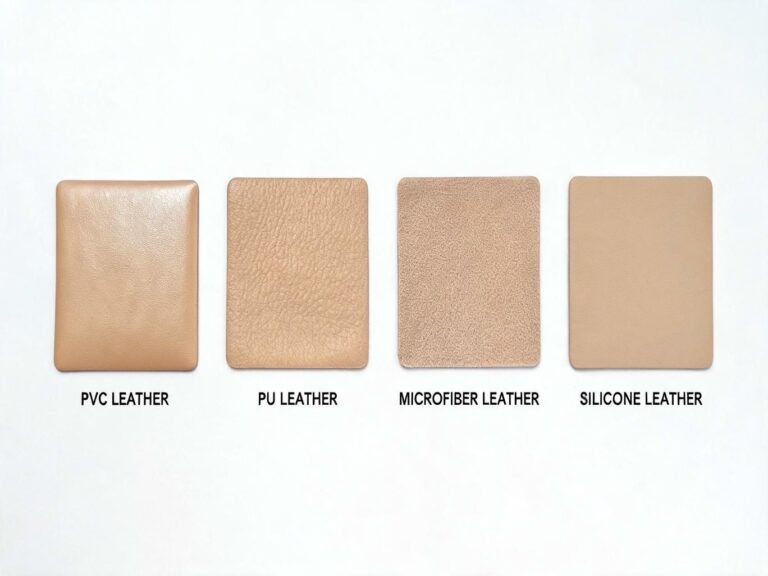
PU leather isn’t the only synthetic leather option. Let’s compare it head-to-head with the two most common alternatives — PVC/vinyl leather and silicone leather — so you can see the tradeoffs clearly.
| Parameter | PU Leather | PVC / Vinyl Leather | Silicone Leather |
|---|---|---|---|
| Cost per m² | $8–$20 | $5–$12 | $18–$40 |
| Service life (commercial) | 2–5 years | 3–6 years | 10–15+ years |
| Hydrolysis resistance | Poor — fails from within | Moderate — better than PU | Excellent — immune |
| UV stability | Poor — fades & cracks | Moderate | Excellent — inherently stable |
| Stain resistance | Good — wipes clean | Good | Excellent — non-porous |
| Cleanability (hospital grade) | Poor — cleaners attack PU | Moderate | Excellent — bleach-cleanable |
| Temperature feel | Warm, leather-like | Sticky when hot, cold when cool | Neutral, comfortable |
| VOC / chemical risk | High (DMF, solvents) | High (plasticizers) | Near zero |
| Leather-like feel | Very good | Poor — plastic feel | Good — soft, different feel |
| Best for | Budget, short-lifecycle products | Lowest cost, wet environments | High-use, long-service-life products |
Here’s the bottom line for procurement teams: PU leather is the cheapest “leather-like” option upfront, but it’s rarely the cheapest over the full product lifecycle. The 2–5 year service life means you’re replacing it 2–5x more often than silicone leather — and when you factor in replacement cost, downtime, and customer complaints, the total cost is often higher.
That said, PU leather absolutely has its place. For short-lifecycle products (fashion accessories, budget furniture, promotional items) where the product is expected to be replaced within 1–3 years anyway, PU is a perfectly good and cost-effective choice. The mistake is specifying PU leather for long-service-life applications where durability and low maintenance matter.
Sourcing Checklist for PU Fabric Leather
If you do decide to source PU fabric leather — and there are many legitimate reasons to — here’s a checklist of things to verify with every supplier before placing an order:
- Process type — Dry or wet process? Get the actual answer, not marketing language.
- PU content — Is it 100% PU or a PU/PVC blend? Many “PU leathers” are mostly PVC with a PU surface layer.
- Hydrolysis rating — Ask for the test method and hours of resistance. Look for ASTM D3690 or ISO 1419:2019 test data.
- DMF content / residue — Is it DMF-free? Get a test report, not just a claim. Critical for EU and California markets.
- VOC emissions — What are the total VOC levels? Get test data for your target market’s standard (VDA 270, GB/T 27630, BIFMA, etc.).
- Abrasion rating — Wyzenbeek or Martindale cycles. Commercial minimum: 50,000+ double rubs.
- Peel strength — How much force to separate the PU layer from backing? Minimum 2.5 N/mm for most applications, 3.5 N/mm for automotive.
- UV / lightfastness — Hours of UV exposure before noticeable fading. Ask for ASTM D4329 or ISO 105-B02 data.
- Compliance certifications — REACH, Prop 65, OEKO-TEX, CPSIA (for children’s products). Get actual certificates with test reports.
- Warranty — Does the supplier offer a performance warranty? What conditions are covered? A supplier confident in their material will stand behind it.
Is Polyurethane Fabric Leather Right for Your Project?
Polyurethane fabric leather is the default synthetic leather for a reason — it’s cheap, versatile, and widely available. It works well for applications where cost is the primary driver and the product doesn’t need to last more than a few years. But for any application where durability, cleanability, low chemical risk, or long service life matters, PU leather has serious limitations that buyers often discover too late.
The key to good procurement isn’t to avoid PU leather entirely — it’s to match the material to the application. Use PU where it makes sense (short-lifecycle, low-cost products), and specify higher-performance materials like silicone leather where the total cost of ownership justifies the upfront premium.
If you’re working on a project where PU leather has failed in the past, or where you’re concerned about hydrolysis, UV degradation, or regulatory compliance, it might be time to evaluate silicone leather as an alternative. The upfront cost is higher, but the 2–3x longer service life and near-zero maintenance usually deliver a lower total cost of ownership.
Request Side-by-Side Material Samples
About TOPSUN
TOPSUN manufactures premium silicone leather — a cleaner, more durable alternative to PU and PVC leather. Our solvent-free production process delivers zero-VOC material with 10+ year service life and inherent resistance to hydrolysis, UV, and chemical damage.
Zero VOC · No DMF · No plasticizers · Hydrolysis-proof · UV stable · 200K+ Wyzenbeek cycles · Full compliance documentation · OEM-grade quality