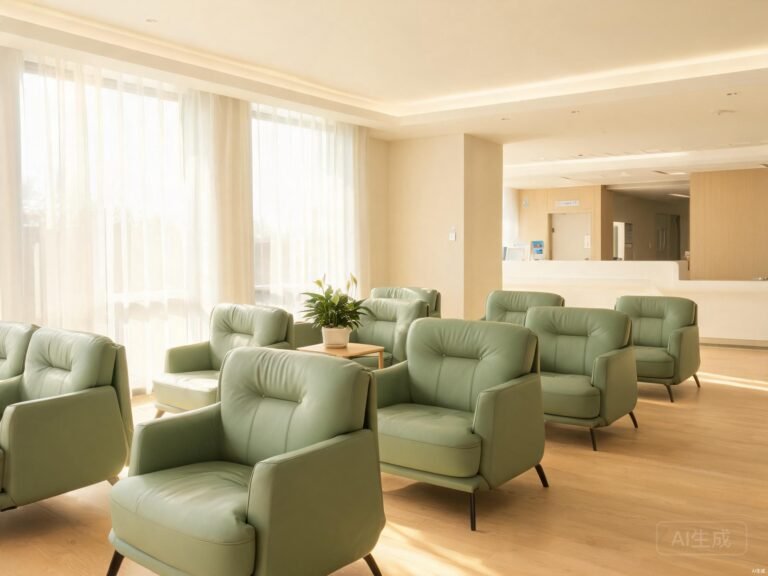
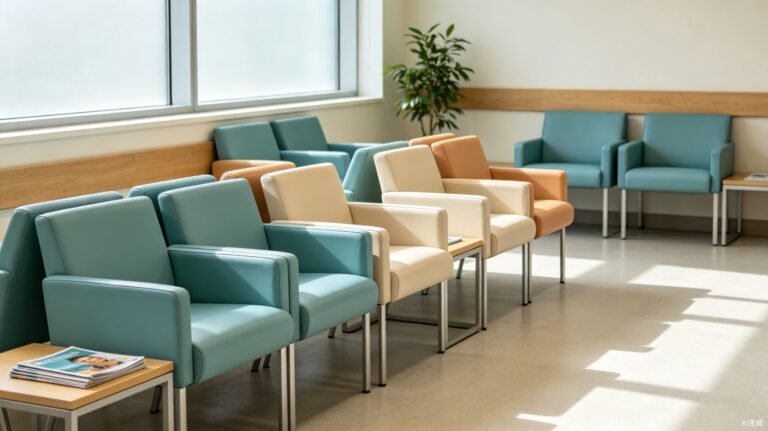
A facilities director at a multi-site medical group replaced 340 waiting room chairs across eight clinics last year. The chairs were only four years old. The upholstery hadn’t worn through from foot traffic — it had dissolved from repeated exposure to the quaternary ammonium disinfectants that janitorial staff applied six times daily across every surface. The waiting room chair leather specified during procurement was standard PU: adequate for appearance, inadequate for the chemical reality of healthcare cleaning protocols. The replacement cost was $87,000. The material spec sheet that caused the failure was one page long. Here are the five specifications that should have been on it.
Request Seating Material Specs
Spec 1: Disinfectant Chemical Tolerance
Healthcare facilities use cleaning agents significantly more aggressive than anything in hospitality or office environments. The standard arsenal includes sodium hypochlorite (bleach) solutions at 1,000+ ppm concentration, quaternary ammonium compounds, hydrogen peroxide solutions, and alcohol-based disinfectants at 70% or above. These chemicals are not gentle. Bleach strips topical treatments, causes color fade, and degrades PU and PVC surfaces. Quat solutions break down plasticizers. Alcohol dissolves PU coatings over repeated exposure.
A spec sheet for waiting room chair leather must state the specific chemicals tested and the number of cleaning cycles survived without visible degradation. Silicone leather tolerates all of these agents without surface damage because its siloxane polymer is chemically inert. Bleach, alcohol, quat solutions — none of them react with the silicone backbone. The antimicrobial test guide documents the specific disinfectant compatibility data healthcare facilities require.

Abrasion resistance testing quantifies how seating upholstery withstands repeated contact across years of daily use.
Spec 2: Inherent Antibacterial Properties
Waiting room surfaces are environmental transmission points. CDC classifies them as “environmental surfaces” — lower individual risk than medical instruments, but requiring regular decontamination. The question isn’t whether the surface can be cleaned, but whether it actively resists bacterial colonization between cleanings.
Standard PU leather and PVC vinyl rely on topical antimicrobial treatments that wash out over time — exactly when the surface needs them most, after months of chemical cleaning. Silicone leather naturally inhibits bacterial growth at 99.9% effectiveness against E. coli and Staphylococcus aureus without any chemical additives. The antibacterial property is molecular — built into the silicone polymer itself. It doesn’t deplete, wash out, or degrade with cleaning. The most durable leather comparison shows why inherent properties outperform applied treatments in commercial settings.

Medical-grade seating upholstery must resist bacterial colonization between cleaning cycles — not just after cleaning.
Spec 3: Martindale Abrasion Rating (Post-Chemical Exposure)
The Martindale abrasion test measures how many cycles a material withstands before showing visible wear. EN ISO standards for contract furniture require 50,000 cycles minimum. Standard PU leather typically rates 100,000 cycles when new. PVC vinyl manages 50,000. These numbers look adequate — until you account for the fact that chemical cleaning degrades the surface over time, reducing abrasion resistance by 30–50% within the first year of healthcare use.
Silicone leather passes 200,000+ Martindale cycles and maintains that rating after repeated chemical exposure because the polymer doesn’t degrade. The same chemical inertness that makes it disinfectant-tolerant also means its abrasion resistance doesn’t drop over time. For a waiting room chair that gets sat in 50+ times per day and wiped down 6 times daily, this spec determines whether the upholstery lasts 4 years or 10. The abrasion test methodology provides the reference data for contract furniture specifications.

Flex and bending tests simulate years of repeated sitting — the stress that causes cracking at seat edges and armrest junctions.
Spec 4: Flex Resistance and Crack Prevention
Waiting room chairs flex every time someone sits down and stands up. The material bends at the seat edge, the backrest junction, and the armrest connection points. EN ISO 5402-1 requires 50,000 flex cycles for contract-grade leather. But flex resistance is where PU leather fails first in high-traffic settings: the plasticizer depletion that stiffens the material over time concentrates stress at flex points, causing cracks that spread across the seat surface within 2–3 years.
Public seating hygiene testing demonstrates how silicone leather maintains antibacterial performance and surface integrity under daily use.
Silicone leather’s flexibility is inherent to the polymer — no plasticizers to deplete, no stiffening over time. It maintains its flex resistance throughout its service life because the material chemistry doesn’t change. The seat that flexes smoothly on day one flexes the same way on day 3,650. The vinyl chair upholstery comparison shows where traditional materials fall short under sustained flex stress.

Commercial seating detail shows the stress points — seat edges, armrest junctions, backrest transitions — where material failure begins.
Spec 5: Total Cost of Ownership Over Replacement Cycles
The $87,000 replacement cost that the medical group incurred for 340 chairs wasn’t a material problem — it was a specification problem. The PU leather specified was $4.20 per meter cheaper than silicone leather. Over 340 chairs, that saving was roughly $2,800. The four-year replacement cycle cost $87,000. The ten-year silicone alternative would have cost $28,000 in material and zero in replacement. The procurement team optimized for unit price and missed the total cost of ownership by $59,000.
A spec sheet for waiting room furniture should include a TCO calculation factoring replacement cycles, labor costs, and downtime. When you calculate the cost per year of service life instead of cost per meter, silicone leather at 10+ years outperforms PU at 3–5 years and PVC vinyl at 2–4 years by a significant margin. The upholstery TCO guide provides the calculation framework for contract furniture procurement.
Waiting Room Material Comparison: The Specs Side by Side
When you compare the four most common waiting room upholstery materials against the five specs that determine field performance, the hierarchy is clear:
| Seating Spec | Genuine Leather | PU Leather | PVC Vinyl | Silicone Leather |
|---|---|---|---|---|
| Disinfectant Tolerance | Low (strips finish) | Limited (degrades coating) | Moderate (cracks over time) | Full (bleach, quat, alcohol) |
| Antibacterial (inherent) | No | No (topical only) | No (topical only) | Yes (99.9% vs E. coli, S. aureus) |
| Martindale Cycles | 50,000–100,000 | 100,000 (new) / 50,000 (aged) | 50,000 | 200,000+ (no degradation) |
| Flex Resistance | Good (conditions needed) | Degrades with plasticizer loss | Poor (cracks at stress points) | Excellent (inherent flexibility) |
| Service Life (healthcare) | 5–8 years (with conditioning) | 3–5 years | 2–4 years | 10+ years |
About TOPSUN
TOPSUN supplies silicone leather to contract furniture manufacturers and healthcare facilities that specify waiting room seating built for daily chemical cleaning, high-traffic abrasion, and infection control protocols. Our material passes 200,000+ Martindale abrasion cycles, inherently inhibits bacterial growth at 99.9% effectiveness without chemical additives, and tolerates full-strength bleach, quaternary ammonium, and alcohol disinfectants without surface degradation. We provide waiting room chair leather with full antibacterial test documentation, disinfectant compatibility reports, abrasion certification, and flex resistance data. For facilities teams replacing PU or vinyl seating every 3–4 years, our 10-year service life spec changes the total cost of ownership calculation from a recurring expense to a one-time investment.
Request Seating Material Specs
Frequently Asked Questions
What is the best leather for medical waiting room chairs?
Silicone leather is the best material for medical waiting room chairs because it combines three properties that no other leather type offers simultaneously: full disinfectant tolerance (survives bleach, quat solutions, and 70% alcohol without degradation), inherent antibacterial properties (99.9% effective against E. coli and S. aureus without chemical additives that wash out), and 200,000+ Martindale abrasion cycles that don’t degrade after chemical exposure. PU leather lacks disinfectant tolerance, PVC vinyl cracks under flex stress, and genuine leather requires conditioning and loses finish under aggressive cleaning. For healthcare settings, the material must tolerate the cleaning protocol — not the other way around.
How do you disinfect silicone leather seating?
Wipe with standard hospital-grade disinfectants — sodium hypochlorite (bleach) at 1,000 ppm, quaternary ammonium compounds, hydrogen peroxide solutions, or 70% alcohol-based cleaners. No special conditioning or protective treatment is needed. For routine cleaning, a damp cloth with mild soap is sufficient. Unlike PU leather, which degrades under repeated chemical exposure, and PVC vinyl, which stiffens and cracks over time, silicone leather’s chemically inert polymer backbone doesn’t react with these agents. The surface maintains its texture, color, and flexibility regardless of how frequently it’s disinfected.
Specify seating that lasts 10 years, not 3. Request our waiting room chair leather specs with antibacterial test data, disinfectant compatibility reports, and TCO calculations. Get specs →