The spec sheet for our café banquette reupholstery looked flawless: 0.9 mm, “commercial grade”, a pebbled texture that matched the mood board. Then the first panel hit the sewing machine. Skipped stitches. A top layer that fed slower than the bottom, so every seam wandered off the chalk line. A backing that seemed to grow half an inch with every cut. Nothing on that sheet had predicted any of it, because nothing on the sheet was about sewing. Faux leather fabric is sold on how it looks and feels — but it lives or dies at the needle, and seven spec lines decide which way that goes.
Why Faux Leather Fabric Fights the Sewing Machine
Woven textiles forgive the needle. Fibers part, the thread passes, the weave closes behind it. Coated fabric does none of that. The needle punches a hole through film, backing, and all, and that hole is there forever. A row of stitches is a row of perforations — the same seam that holds a linen cushion together becomes a tear line across a vinyl seat. Every setting choice downstream, from needle size to stitch length, exists to manage that one fact.
Scale makes this a supply-chain issue, not a hobbyist quibble. The global faux leather market is valued at USD 43.80 billion in 2026 and projected to reach USD 68.96 billion by 2033 at 6.7% a year, per Coherent Market Insights — and a rising share of those yards is sewn by workrooms that trained on woven goods. Add the physics: a coated surface grips a standard presser foot, the bottom layer advances faster than the top, and the differential surfaces as puckered seams. A walking foot or Teflon foot fixes the drag; sewing faux leather is its own discipline, and the settings below are the short version.
Backing Type: The Hidden Spec Line in Faux Leather Fabric
Every faux leather fabric is a sandwich: polymer coating on top, textile underneath. Buyers scrutinize the coating; the machine only feels the fabric backing. A warp-knit tricot backing — the most common substrate in sofa-cover materials — loops along the warp direction, giving the roll elasticity and a soft drape that wraps around curved shells. That same stretch is what makes panels grow under the foot and seams drift. A woven polyester backing behaves the opposite way: test data on artificial leather found woven-back samples out-broke knit-back samples in both warp and weft directions, per a textile-science study. Stability at the machine, paid for with drape.
| Backing type | Stretch & drape | Behavior at the machine | Best workroom fit |
|---|---|---|---|
| Warp-knit tricot | Two-way give, soft drape | Panels grow under the foot; needs a walking foot and generous cutting tolerance | Curved chair shells, wrapped arms, auto trim |
| Woven polyester | Minimal stretch, dimensionally stable | Seams stay on the chalk line; allowances hold through stitching | Banquettes, cushions, paneled sofa fronts |
| Nonwoven | Little stretch, papery hand | Cuts cleanly but tears at stress points and corners | Low-stress craft goods, linings, display panels |

Base fabric rolls staged at the coating line — the layer that decides how the finished fabric behaves under a needle.
Base fabric selection decides how a finished fabric sews — see how the substrate layer is chosen and bonded before a single yard is coated.
Needle, Foot & Stitch Settings by Fabric Thickness
Thickness drives every setting on the machine. A leather needle has a cutting point that slices the material rather than displacing fibers, and sizing follows the stack you are pushing it through: 90/14 handles garment-weight faux leather under 0.6 mm, 100/16 covers the 0.8–1.2 mm upholstery range most furniture programs use, and 110/18 belongs on doubled seams, piping, and anything past 1.5 mm. Coated surfaces dull needles fast — budget one fresh needle per project, because a dragging point starts skipping stitches before anyone notices the sound change.
The settings that prevent rework, in the order workrooms usually get them wrong:
- Stitch length 3–4 mm — longer stitches mean fewer holes, and fewer holes mean a stronger seam line
- Walking foot or Teflon foot from the very first seam, not after the puckering starts
- Clips instead of pins — a pin hole in coated fabric is a permanent pin hole
- A test offcut under the needle before every panel, for stitch length, direction, and needle size
We stitch-test every new construction on a standard walking-foot machine before it leaves our factory — a construction that skips stitches at 3.5 mm shows up in five minutes, not after 400 meters have been cut into panels.
Width, Weight & Tear Strength: The Specs That Cut Your Labor
Roll width is the quietest cost lever in the whole spec. A 54-inch bolt — about 137 cm — forces a center seam into any banquette seat, sofa back, or booth wider than that. On a light-colored seating program, a visible center seam is a defect complaint waiting to happen; on any program it means two extra cut edges, one extra seam allowance, and stitching labor charged twice. If your program buys faux leather fabric by the yard, run the width math before the price math.
A 54-inch bolt puts a center seam in every wide panel. Roll goods in the 1350–1800 mm range cut the same panels in one piece — fewer seams, fewer failure points, less stitching time.
Weight and strength close out the seven lines. GSM in the 200–800 g/m² range tells the sewing floor how the material will handle: light weights gather into curves, heavy weights strain anything below an industrial machine. Tear strength — look for 15–20 N in stronger constructions — is the insurance number for seam allowances, because a seam is only as strong as the strip it pierces. Elongation at or above 250% is what lets a curved seam flex under load without popping its stitches. The drape side — how a cover feels once it is on the chair — is covered in our guide to soft faux leather fabric.

Fabric inspection before coating — the cheapest place to catch a backing that will misbehave at the machine.
Frequently Asked Questions
Can a home sewing machine handle faux leather fabric?
Up to a point. A household machine with a 90/14 or 100/16 leather needle, a walking foot, and reduced presser-foot pressure sews single layers and light upholstery weights cleanly — roughly anything under 1.2 mm of stacked thickness. Doubled seams, piping, and heavier gauges need an industrial compound-feed machine, because needle penetration force, not motor power, is the wall.
Do needle holes weaken faux leather fabric?
Yes — every hole is a permanent perforation, and a row of them is a tear path running exactly where the seam sits. That is a design constraint, not a dealbreaker: longer stitch lengths, seams placed away from load-bearing edges, and generous seam allowances all keep the perforated strip out of the highest-stress zone.
Is thicker faux leather fabric always more durable?
No. Durability lives in the coating chemistry and the backing construction — abrasion performance comes from the surface system, not the gauge. Thickness past what the design needs mostly buys machine strain, skipped stitches, and bulk at every seam intersection.
Spec Faux Leather Fabric Like a Workroom, Not a Brochure
Here is the seven-line spec, assembled: coating chemistry, backing construction, thickness, width, weight, tear strength, elongation. A supplier’s data sheet that omits backing type or width is not being brief — it is hiding the two lines that decide your cutting yield and stitching labor. And within coating chemistry, the field is not equal: silicone and PU behave differently at the seam, because silicone leather is bonded to its backing without the solvent-adhesive layer that eventually separates in older faux leather constructions.
That is also why we ship free A4 swatches worldwide — the fastest sewability test that exists is your own machine and your own operators. Run the swatch through a curved seam before committing to a 500-meter minimum. Our café banquette program ended exactly that way: re-specced onto a wider woven-back roll, every seat cut in one piece, stitching hours down by a third. Inside the furniture and sofa programs we supply, the constructions that survive are the ones the workroom signed off on first.

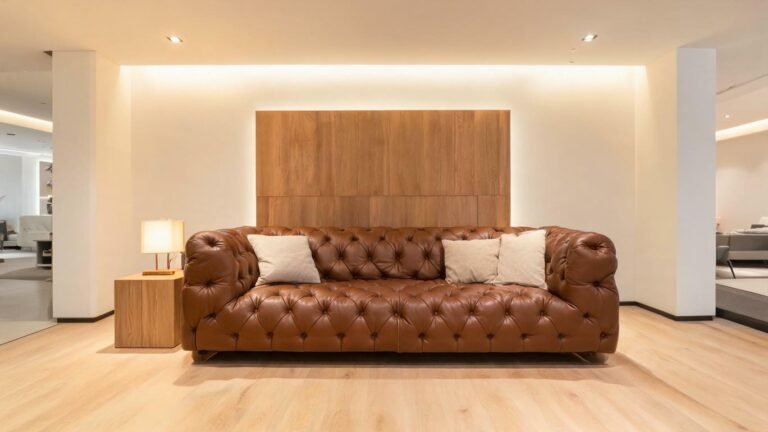
The end product: a sofa program where every seam position was decided by the fabric spec, not discovered on the sewing floor.
Spec it from the cutting table backward and the economics change: fewer seams, faster runs, warranty claims that never happen. Texture and color — the spec lines everyone loves — come last; our embossed faux leather guide covers how grains are engineered once the base construction is settled. However the mood board reads, faux leather fabric that sews badly costs more than any per-yard saving ever returns.
Get a Workroom-Ready Roll Quote
About TOPSUN
TOPSUN manufactures silicone-coated faux leather fabric rolls for the upholstery workrooms, furniture studios, and contract sewing operations that cut and stitch every panel in-house.
Rolls ship in 1350–1800 mm widths that let banquettes and sofa backs be cut without center seams, in 200–800 g/m² weights and 0.23–2.0 mm gauges matched to machine capacity, with tear strength ≥15 N and ≥250% elongation for curved seams — plus free A4 swatches your sewers can stitch-test on their own machines before the 500-meter minimum.