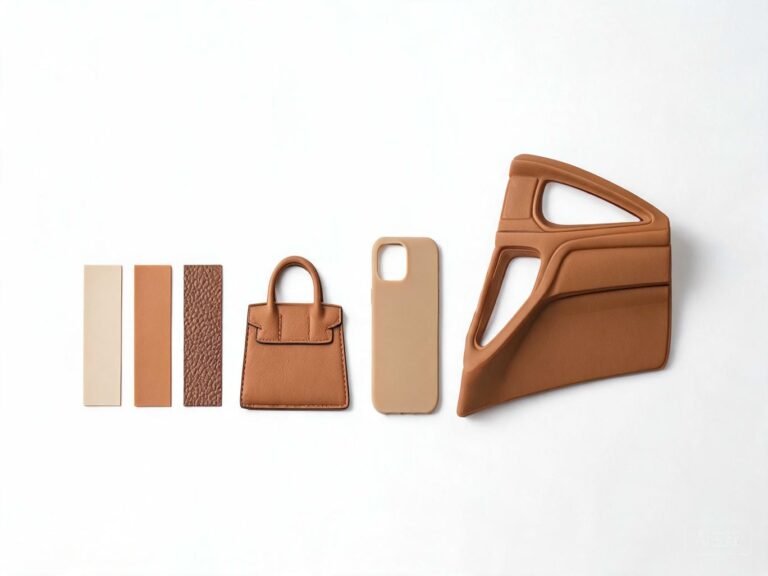
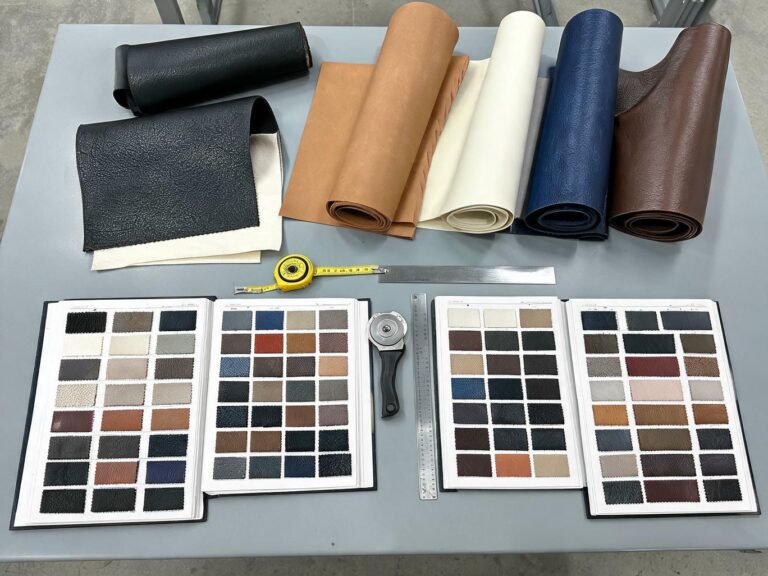
The leather accessories market is in the middle of a material reckoning. Consumers want the look and feel of genuine leather without the animal-hide price tag, the ethical concerns, or the supply chain volatility. Brands want materials that are consistent, customizable, and compliant across global markets. And the gap between what PU leather promises on a spec sheet and what actually happens to a wallet or watch strap after 18 months of daily use is where most sourcing decisions go wrong.
Whether you’re sourcing material for wallets, cardholders, bag panels, watch straps, or small leather goods, the question isn’t just “does it look like leather?” — it’s “will it still look like leather after 50,000 flex cycles, repeated sweat exposure, and daily abrasion from pocket carry?” The answer separates materials that last decades from materials that peel within two years.
The Material Reality Behind “Leather-Look” Accessories
Most leather accessories on the market today fall into four material categories. Understanding the chemistry behind each one determines whether your product returns at a 2% defect rate or a 25% return rate:
- Genuine leather (top-grain, full-grain) — The premium benchmark. Lasts 10-30+ years with care, develops a patina, and resists wear. But supply is volatile, prices fluctuate with hide availability, and tanning compliance (REACH, LWG) adds cost and complexity. A genuine leather wallet can cost $8-15 per unit in material alone.
- Bonded / reconstituted leather — Leather scraps bonded with polyurethane binder. Looks acceptable on day one but delaminates within 12-18 months as the adhesive breaks down. Increasingly rejected by premium brands.
- PU (polyurethane) faux leather — The most common “vegan leather” for accessories. Smooth, uniform, and cheap ($2-4 per yard). But the plastic topcoat is bonded to a fabric backing that flexes underneath — and eventually that bond breaks down. Straps peel, wallet edges flake, and the surface cracks at stress points within 1-5 years.
- Silicone synthetic leather — The newest category. Silicone polymer bonded to fabric substrate, combining the hand-feel of genuine leather with the consistency and compliance of synthetic materials. UV-stable, hydrolysis-resistant, and flexible at temperatures from -30°C to 200°C.
The accessory market’s dirty secret is that most “vegan leather” products are PU leather that will peel — not eventually, but predictably. The plastic coating on PU leather flexes every time a wallet opens, a strap bends, or a bag panel creases. After enough cycles, the coating separates from the backing and the surface starts to flake. For a deeper dive into B2B leather goods sourcing, our sourcing guide covers the full qualification process.

Flex Cycle Testing: The Accessory Industry’s Missing Standard
Here’s a specification most accessory brands never request: flex cycle resistance. The ISO 17645 standard (low-temperature flexing) tests how many times a material can be folded before surface cracking appears. For a wallet that opens and closes 20+ times per day, or a watch strap that bends with every wrist movement, this is the single most relevant durability metric — and most suppliers don’t test for it because the results would disqualify their material.
| Property | Genuine Leather | PU Faux Leather | Silicone Leather |
|---|---|---|---|
| Flex Cycles (ISO 17645, -30°C) | 100,000+ | 20,000-40,000 | 200,000 |
| Martindale Abrasion | 50,000-100,000 | 25,000-50,000 | 150,000 |
| UV Stability (ASTM D329) | 500 hours | 300-500 hours | 1,500 hours |
| Sweat Resistance | Moderate (stains) | Poor (degrades) | Excellent (ISO 11641 Class 5) |
| Skin Contact Safety | Variable (chrome residues) | DMF risk | ISO 10993-5/10 certified |
| Color Customization | Limited by dye lots | Wide range | Full Pantone matching + custom prints |
The flex cycle gap is dramatic: PU leather fails at 20,000-40,000 cycles, while silicone leather survives 200,000. For a watch strap worn daily (estimated 500+ flex cycles per day), PU leather hits its failure threshold in 40-80 days. Silicone leather lasts over a year of continuous flexing — and that’s at -30°C, the worst-case scenario for flexibility. For more on leather textures and buyer specifications, our texture guide covers grain patterns, embossing, and surface treatments.
Skin Contact: The Hidden Risk in Accessory Materials
Leather accessories are in constant skin contact — watch straps against the wrist, wallets against the palm, bag handles against the fingers. This makes biocompatibility testing non-negotiable, yet most PU and PVC leather suppliers cannot provide ISO 10993 certification for their materials.
TOPSUN silicone leather passes three critical biocompatibility tests:
- In vitro cytotoxicity (ISO 10993-5:2009) — Level 1, meaning no toxic cellular response. Critical for watch straps and jewelry-adjacent accessories worn for 8+ hours daily.
- Skin sensitization (ISO 10993-10:2010) — Level 0, meaning zero sensitization potential. Essential for accessories contacting sensitive skin areas.
- Skin irritation (ISO 10993-10:2010) — Level 0, meaning no irritation response. Required for hypoallergenic product lines and children’s accessories.
Genuine leather’s skin safety varies by tanning method: chrome-tanned leather can leach hexavalent chromium, a known skin sensitizer and carcinogen. PU leather risks include residual DMF (dimethylformamide), a reproductive toxicant used as a solvent in polyurethane production. Silicone leather eliminates both risks entirely — the polymer is chemically inert and contains no plasticizers, solvents, or heavy metal residues.

Customization: Where Silicone Leather Outperforms Everything
The accessories market runs on differentiation — a wallet brand needs 12 colors and 3 textures per season, a watch strap brand needs Pantone-perfect matching, and a bag manufacturer needs custom prints for licensed collections. This is where genuine leather hits its limit: dye lots vary, custom prints are impossible, and minimum order quantities for specific shades can exceed 1,000 square feet.
Silicone leather offers full customization freedom:
- Pantone color matching — Any shade, from cognac to midnight blue, matched to within Delta E ≤ 1.5. No dye lot variation between batches.
- Custom prints — Floral, geometric, cartoon, and brand-specific patterns printed directly into the silicone layer. The print cannot wear off because it’s embedded in the material, not applied as a surface coating.
- Embossed grain patterns — Lychee, pebbled, smooth, nappa, saffiano, and custom textures available. The grain is permanent and cannot flatten with wear.
- Thickness range — From 0.23mm ultra-thin for phone cases and earbud covers to 1.5mm+ for bag panels and belts. The Ultra Thin Collection covers the full 0.23-0.8mm range for 3C and fashion accessories.
Cost Analysis: Beyond the Per-Yard Price
The per-yard price tells you nothing about total cost. Here’s what actually matters when calculating material cost for an accessory line:
| Cost Factor | Genuine Leather | PU Faux Leather | Silicone Leather |
|---|---|---|---|
| Material Cost / Yard | $8-15 | $2-4 | $5-8 |
| Yield (usable area) | 60-70% (hide shape) | 95% (roll goods) | 95% (roll goods) |
| Defect Rate | 15-25% (natural flaws) | 3-8% | 1-3% |
| Return Rate (18 months) | 2-5% | 15-25% | 1-3% |
| Compliance Cost | High (LWG, REACH, chrome testing) | Moderate (DMF testing, REACH) | Low (inherent compliance) |
| Effective Cost / Usable Unit | $12-22 | $2.50-5 | $5.50-9 |
The critical line is “Return Rate (18 months).” A PU leather wallet that costs $3 in material but generates a 20% return rate due to peeling actually costs more in reverse logistics, replacement units, and brand damage than a silicone leather wallet that costs $7 in material with a 2% return rate. For brands sourcing premium phone case materials or other 3C accessories, the same calculation applies — the warranty period drives the real material cost.
topsun-silicone-leather-bag-premium-intro
About TOPSUN
TOPSUN manufactures silicone synthetic leather for fashion accessories, 3C electronics, bags, and small leather goods. Our material combines the tactile experience of genuine leather with the consistency, compliance, and customization flexibility that accessory brands require. With thicknesses from 0.23mm to 1.5mm+, full Pantone color matching, custom print capabilities, and ISO 10993 biocompatibility certification, we supply accessory OEMs and ODMs who need material that performs under daily skin contact, flex stress, and pocket abrasion — without the peeling, cracking, and degradation that plagues PU leather accessories.
Frequently Asked Questions
Is silicone leather safe for skin contact in accessories?
Yes. TOPSUN silicone leather passes ISO 10993-5:2009 (cytotoxicity Level 1), ISO 10993-10:2010 (skin sensitization Level 0), and ISO 10993-10:2010 (skin irritation Level 0). The silicone polymer is chemically inert and contains no plasticizers, solvents, or heavy metal residues — making it safe for 8+ hours of continuous skin contact in watch straps, wallets, and bag handles.
How thin can silicone leather be made for accessories?
TOPSUN’s Ultra Thin Collection ranges from 0.23mm to 0.8mm — thin enough for phone cases, earbud covers, and card sleeves while maintaining the durability and stain resistance of thicker formulations. At 0.23mm, the material is lighter than most PU alternatives while being dramatically more resistant to flex cracking.
Can silicone leather be custom printed for accessory brands?
Yes. Custom prints — including floral, geometric, cartoon, and brand-specific patterns — are printed directly into the silicone layer. Unlike surface-printed PU leather where the print wears off within months, the print in silicone leather is embedded in the material matrix and cannot be abraded away. Pantone color matching within Delta E ≤ 1.5 is standard.
How does silicone leather compare to genuine leather for watch straps?
Genuine leather watch straps develop patina and can last years with conditioning, but they absorb sweat, stain, and require regular maintenance. Silicone leather offers the same premium look and feel while being completely sweat-proof (ISO 11641 Class 5), stain-proof against oil and cosmetics, and washable with soap and water. It won’t develop the odor that genuine leather accumulates from perspiration.