A boat seat endures more punishment in one summer than a car seat faces in five years. Saltwater spray, reflected UV radiation off the water surface, humidity cycles from 30% to 95%, and deck temperatures reaching 165°F (74°C) — these conditions break down standard upholstery materials at the molecular level. Marine vinyl (PVC) begins chalking and cold-cracking after 48 to 120 hours of salt spray exposure. Genuine leather absorbs moisture and grows mold within days. The search for a boat seat leather that actually survives the marine environment has led boat builders and marine upholsterers to silicone-based materials — and the performance gap is not incremental, it is categorical.

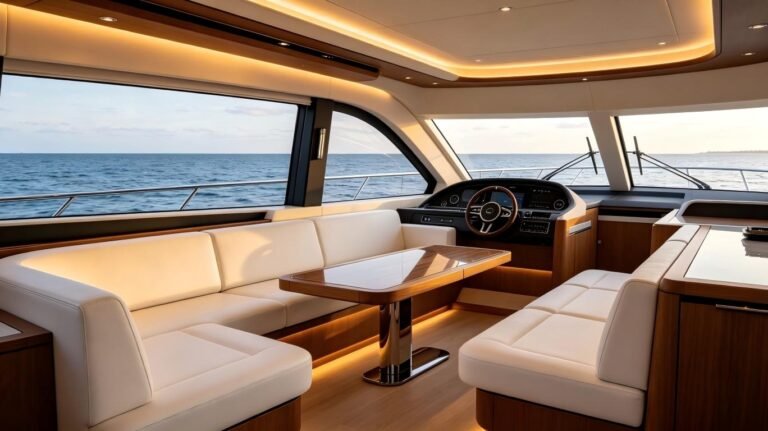
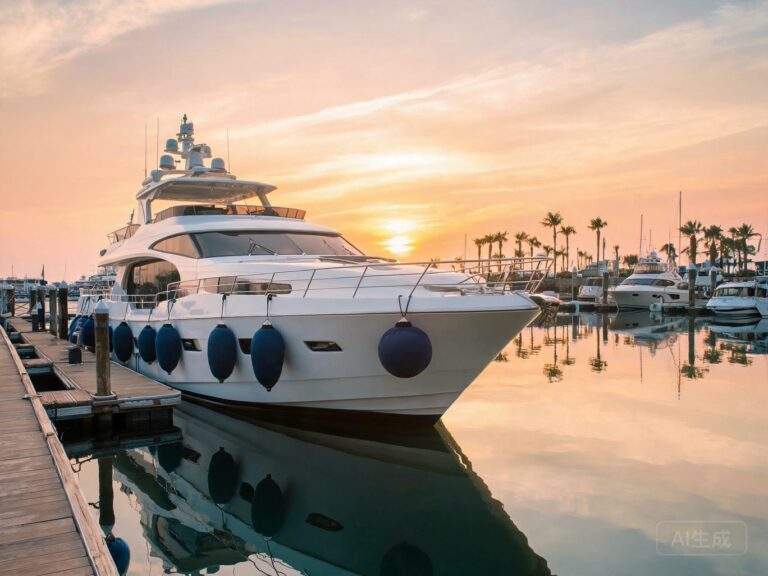
Silicone leather boat seats in a yacht cockpit, maintaining appearance under direct sun and saltwater exposure.
Why Boat Seat Leather Fails: Three Marine Killers
The marine environment destroys upholstery through three simultaneous attack vectors. Understanding each one explains why traditional materials fail — and why silicone chemistry survives.
Saltwater hydrolysis is the first killer. Salt crystals penetrate the surface coating of PVC and PU leather, then absorb moisture from humid air. The resulting brine solution hydrolyzes the urethane and ester bonds in the polymer backbone, causing the coating to delaminate from the fabric backing. ASTM B117 salt spray testing shows that PVC marine vinyl begins surface breakdown at 48 to 120 hours, PU leather at 96 to 200 hours. Silicone leather, built on a Si-O (siloxane) backbone, has no hydrolyzable bonds — it survives 1,000+ hours of continuous salt spray with zero structural degradation.
Reflected UV radiation is the second. Water surfaces reflect and concentrate UV rays, meaning boat seats receive roughly 1.5x the UV dose of land-based outdoor furniture. ISO 4892-2 accelerated weathering tests show that PVC vinyl yellows and embrittles after 300 to 500 UV hours. PU leather loses color saturation in the same range. Silicone leather maintains UV resistance Grade 4-5 (negligible to no color change) past 2,000 hours — a 4:1 advantage over marine vinyl.
Mold and mildew is the third. Genuine leather’s collagen fibers and PU’s microporous structure both trap moisture and organic matter, creating breeding grounds for Aspergillus and Penicillium fungi. Once mold penetrates the surface, no cleaning removes the stain. Silicone leather’s non-porous, hydrophobic surface prevents fungal adhesion entirely — mold cannot colonize a surface it cannot wet.

Silicone leather applied in a yacht interior, combining breathability with marine-grade water resistance.
Boat Seat Leather Material Comparison: Vinyl vs Genuine vs Silicone
When specifying boat seat leather, marine upholsterers and boat builders evaluate materials across six performance dimensions. Here is how the three primary options compare:
| Performance Factor | Marine Vinyl (PVC) | Genuine Leather | Silicone Leather |
|---|---|---|---|
| Salt Spray (ASTM B117) | 48–120 hrs, then chalking | Not rated — absorbs saltwater | 1,000+ hrs, zero degradation |
| UV Resistance (ISO 4892-2) | 300–500 hrs, yellows | 200–500 hrs, fades | 2,000+ hrs, no yellowing |
| Cold Crack Threshold | -10°C (14°F) — cracks in winter | -5°C (23°F) — stiffens | -40°C (-40°F) — remains flexible |
| Mold Resistance | Moderate — depends on antimicrobial coating | Poor — collagen fibers retain moisture | Excellent — non-porous, hydrophobic |
| Heat Resistance (deck temp) | Stable to 65°C (149°F) | Softens at 35°C (95°F) | Stable to 250°C (482°F) |
| Martindale Abrasion | 80,000–150,000 cycles | 50,000–100,000 cycles | 200,000+ cycles |
Marine performance comparison — the three primary boat seat leather material options.
The cold-crack threshold is an often-overlooked metric that directly impacts warranty claims. Boats stored outdoors in winter climates experience sub-zero temperatures that cause PVC vinyl to crystallize and crack along fold lines. Once a crack forms, saltwater infiltrates the fabric backing and the upholstery fails completely. Silicone leather’s -40°C flexibility means boat seats stored through winter in Nordic or North American climates emerge in spring with no structural damage.
The PFAS Problem in Marine Vinyl Boat Seat Leather
Many marine vinyl fabrics use fluorine-based water-resistance treatments — essentially PFAS coatings — to achieve water repellency. As regulatory pressure on PFAS intensifies globally (the EU’s universal PFAS restriction proposal is advancing through ECHA, and several US states have enacted bans), boat manufacturers face a material liability issue. A PFAS-treated marine vinyl specified today may become non-compliant within the product’s warranty period.
Silicone leather achieves water repellency through its inherent surface chemistry — the methyl groups on the siloxane backbone create a naturally hydrophobic surface with a contact angle of 100°+ — without any PFAS treatment. This means boat seat leather made from silicone will remain compliant as PFAS regulations tighten, protecting manufacturers from costly material reformulation and re-certification cycles. For more on the regulatory landscape, see our guide on outdoor waterproof leather materials.
TOPSUN silicone leather outdoor UV resistance test — demonstrating performance under accelerated weathering.
Real-World Boat Seat Leather Replacement Cycles: Cost Analysis
The upfront material cost tells only part of the story. A boat builder or reupholstery shop must calculate the total cost of ownership over a 10-year vessel life. Here is the replacement math that drives the shift to silicone:
Marine Vinyl (PVC): Replaced every 3 to 4 years due to UV yellowing, cold cracking, and delamination. Over 10 years: 2 to 3 full reupholstery cycles at $2,500 to $4,500 per run (depending on boat size). Total: $7,500 to $13,500.
Genuine Leather: Replaced every 2 to 3 years in marine environments due to mold and moisture damage. Requires conditioning every 2 weeks. Over 10 years: 3 to 4 reupholstery cycles plus maintenance. Total: $10,000 to $18,000.
Silicone Leather: Projected replacement at 8 to 10+ years based on accelerated aging data. No conditioning required. Over 10 years: 1 initial installation. Total: $4,000 to $7,000.
For boat manufacturers offering multi-year warranties on upholstery, switching to silicone boat seat leather reduces warranty claims by an estimated 60 to 75% based on the salt spray and UV differential. This is the same calculation driving silicone adoption in yacht interior applications, where premium buyers expect materials that last the life of the vessel.

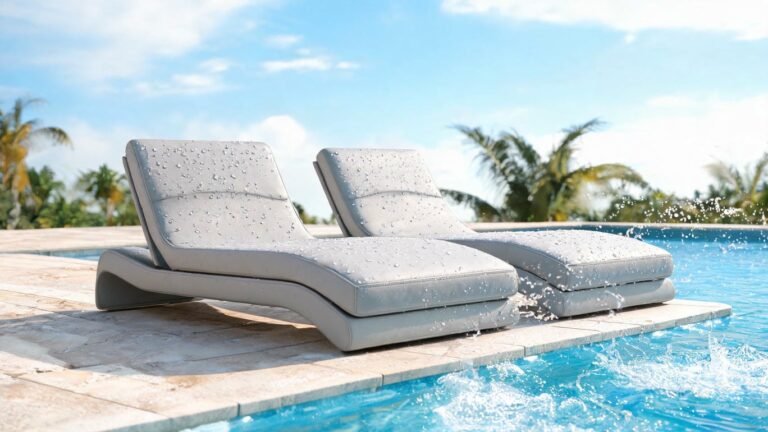
Water droplet test on silicone leather surface — demonstrating hydrophobic contact angle without PFAS treatment.
About TOPSUN: Marine-Grade Boat Seat Leather Manufacturer
TOPSUN manufactures silicone leather specifically engineered for marine and outdoor applications. Our boat seat leather is built on a 100% silicone elastomer topcoat bonded to high-tenacity polyester backing, achieving 1,000+ hours of ASTM B117 salt spray resistance, 2,000+ hours of ISO 4892-2 UV stability, and Martindale abrasion ratings exceeding 200,000 cycles. The material contains zero PFAS, zero plasticizers, and zero animal-derived inputs — making it compliant with emerging EU and US chemical regulations while delivering the hand-feel and aesthetic quality that boat builders and yacht owners demand. Custom color matching to gel-coat references, embossed grain patterns matching premium genuine leather, and fire-retardant variants meeting FMVSS 302 and EN 1021-1/2 are available.
Boat Seat Leather: Frequently Asked Questions
Q: How long does silicone boat seat leather last compared to marine vinyl?
Based on accelerated weathering data (salt spray, UV, and abrasion testing), silicone boat seat leather is projected to last 8 to 10+ years in typical marine use, compared to 3 to 4 years for marine vinyl. The 3:1 lifespan ratio is driven by silicone’s non-hydrolyzable Si-O backbone and inherent UV stability, which do not degrade under the conditions that break down PVC and PU polymers.
Q: Can silicone boat seat leather be repaired if it gets cut or punctured?
Yes. Small punctures and cuts (under 2 cm) can be repaired using silicone-compatible patch kits that bond chemically to the surface. The repair is waterproof and UV-stable. For larger damage, individual seat panels can be replaced without reupholstering the entire vessel, as TOPSUN maintains color and texture consistency across production batches.
Q: Does silicone boat seat leather get hot in direct sunlight?
Silicone leather has lower thermal conductivity than PVC vinyl, meaning the surface temperature in direct sun is typically 5 to 8°C cooler than marine vinyl under the same conditions. The material is stable up to 250°C, so it will not soften, off-gas, or deform at deck temperatures, unlike genuine leather which begins softening at 35°C.
Q: What is the MOQ for custom boat seat leather orders?
TOPSUN’s MOQ for custom silicone leather is 500 linear meters for standard textures and backing configurations. Stock colors in marine-grade formulations are available in smaller quantities for prototyping and on-water testing. Custom color matching to gel-coat or paint references requires 1,000 linear meters minimum.
Request Marine-Grade Boat Seat Leather Samples
Before specifying boat seat leather for your next vessel or reupholstery project, request our Marine Sample Kit — it includes weathered and unweathered swatches, salt spray and UV test reports, and a specification sheet with all mechanical properties:
- Salt spray test report (ASTM B117, 1,000+ hours)
- UV resistance test report (ISO 4892-2, 2,000+ hours)
- Cold crack test data (-40°C flex testing)
- PFAS-free third-party certification
- Color matching to your gel-coat or paint reference
Request Marine-Grade Boat Seat Leather Samples
Get salt spray, UV, and cold crack test data with your sample swatches.
Related reading: Yacht Interior Silicone Leather | Outdoor Furniture Waterproof Leather | RV Upholstery Material Guide