Two identical center consoles sat on the same dock last summer. One ran standard upholstery vinyl and needed new seat covers after two seasons. The other, fitted with a proper marine build, entered its eighth year on original upholstery. The difference was not care. It was the boat fabric spec behind the label.
That gap is documented across the industry. Standard upholstery vinyl fails on a boat within one to three seasons. Marine-grade material, specified and installed properly, runs seven to ten years or more. This piece breaks down what actually separates them.
What “Marine Grade” Actually Publishes
Marine grade is not a regulated term. Any supplier can print it on a hangtag. The buying guides that matter define it by published numbers: UV exposure tested past 500 hours, mildew resistance under ASTM G21, abrasion at 50,000 Wyzenbeek double rubs or Martindale equivalents, and a cold-crack rating at or below negative 20 degrees Fahrenheit. Backing yarn should be polyester, because cotton backing rots in a damp bilge.
Better marine vinyls push UV lightfastness claims to 650, 1,000, or even 1,500 hours. When a seller quotes “marine grade” with no test report behind it, the claim is unverified. Ask for the document, not the adjective.
Salt Water Is the Starting Test, Not the Hard One
A yacht saloon lives through five attacks at once: UV radiation doubled by reflection off water, salt spray that crystallizes into the surface, constant humidity mixed with chlorinated splashes, abrasion from intensive seating, and fire rules that apply on board. Contract fabric guides for marine projects treat seawater color fastness as the entry requirement, not an upgrade.
The standards stack looks like this: color fastness to water and seawater on the grey scale, light fastness on the blue scale, and reaction-to-fire certification where regulations demand it. For commercial vessels, upholstery must meet IMO FTP Code Part 8, and land-based BS 5852 certificates are not accepted as equivalents by classification societies. An overview of all TOPSUN application areas shows how the same material family answers each of these duty levels.

Waterproof testing on finished material. The dock verdict is written in these tests first.
Why Silicone Coating Changes the Season Count
Most boat fabric is PVC with stabilizers fighting the same five attacks. A silicone-coated build skips the fight. Silicone polymer chemistry carries no plasticizer to migrate out, so the surface does not turn brittle under UV the way plasticized vinyl does. Hydrolysis resistance under ISO 11507 and a working range from minus 40 to 250 degrees Celsius cover both the winter shrink-wrap season and a deck in August sun. The silicone leather introduction explains the chemistry in one page.
For the operator, the practical read is service life per dollar, not sticker price. A cover that survives eight seasons at a higher unit cost usually beats three rounds of re-upholstery at a lower one. That arithmetic is the whole argument behind our company approach to long-life coated fabrics.

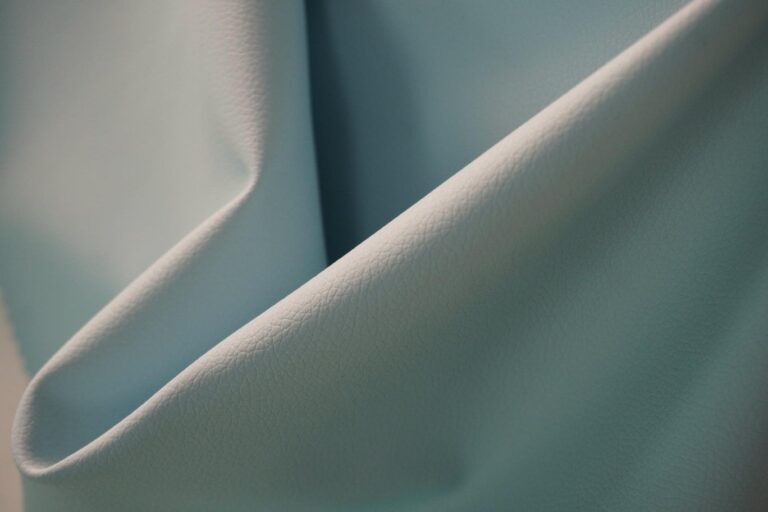
Droplet test on an off-white build: stains bead, wipe clean, and move on.

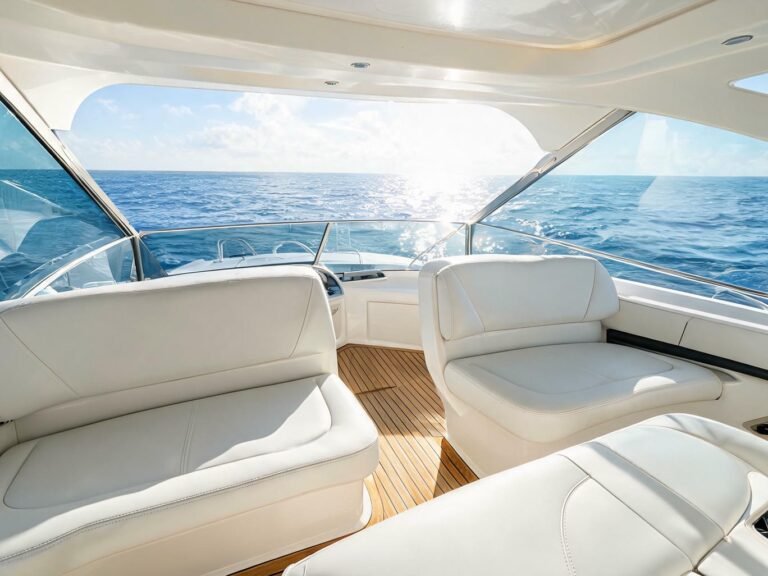
Silicone-coated upholstery in a yacht cabin: sealed surface, no plasticizer to lose.
Outdoor weather resistance: what a boat fabric faces between dockings.
Four checks protect your next boat fabric order:
1. Demand the UV test report with hours and a Delta E value, not a “marine grade” label.
2. Confirm mildew resistance (ASTM G21) and a polyester backing in writing.
3. Match fire certification to your vessel class: IMO FTP Part 8 for commercial, local codes for recreational.
4. Price the material over eight seasons, not over one invoice.
Talk to Our Team About Boat Upholstery
Request Weather-Tested Samples
References
1. decorativefabricsdirect.com: marine grade vin…