Type “best leather for a couch” into any search engine and you’ll get the same answer everywhere: full-grain leather. It’s the thickest, the most durable, the most beautiful as it ages. Consumer guides are unanimous. And for a residential living room couch used 2-3 hours a day by a family of four, they’re right.
But if you’re a furniture manufacturer specifying material for commercial couches — hotel lobbies, corporate lounges, restaurant waiting areas, senior living facilities, cinema seating — the “best leather” question has a completely different answer. In commercial settings, couches endure 12-16 hours of daily use, aggressive cleaning protocols, UV exposure through windows, and abuse that no residential couch ever sees. The material that’s “best” for a home and the material that’s “best” for a commercial contract are not the same thing — and choosing the residential “best” for a commercial application is a costly mistake.
Request Couch Material Samples
The Residential “Best” Framework vs. The Commercial Reality
Every consumer guide ranks leather grades on a spectrum from premium to budget: full-grain > top-grain > genuine/split > bonded > faux. The logic is straightforward: thicker, less-processed leather lasts longer and looks better over time. Full-grain leather can last decades with proper conditioning every 3-4 months, developing a rich patina that adds character.
This framework works for residential furniture because residential couches have:
– Low daily use hours (2-4 hours)
– Gentle cleaning (dusting, occasional damp wipe)
– No UV exposure management (homeowners close blinds)
– Patina is desirable (uneven wear adds “character”)
– One user pattern (consistent wear)
Commercial couches invert every one of these assumptions:
- High daily use (12-16 hours) — Full-grain leather requires conditioning every 3-4 months. No hotel housekeeping team conditions leather furniture. The leather dries, the fibers become brittle, and cracking begins within 2-3 years.
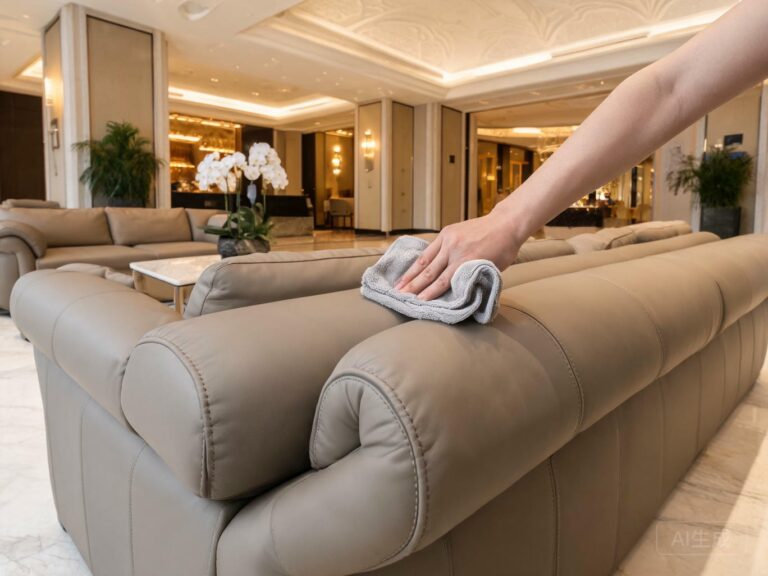
- Aggressive cleaning — Housekeeping uses hospital-grade quaternary ammonium disinfectants. These strip the natural oils from genuine leather, accelerating drying and cracking. PU and PVC faux leather fare no better — chemical exposure breaks down the plastic coating.
- Continuous UV exposure — Commercial spaces with floor-to-ceiling windows have no “close the blinds” option. UV degrades PU coatings within 18-24 months, causing color shift and surface chalking.
- Patina is a defect — In a 200-location franchise, uneven patina on different couches creates brand inconsistency. What consumers call “character” looks like neglect in a commercial setting.
- Variable user patterns — Hundreds of different users create unpredictable, uneven wear patterns that genuine leather amplifies through differential patina.
For furniture manufacturers sourcing furniture and sofa materials, the “best” leather isn’t determined by grade hierarchy — it’s determined by how the material performs under commercial use conditions over a defined warranty period.

The TCO Framework: What “Best” Actually Means
For commercial furniture procurement, “best leather for a couch” means the material with the lowest total cost of ownership over the couch’s expected service life. Here’s the TCO comparison across all five material tiers, calculated for a commercial lobby couch with a 7-year target service life:
| Material | Cost/Yard | Martindale | UV Stability | Expected Life (Commercial) | 7-Year TCO |
|---|---|---|---|---|---|
| Full-Grain Leather | $15-25 | 100K cycles | 500 hrs | 3-4 years (cracks w/o conditioning) | $$ (1 reupholstery) |
| Top-Grain Leather | $10-18 | 50-100K | 300-500 hrs | 2-3 years | $$$ (1-2 reupholsteries) |
| Bonded Leather | $3-5 | 15-25K | 200 hrs | 1-1.5 years (delamination) | $$$$ (3-4 reupholsteries) |
| PU Faux Leather | $4-8 | 25-50K | 300-500 hrs | 2-3 years (hydrolysis + UV) | $$$ (2 reupholsteries) |
| Silicone Leather | $8-15 | 150K | 1,500 hrs | 7-10 years | $ (0 reupholsteries) |
The TCO reversal is striking. Full-grain leather — the consumer “best” — actually generates the second-worst 7-year cost in commercial settings because it requires reupholstery when it cracks from lack of conditioning. Bonded leather, the cheapest option per yard, generates the worst TCO because it needs 3-4 reupholstery cycles. Silicone leather, despite costing more per yard than PU or bonded, generates the lowest 7-year TCO because it reaches the end of the target service life without a single reupholstery. For a deeper breakdown of leather sofa quality in B2B contexts, our B2B guide covers the full specification framework.

Why Silicone Leather Wins the Commercial Couch Argument
The consumer guide answer to “best leather for a couch” is full-grain leather. The commercial furniture answer is silicone synthetic leather. Here’s why:
- No conditioning required — Silicone leather doesn’t contain natural oils that deplete over time. Housekeeping can clean it with standard disinfectants without any conditioning protocol. This eliminates the primary failure mode of genuine leather in commercial settings.
- UV-stable chemistry — The Si-O backbone of silicone polymers absorbs UV energy without degrading, achieving 1,500 hours of UV stability (ASTM D329-05) vs. 300-500 hours for PU and genuine leather. A hotel lobby couch next to floor-to-ceiling windows will not fade, chalk, or crack.
- 150,000 Martindale cycles — Three times the abrasion resistance of top-grain leather and 5-6 times that of bonded leather. Commercial couches see 10x the daily use of residential couches; the material needs to match.
- 14+ weeks hydrolysis resistance — In coastal hotels, spa lounges, and pool-adjacent spaces, moisture exposure is constant. PU leather hydrolyzes in 8-10 weeks; genuine leather absorbs moisture and stains. Silicone leather resists water penetration completely.
- Color consistency across locations — Roll goods production means every couch in every franchise location looks identical. No hide-to-hide variation, no differential patina, no brand inconsistency.
- Fire code compliance built in — Passes BS 5852 (Crib 5), DIN EN 1021, and California TB 117-2013 without additional treatment. For leather sofa upholstery materials in contract furniture, this is mandatory.

The “Best” Depends on the Question You’re Asking
The reason no single article can definitively answer “what’s the best leather for a couch” is that the question itself is incomplete. “Best” for what? Here’s how the answer changes based on what you’re actually asking:
| If your question is… | The best material is… | Because… |
|---|---|---|
| What looks best after 20 years in a home? | Full-grain leather | Patina adds character; low daily use preserves the surface |
| What’s cheapest per yard? | Bonded leather / PVC | $2-5 per yard — but plan for replacement every 1-2 years |
| What’s easiest to maintain in a hotel? | Silicone leather | No conditioning, disinfectant-safe, UV-stable, 7-10 year life |
| What’s best for a franchise with 200 locations? | Silicone leather | Color consistency, no patina variation, predictable replacement cycle |
| What’s best for a coastal restaurant? | Silicone leather | Hydrolysis-resistant (14+ weeks), stain-proof, fire-code compliant |
| What’s best for a residential spec-list home? | Full-grain or top-grain leather | Aesthetic appeal, patina, low maintenance in low-use settings |
Consumer guides correctly identify full-grain leather as “best” for residential couches. But if you’re a furniture manufacturer, procurement manager, or franchise operator specifying material for commercial couches, the residential “best” is a specification error. For more on sofa material leather selection, our material guide covers the complete specification checklist.
topsun-silicone-leather-luxury-furniture-intro
Specifying Couch Leather: The 6-Point Commercial Checklist
When evaluating leather for a commercial couch, request documentation on these six criteria before placing a bulk order:
- Abrasion test certificate (ISO 12947 / Martindale) — Minimum 50,000 cycles for commercial; 100,000+ for high-traffic. If the supplier can’t provide it, don’t place the order.
- UV stability report (ASTM D329-05 / ISO 105-B06) — Minimum 500 hours QUV exposure. For sunlit lobbies, specify 1,000+ hours. Ask for the actual certificate, not a brochure claim.
- Hydrolysis resistance (ASTM D3980-02) — Minimum 7 weeks for general commercial; 10+ weeks for humid environments. PU leather suppliers will resist providing this data because the results disqualify their material for many applications.
- Fire code compliance certificates — BS 5852 (Crib 5) for the UK market, DIN EN 1021 for EU, California TB 117-2013 for the US. These are mandatory for commercial furniture.
- Chemical resistance test — Request the results of exposure to common commercial disinfectants (quaternary ammonium, isopropyl alcohol, bleach solutions). PU leather degrades under these chemicals; silicone leather resists them.
- Color fastness to rubbing (ISO 105-X12) — Minimum Class 4 for commercial; Class 5 for high-traffic. This prevents color transfer from the couch to clothing — a common complaint in restaurant and cinema seating.
For more details on leather couch fabric options, our comprehensive guide covers the full material specification process from swatch to bulk order.
About TOPSUN
TOPSUN manufactures silicone synthetic leather engineered for commercial couch and sofa applications where material failure isn’t an option. Our silicone leather delivers 150,000 Martindale abrasion cycles, 1,500 hours of UV stability, 14+ weeks of hydrolysis resistance, and built-in fire code compliance across BS 5852, DIN EN 1021, and California TB 117-2013. We supply furniture OEMs, hospitality groups, and commercial furniture manufacturers who need couch material that holds its color, texture, and structural integrity through 7-10 years of daily commercial use — without conditioning, without reupholstery, and without warranty claims.
Frequently Asked Questions
Is full-grain leather really the best for a couch?
For residential couches with low daily use, yes — full-grain leather offers the best combination of durability, aesthetics, and aging character. For commercial couches in hotels, restaurants, and corporate settings, full-grain leather is a poor choice because it requires conditioning every 3-4 months (which no housekeeping team provides), absorbs stains in food-adjacent settings, and develops uneven patina that looks like neglect in a franchise environment.
What’s the difference between top-grain and full-grain leather for couches?
Full-grain leather retains the complete hide surface without sanding, making it thicker and more durable (10-30+ year lifespan residential). Top-grain leather is sanded to remove imperfections, resulting in a smoother, thinner, and more uniform surface — but with shorter lifespan (7-10 years residential, 2-3 years commercial) and less natural character. Both require regular conditioning in commercial settings.
How long does silicone leather last on a commercial couch?
Based on accelerated aging tests (150,000 Martindale cycles, 1,500 UV hours, 14 weeks hydrolysis resistance), TOPSUN silicone leather is engineered for a 7-10 year commercial service life. This means a hotel lobby couch can go a full renovation cycle without reupholstery — something neither genuine leather nor PU faux leather can guarantee.
Is faux leather acceptable for a commercial couch?
Standard PU faux leather is not recommended for commercial couches — it hydrolyzes in humid environments within 8-10 weeks, fades under UV within 18-24 months, and cracks at stress points within 2-3 years. Silicone leather, however, is a synthetic material specifically engineered to solve these failure modes while maintaining the look and feel of premium leather.