Reddish leather dominates the 2026 interior design palette. Design publications have declared rusty red, burgundy, and wine-toned leather as the standout colors of the year — appearing in furniture, automotive interiors, fashion accessories, and luxury retail spaces. The warmth, the passion, and the grounded richness of reddish tones create spaces that feel simultaneously bold and inviting. But there is a problem that every B2B buyer specifying reddish leather must understand: red is the least UV-stable color in the leather spectrum. It fades faster than black, brown, beige, or gray. A reddish leather sofa that looks stunning in the showroom can shift to a washed-out pinkish-brown within 18 months of sun exposure. This article examines the color science behind reddish leather, the UV fading mechanism that makes red the most vulnerable pigment, and how silicone leather’s integral pigment chemistry eliminates the dye-to-fade pipeline that plagues conventionally dyed leather.
What Makes Leather Reddish? The Color Science
Reddish tones in leather originate from two sources: tanning chemistry and applied dyes. In vegetable-tanned leather, the tannin source determines the base color. Hemlock bark produces a naturally reddish undertone, while mimosa bark yields a paler tone and quebracho produces a warm pinkish-tan. These tannins chemically bond with collagen fibers in the hide, creating a color that penetrates through the full thickness of the leather — not just the surface. This is why vegetable-tanned leather develops a patina rather than fading: the color is structural, not applied.
In synthetic leathers — PU, PVC, and silicone — the reddish color comes from pigments added to the polymer coating before application. PU and PVC leather use solvent-based dyes or pigment dispersions mixed into the polyurethane or polyvinyl chloride resin. These dyes sit in the top coating layer, making them vulnerable to UV degradation. Silicone leather uses a fundamentally different approach: inorganic pigments are integrated into the silicone polymer matrix during the coating process, becoming part of the material structure rather than a surface treatment. This distinction is the key to understanding why reddish silicone leather resists fading while reddish PU and PVC leather do not.

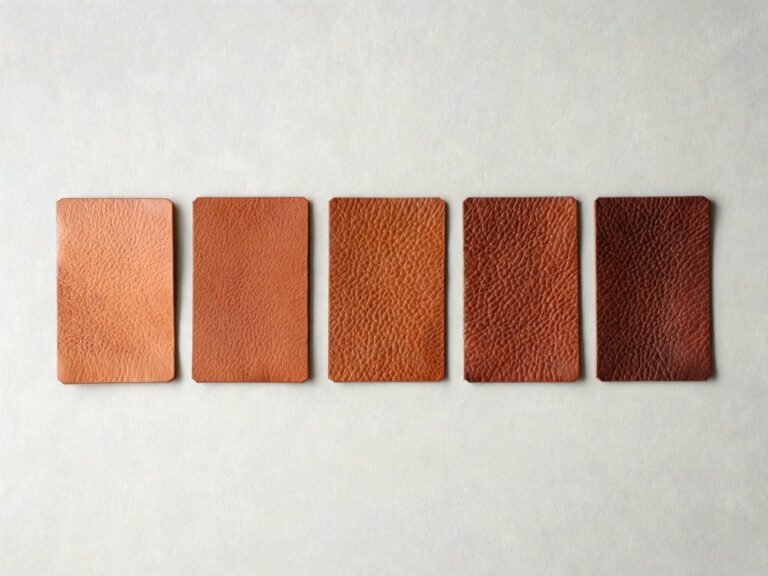
Vibrant red leather texture — the color that looks stunning fresh but fades first under UV exposure
The UV Fading Problem: Why Red Goes First
Color fading in leather is a photochemical process. Ultraviolet radiation from sunlight (or artificial UV sources) transfers energy to pigment molecules, breaking the chemical bonds that give the pigment its color. The rate of this bond-breaking varies by color because different pigments absorb different wavelengths of light. Red pigments absorb in the green-blue range of the visible spectrum, reflecting the red wavelengths we perceive. This absorption profile means red pigment molecules are energized by a broader range of incident light — including UV — making them more reactive and more prone to bond degradation than pigments that absorb in narrower bands.
The practical result: under ISO 105-B02 xenon arc testing, reddish leather dyed with organic dyes typically shows visible color shift (Delta E greater than 3.0) after 40 to 80 hours of exposure. Black leather reaches the same shift after 120 to 200 hours. Brown leather lasts 80 to 150 hours. The redder the tone, the faster the fade. Burgundy and wine red, which contain blue undertones, fade slightly slower than pure red or rust — but all reds fade faster than any other color family. For B2B buyers specifying leather textures and colors for applications with UV exposure — automotive interiors, restaurant booths near windows, outdoor furniture — the fading timeline is a procurement specification, not an aesthetic afterthought.

Wine red leather layers — undertone complexity affects both visual depth and fade resistance
7 Reddish Leather Shades for B2B Specification
Not all reddish leather is the same shade. B2B specification requires precise color definition — a Pantone reference, a Delta E tolerance, and a fade resistance rating. The table below maps the seven most commonly specified reddish leather tones to their procurement characteristics.
| Shade | Undertone | UV Stability (dye) | Best Application |
|---|---|---|---|
| Rust | Orange-brown | Poor (40-60h) | Accent furniture, low-UV |
| Burgundy | Blue-purple | Fair (60-80h) | Luxury interiors, executive |
| Wine Red | Deep blue-red | Fair (60-80h) | Hospitality, dining |
| Chestnut | Brown-red | Fair (70-90h) | Residential furniture |
| Cognac | Amber-red | Fair (70-100h) | Fashion accessories |
| Terracotta | Earth-red | Poor (40-60h) | Decorative panels |
| Crimson | Pure red | Poor (40-50h) | Low-UV environments only |
The UV stability column assumes conventionally dyed PU or PVC leather. Silicone leather with integral inorganic pigments extends the fade threshold to 200-plus hours across all shades — a 3 to 5 times improvement. For fashion accessories where reddish tones are especially popular, this color stability directly affects product lifespan and brand reputation. Brands specifying handbag material types in burgundy or wine red should require ISO 105-B02 test data showing Delta E below 3.0 after 100 hours minimum.

Custom color matching — precise Pantone referencing ensures batch-to-batch color consistency
Silicone Leather Pigment Chemistry: Stable Red Without Dyes
The fundamental difference between dyed leather and pigmented silicone leather lies in the colorant’s relationship to the material. In dyed PU or PVC leather, organic dye molecules are dissolved in the solvent-based coating resin. These dye molecules are discrete chemical entities — they absorb light to produce color, but their molecular bonds are vulnerable to UV energy. When UV photons strike a dye molecule, the energy can break the conjugated double-bond system that gives the dye its color, causing the molecule to lose its absorption properties and the leather to fade.
Silicone leather uses inorganic pigments — iron oxide red, cadmium-free red pigments, and custom blends — that are suspended as solid particles within the silicone polymer matrix. These inorganic pigments are fundamentally different from organic dyes: their color comes from the crystal structure of the pigment particle, not from conjugated molecular bonds. UV radiation cannot break a crystal structure the way it breaks organic molecular bonds. The result is a reddish leather that maintains its color under UV exposure for hundreds of hours — verified by ISO 105-B02 testing at 200-plus hours with Delta E below 1.5 for TOPSUN’s eco-friendly silicone leather formulations.
Color fastness testing — silicone leather pigments resist UV degradation where organic dyes fail
This chemistry advantage translates directly to product performance. A reddish silicone leather automotive interior maintains its original color through 5 to 10 years of daily sun exposure, while a dyed PU leather interior in the same shade shows visible fading within 18 to 36 months. For apparel applications, this stability means a burgundy silicone leather jacket retains its rich color through years of wear, while a dyed PU equivalent fades to a mottled pinkish tone. The vegan leather jacket material market increasingly favors silicone formulations for exactly this reason — consumers expect the color to last as long as the product.
Organic dyes fade because UV breaks molecular bonds. Inorganic pigments stay because crystal structures don’t break. Specify the chemistry, not just the color.
Specifying Reddish Leather: A B2B Color Matching Guide
Specifying reddish leather for B2B production requires more than selecting a color from a swatch. Red is the most spectrally complex color in the leather palette — small variations in undertone, lightness, and saturation produce dramatically different visual impressions. A color that reads as “burgundy” under D65 daylight may shift to “brown” under warm indoor lighting. The following specification framework ensures that reddish leather arrives matching the approved sample, maintains that color under real-world conditions, and stays consistent across production batches.
First, define the color by Pantone reference and spectral data — not by visual matching alone. Request the CIE L*a*b* values and ensure the supplier’s quality control measures against Delta E 1.5 or tighter. Second, specify the light source for evaluation: D65 daylight, CWF (cool white fluorescent), and TL84 (warm fluorescent) are the standard triad for metamerism testing. Reddish tones are particularly prone to metamerism — appearing matched under one light source and mismatched under another. Third, require ISO 105-B02 color fastness test data showing the fade curve over 100, 200, and 300 hours. If the supplier cannot provide this data, the material’s long-term color stability is unknown.

Luxury VIP lounge — reddish leather creates warmth and exclusivity in high-end commercial spaces
Fourth, specify the pigment chemistry: organic dye or inorganic pigment. This single specification determines whether the color will last 40 hours or 200-plus hours under UV. Fifth, request a production batch sample before committing to volume — red is the color most likely to vary between sample and production due to pigment dispersion sensitivity. Sixth, document the acceptable color tolerance range in the purchase specification so that incoming quality inspection has a quantitative acceptance criterion, not a subjective visual judgment.
Frequently Asked Questions
Why does reddish leather fade faster than other colors?
Red pigments absorb light across a broader range of the visible and UV spectrum than pigments of other colors. This broader absorption means more UV energy reaches the pigment molecules, accelerating the breakdown of the chemical bonds that produce the red color. In conventionally dyed leather (PU, PVC), organic dye molecules lose their color when these bonds break. Inorganic pigments used in silicone leather do not rely on molecular bonds for color — they use crystal structure — making them inherently resistant to UV degradation.
Can you prevent reddish leather from fading?
You can slow fading in dyed leather with UV-blocking topcoats, but you cannot prevent it — the underlying dye chemistry remains vulnerable. The only way to achieve true fade resistance in reddish leather is to specify a material that uses inorganic pigments rather than organic dyes. Silicone leather with integral inorganic pigments maintains its color for 200-plus hours under ISO 105-B02 testing, compared to 40 to 80 hours for dyed PU or PVC leather in the same shades.
What is the best reddish leather shade for commercial furniture?
For commercial furniture with UV exposure, burgundy and wine red offer the best combination of aesthetic appeal and relative fade resistance among conventionally dyed leathers, lasting 60 to 80 hours before visible shift. For silicone leather, all reddish shades perform equally well — 200-plus hours — making the choice purely aesthetic. Rust and terracotta are popular for accent furniture in low-UV environments, while burgundy and cognac work well in hospitality and executive settings where warmth signals quality.
Specify the Chemistry, Not Just the Color
Reddish leather is the color of 2026 — and it deserves to stay that color. The fading problem is not a mystery or a manufacturing defect; it is a direct consequence of pigment chemistry. Organic dyes break under UV. Inorganic pigments do not. The procurement specification that matters most for reddish leather is not the Pantone reference — it is the pigment type. A reddish leather specified with organic dyes will fade in 40 to 80 hours of UV exposure. A reddish leather specified with inorganic pigments in a silicone matrix will last 200-plus hours and maintain its original shade for the full life of the product. For B2B buyers who need reddish leather that looks as rich in year five as it did in year one, the specification is straightforward: demand ISO 105-B02 test data, require inorganic pigment chemistry, and choose a material built to hold its color.
Discuss Your Color Specification
About TOPSUN
TOPSUN produces silicone leather with integral inorganic pigments that resist UV fading across the full reddish color spectrum — rust, burgundy, wine red, chestnut, cognac, and custom Pantone-matched shades. Our color matching process targets Delta E 1.5 or better, verified under D65, CWF, and TL84 light sources. Every reddish leather formulation is tested to ISO 105-B02 for 200-plus hours of color fastness, ensuring that the shade you approve is the shade your customers see for the full product lifecycle.
ISO 105-B02: 200+ hours color fastness | Delta E 1.5 color matching | Inorganic pigment chemistry | Custom Pantone shades | D65/CWF/TL84 metamerism tested