Polyurethane (PU) is the most widely used synthetic upper material in global footwear manufacturing. It is lightweight, inexpensive, accepts any color or texture, and processes cleanly on standard cutting and stitching lines. For entry-level to mid-range footwear, it is the default choice. But PU upper material has a structural vulnerability that costs footwear brands millions annually in warranty claims, returns, and reputational damage: hydrolysis.
If your footwear brand, factory, or sourcing office specifies upper PU without understanding its hydrolysis timeline, flex specifications, and failure thresholds, you are accepting a liability that will surface as warranty claims 12–18 months after production. This article provides the technical specifications, failure analysis, and material comparison data that footwear procurement teams need to make informed upper material decisions for fashion and sports applications.
By the numbers: PU upper material costs $1.64–2.14 per meter — but average hydrolysis failure begins at 18 months. Silicone leather delivers 200,000+ flex cycles versus PU’s 100,000, with zero hydrolysis risk.
What Is PU Upper Material? Beyond the Label
PU upper material is a synthetic leather consisting of a polyurethane coating applied to a fabric substrate (typically nylon, polyester, or cotton blend). The PU coating provides the leather-like surface appearance and texture, while the fabric backing provides tear strength and structural stability for shoe construction. For a broader overview of PU fabric leather categories, the key distinction most footwear buyers miss is that not all PU is the same.
| Component | Material | Function |
|---|---|---|
| Top layer (skin coat) | Polyurethane (ester or ether type) | Surface appearance, color, texture, initial abrasion resistance |
| Middle layer (foam) | PU foam (optional) | Softness, handfeel, thickness |
| Backing fabric | Nylon, polyester, or cotton knit/woven | Tear strength, dimensional stability, stitchability |
There are two fundamentally different PU chemistries used in upper materials, and they have dramatically different hydrolysis resistance profiles.
| Property | Ester-Type PU | Ether-Type PU |
|---|---|---|
| Chemical backbone | Ester bonds (C-O-C) | Ether bonds (C-O-C, different structure) |
| Hydrolysis resistance | Poor — ester bonds break under moisture | Better — ether bonds resist hydrolysis |
| Typical upper lifespan | 12–18 months before cracking | 24–36 months before cracking |
| Cost per meter | $1.64–2.14 | $2.50–4.00 |
| Market share in footwear | ~70% (cost-driven default) | ~30% (premium/athletic) |
Procurement alert: If your supplier quotes PU upper at $1.50–2.00/meter without specifying ester vs. ether type, you are almost certainly getting ester-type PU — the cheaper formulation that will begin hydrolyzing within 12–18 months. Request the PU type in writing on your specification sheet.

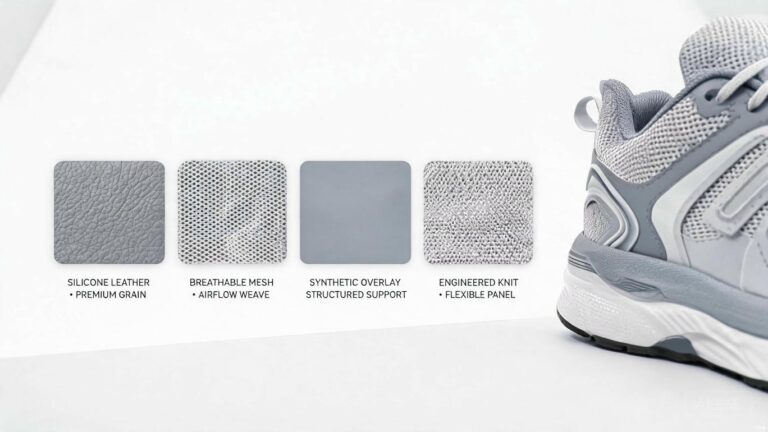
PU upper material used in sports footwear — lightweight and versatile, but vulnerable to hydrolysis in humid climates
The Hydrolysis Problem: Why PU Uppers Crack in 18 Months
Hydrolysis is the chemical reaction between water molecules and the ester bonds in polyurethane. In shoe uppers, this reaction is accelerated by three factors: ambient humidity, body heat from the wearer’s foot, and mechanical stress from walking. The result is a predictable degradation sequence that destroys PU uppers from the inside out.
Months 0–6: Material performs normally. Moisture from air and perspiration begins penetrating the PU micro-structure.
Months 6–12: Ester bonds begin cleaving. Surface may develop slight tackiness in high-flex areas (toe box, ball of foot). Not yet visible to consumers.
Months 12–18: Hairline cracks appear at flex points. PU coating loses adhesion to backing fabric. Peeling begins at stitch holes and edges.
Months 18–24: Large-scale cracking and peeling. Surface fractures into flakes. Warranty claims spike.
Months 24+: Complete structural failure. PU coating crumbles away from backing fabric. Shoe is unwearable.
Hydrolysis is not a quality defect — it is a chemical property of ester-type polyurethane. Even perfectly manufactured PU upper material will hydrolyze. The only question is when, not if. The “when” is determined by the PU chemistry, the ambient humidity of the shoe’s storage and use environment, and the thickness of the PU coating.
This is why footwear brands selling into humid climates (Southeast Asia, coastal regions, tropical markets) experience disproportionately higher PU upper failure rates. A PU upper that lasts 24 months in a dry temperate climate may fail in 12 months in Singapore or Miami. The International Organization for Standardization (ISO) maintains test methods including ISO 14271 for accelerated hydrolysis testing that predicts real-world performance in tropical conditions.

Flex testing equipment: the first line of defense against premature upper cracking — ISO 17707 flex resistance testing
PU vs Microfiber vs Silicone: Upper Material Showdown
PU is not the only option for synthetic shoe uppers. Microfiber leather and silicone leather both offer superior performance in key metrics. Here is the comparison footwear procurement teams need when evaluating material options. For a deeper analysis of silicone vs PU at the molecular level, the Si-O-Si backbone is the structural difference that eliminates hydrolysis risk entirely.
| Metric | PU (Ester) | PU (Ether) | Microfiber | Silicone Leather |
|---|---|---|---|---|
| Flex resistance | 100K cycles | 120K cycles | 150K cycles | 200K+ cycles |
| Hydrolysis risk | High — fails in 12–18 months | Moderate — fails in 24–36 months | Low | None — Si-O-Si is hydrolysis-immune |
| Taber abrasion | 500 cycles | 600 cycles | 800 cycles | 1,000+ cycles |
| Temperature range | -20°C to 80°C | -20°C to 80°C | -30°C to 120°C | -40°C to 250°C |
| Chemical safety | REACH (varies) | REACH (varies) | REACH (varies) | REACH + ISO 10993-5 + FDA + RoHS |
| Cost per meter | $1.64–2.14 | $2.50–4.00 | $3.50–6.00 | $5.00–10.00 |
| Best application | Entry-level fashion | Mid-range athletic | Premium athletic | Premium/durable/medical |
The decision matrix is straightforward: if your product is entry-level fashion footwear with a 6–12 month expected consumer lifespan, ester-type PU is economically appropriate. If your product targets mid-range athletic or casual footwear where consumers expect 18+ months, ether-type PU or microfiber is the minimum. If your product is premium, durability-positioned, or targeted at humid climates where hydrolysis is accelerated, silicone leather eliminates the failure mode entirely — and its 10+ year lifespan means the per-year cost difference is minimal. To understand what makes silicone leather structurally different, the key is the Si-O-Si backbone.

Abrasion resistance testing: Taber abrasion is the standard metric for shoe upper surface durability
The Hidden Cost: How PU Hydrolysis Destroys Brand Margins
The true cost of PU hydrolysis is not the material price — it is the warranty claims, returns, brand damage, and customer acquisition cost that result from premature product failure. Here is the financial impact model for a 100,000-pair annual production run.
| Cost Component | Ester PU Upper | Silicone Leather Upper |
|---|---|---|
| Material cost per 100K pairs | $350,000 | $1,200,000 |
| Hydrolysis failure rate (18 months) | 15–25% (humid markets) | 0% |
| Warranty claims (100K pairs × 20% rate) | 20,000 claims | 0 claims |
| Total warranty cost | $500,000–800,000 | $0 |
| Brand damage (reviews, lost customers) | $300,000–600,000 | $0 |
| Total 18-month cost | $1,150,000–1,750,000 | $1,200,000 |
The model reveals that the $850,000 material cost premium for silicone leather is fully offset by the $500,000–800,000 in warranty costs and $300,000–600,000 in brand damage that PU hydrolysis generates. In humid-climate markets, silicone leather is not more expensive than PU — it is comparably priced when total cost of ownership is calculated.

Tensile strength testing: verifies that upper material can withstand lasting and stitching without tearing
Silicone leather flexing resistance test — 200,000+ cycles with no cracking at the vamp or toe box
6 Specifications to Lock Down With Your PU Upper Supplier
Whether you ultimately choose PU or silicone leather for your shoe uppers, these six specifications must appear on your purchase order. Any supplier who cannot provide test data for each specification is not a qualified footwear material partner.
- Specify ester-type or ether-type PU in writing. This single specification determines whether your uppers will last 12 months or 36 months. If the supplier will not commit in writing, they are supplying ester-type — the cheaper, hydrolysis-prone formulation.
- Provide ISO 17707 flex resistance test data (minimum 100,000 cycles for casual, 150,000 for athletic). Flex is the #1 failure mode for shoe uppers. Below 100,000 cycles, the surface will crack at the vamp within one year of normal consumer use.
- Provide ISO 14271 hydrolysis test data (70°C/95% RH, minimum 4 weeks). This predicts whether your uppers will survive humid climates. If the supplier has never tested hydrolysis resistance, they are not selling material suitable for footwear.
- Provide Taber abrasion data (ASTM D3884, CS-10 wheel, 1kg load, minimum 500 cycles). Below 500 cycles, the leather-look surface will visibly wear within 3–6 months.
- Provide ISO 11640 color fastness to rubbing data (Grade 4 dry minimum, Grade 3 wet minimum). Color transfer to socks and skin is a top-5 consumer complaint. Without this specification, you risk batch-level color transfer issues.
- For silicone leather: provide ISO 10993-5 biocompatibility certificate and REACH compliance documentation. Request original SGS or Intertek certificates, not self-declarations.
Frequently Asked Questions
Can I use PU upper material for athletic/running shoes?
Yes, but you must specify ether-type PU (not ester-type) and require a minimum flex resistance of 150,000 cycles (ISO 17707). Athletic footwear flexes 8,000–15,000 times per day per shoe, and the perspiration environment accelerates hydrolysis. Ester-type PU will fail within 12 months in athletic use. For premium athletic footwear where durability is a brand promise, consider silicone leather (200,000+ flex cycles, zero hydrolysis risk).
How do I know if my current PU upper supplier is using ester or ether type?
Ask directly for the PU type specification and request the material safety data sheet (MSDS). If the supplier cannot answer or evades, they are almost certainly using ester-type (the cheaper, more common formulation). You can also commission a third-party FTIR analysis (typically $200–400 per sample) from SGS or Intertek to chemically identify the PU type. This is worth doing for any large-volume footwear program.
Is silicone leather breathable enough for shoe uppers?
Silicone leather has moderate breathability (MVTR of 1.8–2.2 mg/cm²·h) compared to microfiber leather (2.5–3.5). For casual and premium footwear, this is adequate, especially when perforated patterns are used. For high-performance athletic footwear where maximum moisture transfer is essential, microfiber leather remains the breathability leader. However, silicone leather’s zero hydrolysis risk and 2× flex resistance make it superior for footwear sold in humid climates where breathability is secondary to longevity.
Choosing Upper Material That Outlasts the Warranty Period
PU upper material remains the volume leader in footwear manufacturing for good reason — it is inexpensive, versatile, and process-friendly. But the hydrolysis problem is structural, not solvable through quality control. For footwear brands selling into humid climates, targeting premium positioning, or facing warranty cost pressure from premature failures, silicone leather eliminates the hydrolysis failure mode at the molecular level. Understanding the difference between PU and faux leather alternatives is the first step toward specifying upper material that survives the full product lifecycle — not just the first 18 months.
About TOPSUN
TOPSUN manufactures silicone leather for footwear upper applications where hydrolysis immunity, flex resistance, and direct-skin-contact safety are non-negotiable. The Si-O-Si molecular backbone eliminates the ester bond hydrolysis that destroys PU uppers in humid climates — no coating to peel, no plasticizer to migrate, no ester bond to hydrolyze.
Flex resistance 200,000+ cycles (ISO 17707) · Hydrolysis immunity (Si-O-Si backbone) · Taber abrasion 1,000+ cycles · ISO 10993-5 biocompatible · REACH compliant · FDA food-contact approved · RoHS compliant