The global imitation leather fabric market is projected to reach USD 68.96 billion by 2033, growing at 6.7% CAGR — yet 70% of B2B procurement teams we speak with cannot name the coating polymer in the material they just specified. That’s not a knowledge gap; it’s a specification failure waiting to happen. Imitation leather fabric is not one material. It is three fundamentally different chemistries — polyurethane (PU), polyvinyl chloride (PVC), and silicone — bundled under one label, each with drastically different performance, compliance, and lifecycle profiles. If your spec sheet says “imitation leather” without identifying the polymer, you are buying a mystery material and hoping it performs.
Request Lab-Tested Sample Swatches
“Imitation Leather Fabric” Is Three Materials, Not One
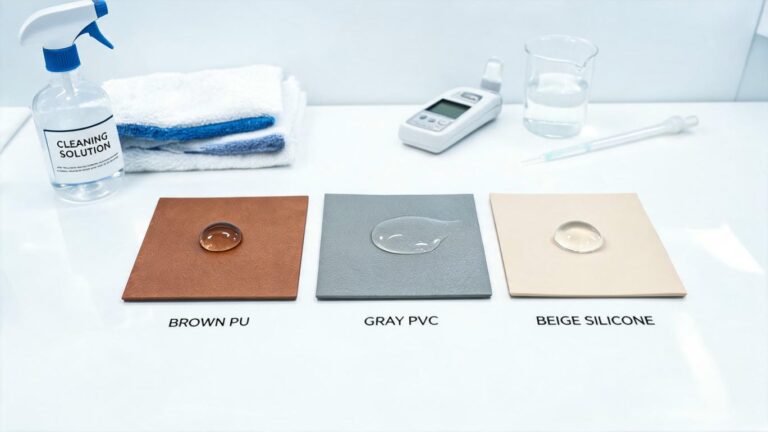
The term “imitation leather fabric” covers any textile substrate coated with a polymer that mimics the appearance and hand-feel of animal hide. The substrate is usually a woven, knitted, or non-woven fabric — polyester, cotton, or blends. What matters is the coating, because the coating determines 90% of the material’s performance. Three coating chemistries dominate the market:
- PU (Polyurethane): The most common imitation leather fabric type. Applied via wet coagulation or dry casting. Softer and more breathable than PVC, but susceptible to hydrolysis in humid environments. Typical service life: 2–5 years.
- PVC (Polyvinyl Chloride): The oldest and cheapest variant. Applied via calendering or release-paper coating. Excellent water resistance and low cost, but requires plasticizer additives that migrate over time, causing surface hardening and brittleness. Service life: 2–10 years depending on plasticizer quality.
- Silicone: The newest generation. Liquid silicone rubber coated onto textile substrates via dry coating. No plasticizers, no solvents, inherently flame retardant. Service life: 5–15 years. Higher upfront cost but lowest cost per year of service.
If your current supplier quotes “imitation leather fabric” without specifying which of these three chemistries they’re offering, you cannot evaluate durability, compliance, or lifecycle cost. For a deeper breakdown of how these types differ in manufacturing and application, see our artificial leather types comparison.

Release-paper coating production line — the dry coating process used for both PU and silicone-based imitation leather fabric.
7 Lab Metrics That Replace Marketing Claims
When comparing imitation leather fabric durability, adjectives like “premium,” “heavy-duty,” and “long-lasting” are meaningless without test data behind them. The following seven metrics are the ones that actually predict how the material will perform in your application — and the ones your quality team should require on every spec sheet:
| Test Metric | Standard | PU | PVC | Silicone |
|---|---|---|---|---|
| Martindale Abrasion | ISO 5470 | 100K–150K | 50K–100K | Up to 150K+ |
| UV Stability | ASTM D329 | 500–1,000 hrs | 500 hrs | 1,500 hrs |
| Hydrolysis Resistance | ASTM D3980 | 4–7 weeks | 7 weeks | 14 weeks |
| Low-Temp Flex | ISO 1764 | -20°C | -10°C (cracks) | -30°C / 200K cycles |
| Color Fastness (Rubbing) | ISO 105-X12 | Class 4 | Class 3–4 | Class 5 |
| Flame Retardancy | BS 5852 / TB 117 | Additive-dependent | Crib 5 achievable | Inherent (no additives) |
| VOC Emission | REACH SVHC | DMF residue | Plasticizers | Negligible / odorless |
Data compiled from standardized test reports. Actual values depend on substrate, thickness, and formulation. PU and PVC ranges reflect typical commercial-grade materials.
Read this table as a procurement decision tool, not a spec sheet. Silicone outperforms PU and PVC in six of seven metrics — the one area where it trails is upfront cost per meter. But when you factor in service life, the math changes entirely. Our synthetic leather vs genuine leather comparison shows how these metrics stack up against animal hide as well.
The Year-3 Failure: Why PU and PVC Spec Sheets Lie
Here is the pattern we see repeatedly in B2B procurement: a buyer specifies PU imitation leather fabric for furniture or automotive interiors based on initial hand-feel and price. The material passes incoming QC. Eighteen months later, the surface starts peeling, cracking at stress points, or fading near windows. By Year 3, the product has failed and the buyer is back at square one — except now they have warranty claims and reputational damage.
This isn’t a quality control failure. It’s a chemistry failure. PU coatings undergo hydrolysis — the polymer chains break down when exposed to moisture over time. The process is slow at first, then accelerates. A PU imitation leather fabric that passed all lab tests on Day 1 can fail them by Day 700, not because the batch was defective, but because the polymer itself degrades. PVC has a related but different failure mode: plasticizer migration. The additives that make PVC flexible gradually leach out, leaving the surface stiff, cracked, and discolored.

Cost vs. lifespan comparison — silicone’s higher upfront cost is offset by 3–7x longer service life.
Silicone doesn’t have this problem. The silicone polymer (Si-O backbone) is inherently resistant to UV, hydrolysis, and thermal degradation. It doesn’t rely on additives for flexibility or flame retardancy, so there’s nothing to migrate or leach. When we run the same hydrolysis test (ASTM D3980-02) on silicone leather, it survives 14 weeks — double the PU threshold — with no visible degradation. For applications where the imitation leather fabric vs genuine leather comparison matters, the question isn’t whether synthetic can match real leather. It’s whether you chose the right synthetic.
Environmental Compliance: What Actually Gets Audited
Imitation leather fabric environmental impact is no longer a soft concern — it’s a procurement gate. EU REACH SVHC, RoHS 2.0, California Prop 65, and the emerging PFAS restrictions are being enforced at the import level. If your material contains restricted substances, your shipment doesn’t clear customs. Here’s what each imitation leather type brings to the compliance table:
- PVC: Contains phthalate plasticizers (many on the REACH SVHC list). May trigger Prop 65 warnings. Increasingly excluded by automotive OEMs and major retailers.
- PU: Wet-process manufacturing uses DMF (dimethylformamide) solvent. Residual DMF can exceed VOC limits. Some formulations also contain formaldehyde and BPA.
- Silicone: Free of plasticizers, phthalates, formaldehyde, BPA, PFAS, and heavy metals. Compliant with RoHS 2.0, REACH SVHC 181, and Prop 65 out of the box. Negligible VOC emissions, odorless, and recyclable.
The compliance audit isn’t theoretical. If you’re shipping to the EU, US, or California market, your material documentation needs to include substance declarations, not just performance test reports. Silicone leather’s clean chemistry makes this audit straightforward — there’s nothing to disclose because there’s nothing restricted in the formulation.
Cost Per Year — The Only Number Procurement Should Calculate
Here’s where the specification conversation gets uncomfortable for most procurement teams. The upfront cost per meter of imitation leather fabric looks like this:
| Material | Cost per Meter (approx.) | Service Life | Cost per Year |
|---|---|---|---|
| PVC | $1.50–$3.00 | 2–5 years | $0.30–$1.50 |
| PU | $3.00–$6.00 | 2–5 years | $0.60–$3.00 |
| Silicone | $8.00–$15.00 | 5–15 years | $0.53–$3.00 |
Silicone’s cost per year overlaps with PU’s range — and can fall below it in applications where PU fails early. When you add warranty cost, replacement labor, and reputational damage from premature failure, the lifecycle cost gap widens further. The cheapest material at the point of purchase is rarely the cheapest material over the product’s actual service life.
How to Specify Imitation Leather Fabric Without Regret
If you’re writing a specification for imitation leather fabric, replace every adjective with a test value. Here’s the minimum spec language we recommend:
- Coating polymer: Specify “silicone-coated” or “PU-coated” — not “synthetic” or “faux.”
- Abrasion: Require Martindale test report, minimum 100,000 cycles (ISO 5470).
- Hydrolysis: Require ASTM D3980-02 test report, minimum 10 weeks for PU; 14 weeks for silicone.
- Color fastness: Require ISO 105-X12 (rubbing) Class 4 minimum, ISO 105-B06 (light) Class 4 minimum.
- Flame retardancy: Specify the exact standard — BS 5852 Crib 5, FMVSS 302, or CA TB 117-2013 — not “flame retardant.”
- Compliance: Require substance declaration for REACH SVHC, RoHS, Prop 65, and PFAS.
If a supplier cannot provide batch-level reports for these items, they are not a specification partner — they are a commodity vendor. The difference matters when your product is on the line.
Silicone leather properties introduction — see how the seven lab metrics translate into real-world material behavior.
FAQ: Imitation Leather Fabric
Q: What is the difference between imitation leather fabric and synthetic leather?
A: They are the same category. “Imitation leather,” “synthetic leather,” and “faux leather” all describe textile substrates coated with polymers to mimic animal hide. The meaningful distinction is which polymer — PU, PVC, or silicone — is used as the coating.
Q: Is imitation leather fabric breathable?
A: Breathability depends on the coating. PU offers moderate breathability due to its porous microstructure. PVC is essentially non-breathable. Silicone leather provides limited breathability but compensates with superior thermal stability — it doesn’t trap heat the way PVC does.
Q: How long does imitation leather fabric last?
A: Service life ranges from 2 years (low-grade PVC) to 15 years (silicone-coated). The primary failure mode for PU is hydrolysis; for PVC, plasticizer migration. Silicone’s Si-O backbone is inherently resistant to both degradation pathways.
Q: Can imitation leather fabric meet fire safety standards?
A: Yes, but the method differs. PVC and PU require additive flame retardants to pass BS 5852 or CA TB 117. Silicone is inherently flame retardant — the polymer structure itself resists ignition without any chemical additives, and this property does not degrade over the material’s service life.
Q: Which imitation leather fabric type is most environmentally friendly?
A: Silicone. It contains no plasticizers, phthalates, formaldehyde, PFAS, or heavy metals. It’s odorless with negligible VOC emissions, compliant with REACH SVHC 181 and RoHS 2.0, and recyclable. PU and PVC both carry chemical residue concerns from their manufacturing processes.
About TOPSUN
TOPSUN is a specialized manufacturer of silicone-coated imitation leather fabric, producing for B2B clients across automotive interiors, furniture upholstery, medical equipment, marine applications, and consumer electronics. Our production facility operates a full dry-coating line with in-line quality monitoring, and our testing laboratory runs Martindale abrasion, UV stability, hydrolysis resistance, color fastness, and flame retardancy tests on every production batch — not just sample batches for marketing purposes.
We work with procurement teams who need material specifications backed by data, not brochures. Every shipment includes batch test reports mapped to your specification requirements. Our formulation team can adjust coating thickness, substrate type, surface texture, and color to meet application-specific performance targets — from 0.5mm thin-film electronics applications to heavy-gauge upholstery for commercial seating. If you’re ready to move beyond commodity imitation leather and specify by performance, contact our technical team with your application details.