Sustainability claims in the synthetic leather industry are easy to print and hard to prove. A silicone leather sustainability report that actually holds up under procurement scrutiny needs to do more than say “eco-friendly” — it has to quantify VOC output, name the solvents eliminated, cite the certifications behind each claim, and account for what happens at end of life. This report breaks down the five metrics we verify on every batch, and shows where silicone leather genuinely outperforms PU, PVC, and genuine leather on environmental footprint.
What a Silicone Leather Sustainability Report Must Measure
A credible silicone leather sustainability report metrics framework covers five non-overlapping areas: production chemistry (what solvents are or are not used), VOC emissions during use, product lifespan as an environmental multiplier, end-of-life recyclability, and third-party certification chain. Too many supplier sustainability pages stop at “recyclable” and skip the production-stage data that actually differentiates silicone from petroleum-based synthetics.

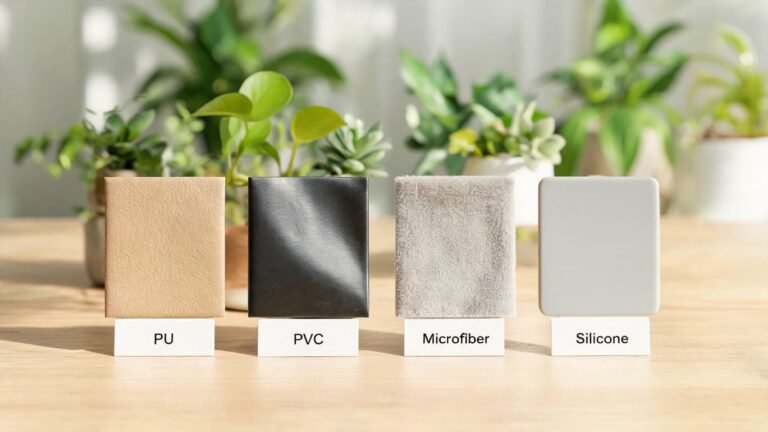
Lifecycle raw-materials board — the starting point for any verifiable sustainability claim.
The reason this matters is that the biggest environmental cost of a synthetic leather is not always at disposal — it is in the repeated manufacturing cycles caused by short lifespan. A material that lasts 10 years generates half the production-stage impact per service year of one that lasts five. We anchor our eco-friendly silicone leather reporting to that lifecycle math, not just to raw-material claims.
VOC-Free Production: Solvents Eliminated vs PU
This is the single largest differentiator. Conventional PU leather manufacturing relies on DMF (dimethylformamide) as a solvent in the coating process. DMF is a reproductive toxicant flagged under EPA and EU REACH SVHC lists, and it requires recovery systems that are never 100% efficient — a portion vents to air or enters wastewater. Silicone leather VOC free production eliminates DMF entirely because the silicone polymer is applied as a solvent-free coating.

Production-stage chemistry — where the DMF-free silicone process diverges from solvent-based PU coating.
In our facility, the silicone leather coating line runs without organic solvent recovery towers because there is nothing to recover. That removes an entire category of air pollution control equipment, wastewater treatment load, and worker exposure risk. The table below maps how the four main leather types compare across the metrics that define a real sustainability profile.
| Metric | Silicone | PU | PVC | Genuine |
|---|---|---|---|---|
| Production solvent | None | DMF | Plasticizers | Tanning chems |
| VOC emissions | Zero | Moderate | High | Low-moderate |
| Lifespan | 10-15+ years | 2-5 years | 3-5 years | 5-10 years |
| End-of-life recyclable | Yes | Difficult | Very difficult | Limited |
Lifespan Multiplier: Why Durability Is a Sustainability Metric
Here is the metric most sustainability reports underweight. A silicone leather sustainability report that ignores lifespan is only counting half the footprint. When a PU car seat cover is replaced three times over a 12-year vehicle life, the production-stage impact of that PU material is effectively tripled — three coating runs, three solvent recovery cycles, three shipping rounds. Silicone leather lifespan environmental impact flips that math: one production cycle serves the full decade.
Eco-certifications walkthrough — see the REACH, OEKO-TEX, and FDA compliance chain behind each sustainability claim.
In our own durability testing, silicone leather routinely reaches 200,000+ Martindale cycles and 2,000+ UV hours before measurable degradation — two to three times the endurance of PU. That is not a marketing claim; it is the data that lets a procurement team calculate environmental cost per service year instead of per square meter. For context on how this stacks against alternatives, our leather industry sustainability analysis breaks down the lifecycle math in more detail.
Verified finding: Silicone leather’s 10-15 year lifespan means 2-3x fewer production cycles than PU over an equivalent service period — cutting cumulative manufacturing impact proportionally.
End-of-Life: Recyclability and Waste Reduction
The final metric is what happens when the material is done serving. PVC leather is notoriously difficult to recycle because chlorine chemistry contaminates recovery streams. PU leather’s multi-layer construction (polymer skin bonded to fabric backing) defeats most mechanical recycling. Silicone leather recyclability end of life is cleaner because the polysiloxane polymer is thermally stable and does not release halogens or dioxins when processed.

Sustainable furniture application — longer lifespan and cleaner end-of-life processing reduce total waste volume.
In practice, silicone leather can be ground and reprocessed into lower-grade silicone applications, or thermally recovered without toxic byproducts. Combined with the longer service life, that means a single silicone upholstery program generates roughly one-third the landfill volume of an equivalent PU program over a decade. For buyers tracking carbon-neutral leather goals, waste reduction at this stage is where the numbers actually move.
Frequently Asked Questions
Is silicone leather biodegradable?
Silicone leather is not biodegradable in the way plant-based leathers are — and that is intentional. Biodegradability in a durable upholstery material means it breaks down during use, which shortens lifespan and increases replacement frequency. Silicone leather’s sustainability advantage comes from longevity (10-15 years) and clean recyclability at end of life, not from decomposing in a landfill.
Does silicone leather production use DMF like PU?
No. Silicone leather is coated using a solvent-free process — the polysiloxane polymer is applied directly without DMF or other organic solvents. This eliminates the reproductive-toxicant exposure, air-emission recovery systems, and wastewater contamination that DMF-based PU production carries. It is the single largest production-stage environmental advantage of silicone over PU.
What This Report Means for Procurement
A silicone leather sustainability report worth attaching to an RFP response does not trade in adjectives. It verifies zero-VOC production, names the solvent eliminated, quantifies the lifespan multiplier, documents the recyclability pathway, and cites the silicone vs PU contrast in measurable terms. If your current supplier cannot produce data for all five of these metrics, the sustainability claim is incomplete — regardless of how green the product photography looks.
Download Sustainability Datasheet
About TOPSUN
TOPSUN manufactures solvent-free silicone leather with independently verified sustainability data for B2B buyers tracking VOC, lifecycle, and end-of-life metrics across automotive, furniture, and medical programs.
Zero-VOC, DMF-free coating line · REACH SVHC and OEKO-TEX Standard 100 certified · 100% recyclable polysiloxane chemistry · FDA-compliant for food-contact applications.