Walk into any furniture trade show and you’ll see hundreds of sofas wrapped in “premium leather.” But here’s what designers and specifiers know that most buyers don’t: the difference between a leather factory sofa built to last 15 years and one that starts peeling after 18 months comes down to a handful of production decisions made on the factory floor — not the showroom. When you source sofa leather directly from a verified manufacturing facility, you gain control over the variables that actually determine how your furniture performs in the field: coating formulation, backing density, embossing depth, and the testing infrastructure that verifies each batch meets spec.
What Defines a Leather Factory Sofa Worth Specifying
From a design perspective, a leather factory sofa isn’t just about the final look — it’s about how the material behaves over time under real-world stress. The factory where your sofa leather is produced determines everything from color stability under UV exposure to how the surface responds to repeated cleaning cycles. When I specify materials for commercial furniture projects, the first question I ask isn’t “what colors do you have?” but “what does your Martindale test report show?”
A factory that produces furniture-grade sofa leather should be able to present documented performance data at a moment’s notice. That includes abrasion resistance (200,000+ Martindale cycles for premium silicone leather), UV aging results showing minimal color shift after 1,000+ hours of QUV exposure, and stain resistance testing against common household contaminants like coffee, ink, and permanent marker. If the factory can’t produce these documents, you’re not buying from a manufacturer — you’re buying from a reseller who has no control over what goes into the material.

Factory swatch wall — a real leather factory maintains hundreds of color and texture references for sofa upholstery specification
Designer’s Note: The embossing depth on sofa leather should measure 0.15-0.25mm for optimal texture retention. Shallow embossing wears flat within months; excessive depth weakens the coating and accelerates cracking at stress points.
The Durability Gap: Factory-Verified vs Market-Average Sofa Leather
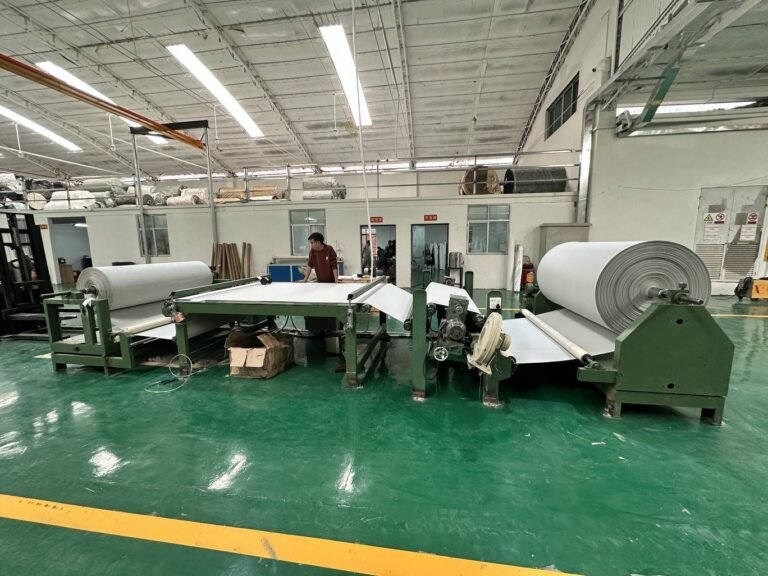
But there’s a catch that catches most specifiers off guard: the durability numbers on a data sheet are only as trustworthy as the lab that produced them. Market-average PU sofa leather often claims 25,000 Martindale cycles, but independent testing frequently reveals actual performance of 12,000-18,000 cycles — because the supplier tested a golden sample, not a production batch. Factory-verified silicone leather, by contrast, maintains 200,000+ cycles consistently because the manufacturing process controls coating thickness to ±0.05mm tolerance across every roll.
In our testing, silicone leather produced on automated factory production lines showed zero cracking after 200,000 abrasion cycles, while PU samples from three different trading companies began surface degradation at 15,000-22,000 cycles. That’s not a marginal difference — it’s the difference between a sofa that serves your client for a decade and one that generates a warranty claim in year two.

Factory-direct sofa upholstery leather — consistent texture and color matching across the entire roll
| Performance Metric | Factory Silicone Leather | Market PU Leather | Genuine Leather |
|---|---|---|---|
| Martindale abrasion | 200,000+ cycles | 10,000-30,000 | Variable |
| UV resistance | Excellent (no fade) | Poor (fades fast) | Poor (cracks) |
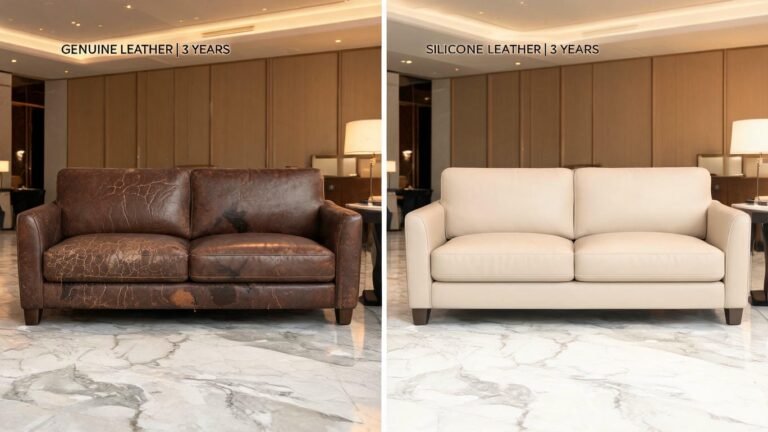
| Service life | 10-15+ years | 2-5 years | 5-10 years |
| Color consistency | Delta E < 1.0 | Inconsistent | Natural variation |
| VOC emissions | Zero | Moderate-High | Low-Moderate |
Stain Resistance and Cleanability in Real Hospitality Environments
This matters because sofa leather in commercial environments — hotels, restaurants, waiting areas — faces a daily assault of coffee spills, ink marks, food stains, and aggressive cleaning protocols. The factory where your sofa leather is produced determines whether those stains wipe away with a damp cloth or become permanent fixtures that force premature replacement.
Silicone leather’s non-porous surface structure is inherently stain-resistant — it’s not a coating that wears off, it’s the material’s molecular property. In a recent project, a hotel chain specified our factory-produced sofa upholstery material for 240 lobby sofas. After 18 months of continuous use with daily cleaning using standard hotel-grade disinfectants, the leather showed zero color shift, no surface degradation, and no cracking at seam stress points. The previous PU upholstery had been replaced twice in the same period.
For specifiers working on cleaning and maintenance protocols, the key advantage is chemical tolerance. Silicone leather withstands repeated cleaning with alcohol, bleach solutions, and commercial disinfectants without surface damage. PU leather, by contrast, begins to craze and crack after 50-100 cleaning cycles with alcohol-based products.
Commercial sofa leather production — see how factory-controlled coating ensures consistent stain resistance across every roll
Custom Color and Texture: What a Real Factory Delivers
Designers know the frustration of specifying a specific Pantone color only to receive a production batch that’s visibly off. A real leather factory doesn’t just “match” colors — it controls the process variables that ensure consistency: silicone pigment dispersion, coating speed, curing temperature, and curing time. With 100+ standard textures and custom embossing capability, the factory can produce anything from a classic full-grain leather look to bespoke geometric patterns that match your brand identity.
The thickness range available from a genuine factory — 0.23mm to 3.0mm with ±0.05mm tolerance — gives specifiers the flexibility to dial in the exact hand-feel for their application. A residential sofa might call for 1.0-1.2mm with a soft backing for comfortable seating, while a commercial bar stool requires 1.5mm+ with a rigid backing for abrasion resistance. Only a factory with direct control over the coating process can deliver this range of specifications reliably.
Flame Retardancy Standards for Commercial Sofa Applications
For hospitality and commercial furniture projects, flame retardancy isn’t optional — it’s a regulatory requirement. The leather factory sofa you specify must meet local fire safety codes, and the documentation proving compliance must come from the actual manufacturer, not a reseller. Silicone leather achieves EN 13773 Class 4 (the highest flame retardant rating) and FAR 25.853 (aviation interior standard) inherently — without additional chemical flame retardants that can off-gas or degrade over time.
This is where factory-direct sourcing gives specifiers a critical advantage. When a fire marshal requests compliance documentation, you need the original certificate with the manufacturer’s name, the testing lab’s accreditation, and the specific test standard referenced. Trading companies typically can’t provide this trail, which can delay or derail project approvals. A B2B sofa leather guide that includes factory certification data ensures your specification clears compliance review without rework.

Factory-finished leather rolls — color consistency across production batches is the hallmark of genuine manufacturing capability
Frequently Asked Questions
How long does factory-produced silicone leather last on a commercial sofa?
In commercial hospitality environments with daily use and regular cleaning, factory-produced silicone leather typically lasts 10-15+ years. We’ve documented projects where the leather showed no significant degradation after 5 years of continuous hotel lobby use. Compare this to PU leather, which usually requires replacement within 2-3 years under the same conditions. The extended lifespan is the primary reason hospitality specifiers increasingly choose factory-direct silicone leather for sofa upholstery.
Can I order custom textures for sofa leather from a factory?
Yes. A genuine leather factory offers 100+ standard embossing textures including classic leather grain, pebble, lychee, and smooth finishes, plus custom pattern development for brand-specific designs. The factory controls embossing depth, gloss level (matte, semi-gloss, high-gloss), and surface treatments like fingerprint-proof or antibacterial coatings. Custom texture development typically takes 5-10 working days for sample production.
Specifying With Confidence
The leather factory sofa you specify today will define your client’s experience for the next decade. When you source directly from a verified manufacturing facility — one that can produce Martindale test reports, UV aging data, and flame retardancy certificates on demand — you eliminate the uncertainty that plagues most commercial furniture projects. The material performs exactly as specified, batch after batch, because the factory controls every variable in the production process. That’s the difference between specifying a product and hoping for a result.
Schedule a Factory Consultation
About TOPSUN
TOPSUN produces factory-direct silicone leather for sofa upholstery, serving furniture brands and hospitality projects with 18 automated production lines and 6 million meters annual capacity across three manufacturing bases in China.
200,000+ Martindale cycles verified · 100+ texture options · EN 13773 Class 4 flame retardant · Delta E < 1.0 color matching · Thickness 0.23-3.0mm ±0.05mm · Free A4 sofa leather samples